
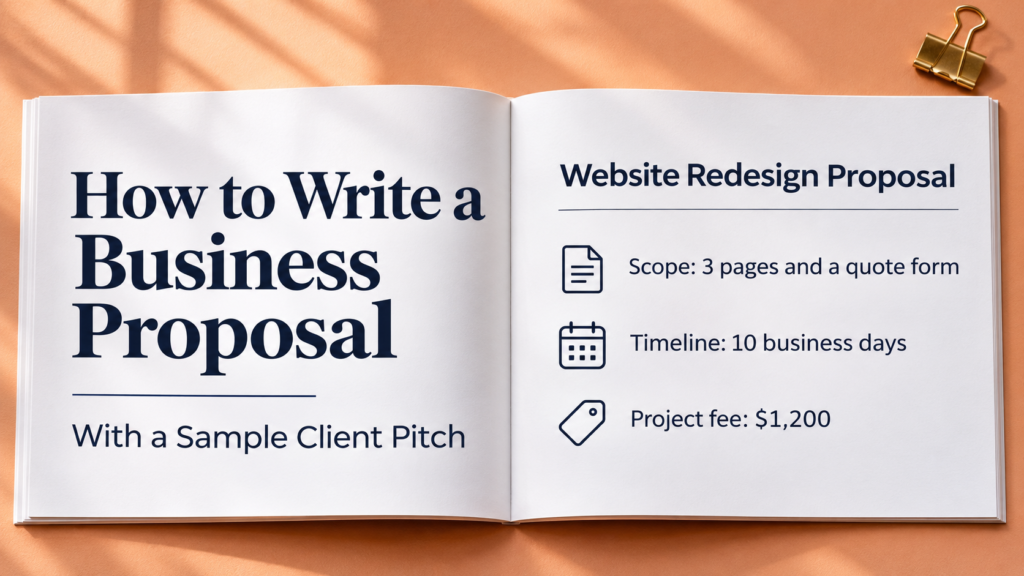

If you’re learning how to write a business proposal, start with the decision your client needs to make. Can they see what you’ll deliver, what it costs, and what you need from them to begin? If they have to email you to find out whether revisions are included or when the work will start, add those details before you send it.
This guide walks through each section of a client proposal, then shows how they fit together in a website redesign example. You’ll also find a reusable outline and a short sample client pitch you can adapt for your own email.
What is a business proposal?
A business proposal is a document that offers to solve a specific client problem or deliver a defined piece of work. It explains your approach, the deliverables, the schedule, the price, and the next step.
When a client asks for a formal proposal, follow their requested format and answer each requirement. If you’re approaching a potential client for the first time, a short pitch can help you confirm their interest and learn what they need before you estimate the work.
How to write a business proposal in six steps
1. Open with the client’s goal
Summarize what the client wants to change and cite a concrete detail from your discovery call or their brief. For example, “Your office retypes appointment requests from email into a spreadsheet” gives the reader a clear reason for the project. “We deliver exceptional digital solutions” leaves the reader to make that connection.
If you’re unsure about the goal, ask the client which result matters most. A client who wants more inquiries may need a different project from one who wants to spend less time sorting the inquiries they already receive.
2. Explain your approach and name the deliverables
State what you’ll do and what the client will receive. For a website project, specify which pages you’ll build, what the form will collect, where messages will go, and what you’ll test before launch.
Include a relevant work sample if you have one and can share it. Briefly explain what the sample demonstrates, such as how you organized the services on a similar site. If you lack a comparable example, show your proposed approach with a short outline or sketch.
3. Define what the price covers
Write down the limits that affect time or cost. Common examples include the number of revision rounds, who supplies photos or copy, and whether the work includes software subscriptions, ongoing support, or additional locations.
If someone requests more work, explain how you’ll handle it. A simple sentence is enough: “If you request an additional page, I’ll send its price and schedule for approval before starting that work.”
4. Set a timeline the client can act on
Tie the start date to the things you need, such as approval, an initial payment, or access to their website. Then list the major milestones and say when the client will need to respond.
Use calendar dates if they’re agreed. If the start date is uncertain, use business days from kickoff. Explain how late feedback or missing materials affect the delivery date.
5. Show the price and payment schedule
State the currency, total, payment amounts, and when each payment is due. If your price is an estimate, identify what could change it. If a third-party subscription is billed independently, call it out in the pricing section so the client can see the ongoing cost of the project.
A fixed fee fits work you can define clearly. If you’re still investigating an unknown problem, you can quote a discovery phase with its own deliverable, such as an audit and a separate implementation estimate.
6. Ask for one clear next step
Tell the client what to do if they want to go ahead. For example, “Reply to confirm the scope and fee, and I’ll send the agreement and kickoff checklist.” If the price or schedule has an expiration date, give the actual date so the client knows when to respond.
Copyable business proposal outline
| Section | What to write |
|---|---|
| Project summary | [Client goal, current problem, and the proposed outcome in two or three sentences] |
| Scope and deliverables | [Work you’ll do, what the client receives, and how you’ll test or hand it over] |
| Client responsibilities | [Materials, access, approvals, and who will give feedback] |
| Exclusions and changes | [Work outside the scope and how you’ll quote changes] |
| Timeline | [Kickoff requirements, project milestones, and review deadlines] |
| Pricing and payment | [Currency, fee, payment dates or milestones, and any separate costs] |
| Next step | [How to proceed and how long the proposal is valid, if relevant] |
Sample business proposal for a client
The businesses and figures below are fictional. The fee and timeline illustrate how to present a defined project, and you can replace them with terms that reflect your own work.
Website redesign proposal for Northline Home Services
Prepared by Cedar Lane Web Studio
Project Three-page website redesign and quote request form
Project goal
Northline’s owner says quote requests often arrive without a ZIP code or service type. The office then has to call back for those details before it can route the inquiry. The redesign will make the request form easy to find on mobile and collect those details before submission.
Scope and deliverables
- Build three pages on the existing WordPress site: Home, Services, and Request a Quote.
- Set up a mobile-friendly quote form that collects the customer’s name, email, ZIP code, service type, and a short job description. Route submissions to the designated office inbox.
- Submit a test request from a phone and desktop, confirm the required fields work, and verify receipt in the office inbox before launch.
- Include one consolidated revision round and a 30-minute handover call.
Client responsibilities and exclusions
Northline will provide WordPress access, its logo, approved service descriptions, and the office email address before kickoff. One client contact will gather feedback and send it within two business days of receiving the draft. The fee covers the work listed above. Hosting, paid plugins, photography, additional pages, and ongoing maintenance are separate. Cedar Lane will quote extra work for approval before proceeding.
Illustrative timeline
| Milestone | Target |
|---|---|
| Kickoff | After written approval, initial payment, and receipt of access and materials |
| Draft pages and working form | By business day 5 after kickoff |
| Client provides consolidated feedback | Within 2 business days of draft delivery |
| Final checks and handover | By business day 10 after kickoff if feedback arrives on time |
If materials, feedback, or final approval arrive late, Cedar Lane will confirm revised dates before scheduling launch.
Investment and payment
| Payment milestone | Amount |
|---|---|
| Initial payment before kickoff | USD 480 |
| Remaining payment after final approval and before launch | USD 720 |
| Total project fee | USD 1,200 |
Next step
Reply with approval of the scope and fee. Cedar Lane will send the project agreement, initial invoice, and a short checklist of materials to provide before kickoff.
Sample client pitch email to send with the proposal
Subject
Proposal for Northline’s website and quote form
Hi Jordan,
Thanks for walking me through what happens when a quote request comes in. You mentioned that your office often has to follow up just to get the ZIP code and service type. I’ve proposed a shorter path from your service pages to a mobile-friendly form that asks for both upfront.
The attached proposal covers the three pages, form setup and testing, and one round of revisions for USD 1,200. If the scope and fee work for you, reply to confirm and I’ll send the agreement and kickoff checklist.
Best,
Casey
Cedar Lane Web Studio
Review your proposal before you send it
Read the proposal as if it had been forwarded to someone who missed the discovery call. Can they explain the project, cost, and next step to a colleague after one read? Check that the payment amounts add up, the timeline accounts for review time, and the client’s name is correct. If you attach a PDF, open it and check that the pricing table and links are readable.
Frequently asked questions
1. How long should a business proposal be?
A few pages can be enough for a small project with one fee and a short timeline. Add detail when there are multiple phases, options, or reviewers. Use the client’s required format if they gave you one.
2. What is the difference between a business proposal and a quote?
A quote usually focuses on the price and the work it covers. A proposal also explains the client’s goal, your approach, and how you’ll deliver the work. For a straightforward repeat job, a quote may give the client everything they need to decide.
3. Should I offer more than one pricing option?
Offer options when the client has a real choice, such as launching with three pages now or adding a booking feature in a second phase. List the deliverables and total for each option so the client can compare them at a glance.
4. How should I follow up after sending a proposal?
Use the decision date you discussed. If you didn’t agree on one, send a short follow-up after a few business days. Ask whether the client has questions about scope, timing, or price and whether their decision date has changed.
5. What should I do if the client asks for a lower price?
Find out which deliverables matter most. If the client needs a lower fee, offer a smaller scope or split the work into phases. Send a revised proposal showing the new price, what it covers, and any change to the schedule.
Conclusion
Draft your next proposal from the client’s notes. Start with the problem they described, list the deliverables they can verify, and make the price and approval step easy to find. Once those details are clear, use the email to remind the client why the work matters and what to do next.