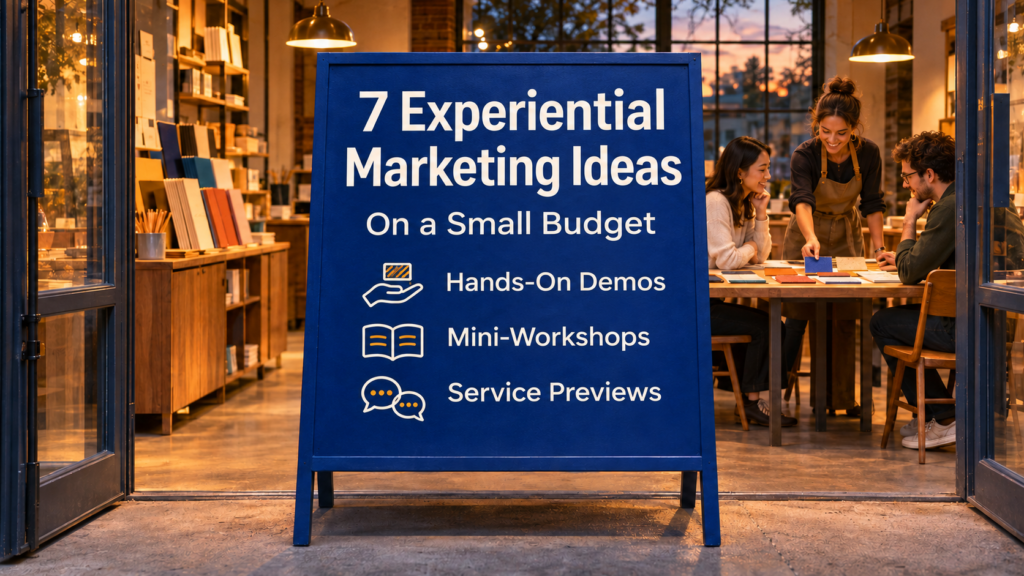

A customer can read that a product is easy to use or try it for themselves. They can scroll past your advice or spend ten minutes using it to solve a problem. Experiential marketing gives people that kind of direct interaction with your offer.
These 7 experiential marketing ideas you can run on a small budget start with spaces, equipment, and skills your business may already have. Choose one that helps customers make a buying decision, limit the first run, and measure the next action they take.
All budgets below are fictional U.S. dollar planning examples. They assume you already have a suitable space and the main equipment. Add your actual staff time, materials, insurance or permit costs where applicable, and any revenue you give up by using the space.
What is experiential marketing?
Experiential marketing invites people to participate in an activity connected to a brand. That could be trying a desk setup, making a simple item, or using a consultant’s checklist with their own project. The experience should help someone understand what your business offers.
Before choosing an idea, finish this sentence: “After taking part, a potential customer will understand ______.” Use the answer to decide what to demonstrate and what action to offer afterward.
1. Run a short “try it yourself” station
A stationery shop sets up one desk where visitors can arrange a notebook, phone, and cables in two different organizers. Staff provide the same objects for each test so customers can compare what fits.
How to run it
Use one small area and three or four familiar items. Add a card explaining the task and put accurate product dimensions nearby. Invite visitors to try the setup, then offer to help them compare options.
Illustrative cash budget
$20 for a reusable desk mat and $15 for printed instructions and product cards, totaling $35. The shop uses display stock it already owns.
What to measure
Count participants and record product inquiries or purchases linked to the station. Staff can ask whether trying the organizer helped the customer choose.
Best fit
Products whose size, feel, or usability is easier to understand by handling them.
2. Host a focused mini-workshop
A plant shop hosts a 20-minute repotting demonstration. Participants practice with supplied pots and materials rather than bringing unknown plants that could change the scope of the session.
How to run it
Teach one skill, set the group size, and list what participants will receive. Leave time for people to try the task. Explain how to get supplies or further help afterward.
Illustrative cash budget
$36 for practice materials, $12 for instruction cards, and $12 for cleanup supplies, totaling $60 for six participants.
What to measure
Record registrations, attendance, and relevant product purchases or bookings. Ask which part participants could now do confidently and what still needs explaining.
Best fit
Businesses that sell supplies, teach a skill, or help customers maintain something they own.
3. Offer a short service preview
A home organization consultant runs four 15-minute desk-planning sessions using a sample desk layout and a worksheet. Visitors choose a layout for a realistic working day and discuss what they would change.
How to run it
Define a task that fits the time available. Explain what the preview covers and show the full service separately. Use appointment slots so the activity doesn’t disrupt normal work.
Illustrative cash budget
$15 for worksheets and $10 for reusable planning materials, totaling $25. Budget the consultant’s delivery time separately.
What to measure
Count completed sessions and subsequent consultation requests. Record the questions that help you explain the paid service more clearly.
Best fit
Service businesses where customers want to understand the process before booking.
4. Create a collaborative display
A design studio invites visitors to arrange reusable color and material samples on a small project board. Each visitor creates a combination for a fictional room, then staff explain how the choices would affect the space.
How to run it
Give people one prompt and a limited selection of samples. Allow a few minutes to assemble a board. Offer a takeaway photo of their arrangement if they want it, and explain how a consultation develops those choices.
Illustrative cash budget
$30 for a reusable board, $15 for mounting materials, and $10 for prompt cards, totaling $55, using samples already on hand.
What to measure
Track participation and requests to discuss an actual project. Note which materials or combinations lead to useful questions.
Best fit
Brands that help customers choose combinations, designs, or configurations.
5. Partner on a demonstration session
A bike shop and a local commuter accessories store host a small display showing how to pack and attach a work bag to a stationary bicycle. Visitors try the bag setup with their usual work items.
How to run it
Agree on the activity, location, staffing, shared costs, and what each business will offer afterward. Use a stable display setup and define who handles customer questions. Each partner promotes the session to its own audience.
Illustrative cash budget
$25 for display materials, $15 for signs, and $20 for extra supplies, totaling $60 across both businesses.
What to measure
Count participants, relevant inquiries for each partner, and purchases that staff can reasonably link to the activity.
Best fit
Two businesses serving similar customers whose products work together.
6. Hold a small behind-the-scenes session
A print shop invites four business owners to see how the same logo looks on different paper stocks. Guests compare samples and discuss what affects the final result.
How to run it
Limit the activity to an approved area that is easy to supervise. Use sample jobs with permission to display them. Give visitors a simple comparison task and show the choices they can make when ordering.
Illustrative cash budget
$30 for sample prints, $15 for take-home reference cards, and $15 for setup materials, totaling $60.
What to measure
Track attendance, quote requests, and whether attendees can describe the choices more accurately after the session.
Best fit
Businesses whose craft, materials, or production process helps explain their value.
7. Build a short online experience
A website designer hosts a live session in which attendees use a mobile-page checklist to review their own homepage. The designer demonstrates the process on a sample site and answers general questions.
How to run it
Use a video tool you already have, publish a clear topic, and send the worksheet in advance. Ask participants to complete one task during the session. Offer a paid review afterward for people who want individual help.
Illustrative cash budget
$15 for worksheet preparation assets and $20 for a small optional promotion test, totaling $35, using existing meeting software.
What to measure
Track attendance, worksheet participation, and follow-up inquiries. Use a distinct booking link if you want to identify requests associated with the session.
Best fit
Consultants, digital service businesses, and brands whose customers are spread across several locations.
Choose one idea and set a full budget
Match the experience to a question customers already ask. Start with existing equipment and a manageable audience, then assign a person to run it and another to handle normal customer work if necessary.
A shop planning the $35 try-it station might estimate the full cost like this:
| Cost | Illustrative amount |
|---|---|
| Desk mat and printed materials | $35 |
| Two staff hours allocated at $20 per hour | $40 |
| Allowance for damaged display materials | $10 |
| Total test cost | $85 |
If five extra organizer sales each contribute $18 after direct product and transaction costs, their combined contribution is 5 × $18 = $90. That covers the $85 test cost with $5 left before any other costs omitted from the example.
Check whether those were additional sales or purchases customers might have made anyway. Use the numbers to decide whether to repeat the activity, change it, or collect more evidence.
Keep the follow-up relevant
Offer one action that follows naturally from the experience. A product trial can end with a comparison page. A mini-workshop can point to a supply list. A service preview can lead to a consultation request.
Tell participants what follow-up they are requesting. If you collect contact information for a booking or to send a worksheet, make any separate marketing sign-up clear. Ask permission before publishing photos or testimonials from the activity.
Frequently asked questions
1. Can a very small business use experiential marketing?
Yes. A single demo station or a few appointment slots can be enough for a first test. Limit the activity to something staff can deliver well alongside normal work.
2. How much should I spend on the first experience?
Work backward from the question you want to test. Price the materials, staff time, space, and follow-up. The sample budgets assume you already own the main equipment, so replace those figures with your own quotes and costs.
3. Do I need to give participants free products?
You can build the experience around trying a display item, using a worksheet, or learning a skill. Choose a takeaway only if it supports the activity and fits the budget.
4. How do I measure results beyond attendance?
Track an action related to your goal, such as a quote request, product inquiry, booking, or purchase. Also record practical feedback about the offer. Attendance tells you who showed up, while the follow-through helps you judge what the experience changed.
5. Can I repeat the same experience?
Yes. Review what confused participants or took too long, make a specific change, and run it again. Keep your measurement definitions consistent so the next result is easier to compare.
Conclusion
Choose an activity that lets customers answer a real buying question. Keep the first run small, budget for staff time as well as materials, and offer a relevant next step. Use what people do afterward to decide whether the experience deserves another run.