
When a small business needs more customers, the first response is often to try another marketing channel. But more advertising may not solve a confusing offer, slow inquiry handling, or limited capacity.
A SWOT analysis helps organize what your business does well, what needs attention, and what is happening in the market. The useful outcome is a set of decisions about where to focus.
This guide explains SWOT analysis for marketing with a completed small business example, a reusable template, and a practical action plan. You will learn how to separate internal issues from external conditions and turn the findings into manageable tests.
What Is SWOT Analysis in Marketing?
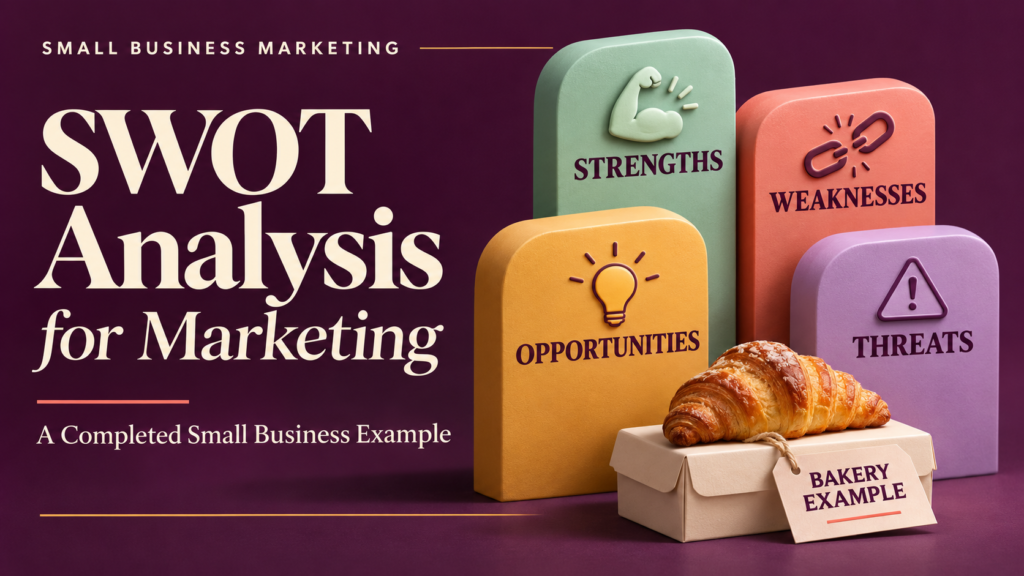
SWOT stands for:
- Strengths: internal capabilities or assets that support your objective.
- Weaknesses: internal gaps or constraints that make it harder to achieve.
- Opportunities: external conditions your business could benefit from.
- Threats: external conditions that could harm your plans.
Business Queensland’s SWOT guidance uses this internal/external distinction and explains that SWOT can focus on a specific issue rather than the whole organization.
For marketing, the issue might be attracting qualified inquiries, improving repeat purchases, or launching a service in a defined area.
| Category | Question to ask | Marketing example |
|---|---|---|
| Strength | What capability or asset supports this objective? | A portfolio demonstrating the exact service prospects want |
| Weakness | What internal gap is limiting progress? | An inquiry form that does not work reliably on mobile |
| Opportunity | What external need or opening could we serve? | Customers seeking a service competitors do not currently offer |
| Threat | What external condition could undermine the plan? | A competitor introducing a directly comparable lower-priced package |
A factor should matter to the objective you have chosen. An office feature with no influence on customer acquisition does not need space in a campaign SWOT.
Why Marketing Teams Use SWOT
A focused SWOT can help you decide whether to improve an existing process, test a new offer, adjust messaging, or reduce exposure to a risk.
For example, advertising may generate inquiries successfully while the business struggles to respond. In that situation, fixing follow-up could be a sensible early priority.
SWOT also gives owners and staff a shared way to discuss assumptions. A salesperson may hear pricing objections that are invisible in website analytics, while an operations manager may identify delivery constraints.
The analysis is a planning aid. It does not prove customer demand, predict sales, or establish which campaign will perform best.
How to Create a Marketing SWOT Analysis
1. Define One Decision and a Time Period
Write the decision at the top of the worksheet.
A useful scope might be:
Decide how to attract more suitable weekday catering inquiries over the next 90 days without disrupting existing orders.
This is more useful than “improve marketing” because it identifies the audience, business activity, and operating constraint.
Define what makes an inquiry suitable. For catering, that might involve delivery area, order size, timing, and dietary requirements.
2. Gather Evidence Before Filling the Boxes
Review information you already have:
- Inquiry and sales records.
- Website and campaign reports.
- Customer questions and complaints.
- Reasons quotes are accepted or declined.
- Repeat-purchase patterns.
- Available staff time and delivery capacity.
- Competitor websites, offers, and public communications.
Ask customers about specific buying experiences: what triggered the need, what alternatives they considered, and what made the decision difficult.
Distinguish an observation from an interpretation. “Customers asked whether delivery is available” is an observation when supported by records. “Delivery would increase sales” is a hypothesis requiring further investigation.
Avoid placing personal information or confidential customer details in a widely shared planning document.
3. Identify Internal Strengths and Weaknesses
Examine your offer, people, processes, assets, and resources.
Potential strengths include relevant expertise, reliable fulfillment, useful customer relationships, or original content that answers buying questions.
Potential weaknesses include incomplete pricing information, poor source tracking, limited capacity, or inconsistent follow-up.
Be specific:
Vague: “Our marketing is weak.”
Useful: “The catering page does not explain minimum order quantities, so staff repeatedly answer the same eligibility questions.”
A limited advertising budget is usually an internal constraint. A competitor with a larger advertising budget is an external condition. Keep those observations separate.
4. Identify External Opportunities and Threats
Look outside the business for changes in customer needs, competitive behavior, distribution, technology, and market conditions.
An opportunity should describe the condition you could respond to. “Post more videos” is an action. “Prospects increasingly ask to see how the product works before buying” could be an opportunity if your evidence supports it.
Similarly, “our website is slow” is an internal weakness. A platform changing how businesses reach customers is an external threat if it materially affects your strategy.
An external factor can have mixed effects. A new marketplace could provide customer access while also increasing competition. Explain the separate implications.
5. Keep the Matrix Short and Specific
Aim for a few important findings in each category rather than a long brainstorming list.
For each finding, record:
- Evidence source and date.
- Relevance to the objective.
- Confidence level.
- Any question that still needs testing.
The Australian government’s SWOT guidance provides another reference for organizing the four categories and using the analysis in planning.
Completed Marketing SWOT: A Small Bakery Example
Fictional business: Maple Lane Bakery
Focus: Weekday office breakfast orders
Planning period: Next 90 days
Decision: Whether to test a simple preorder offer for nearby offices
All details below are illustrative assumptions for teaching the method. They are not findings from an actual business, verified market research, or claimed results.
Completed SWOT Matrix
| Strengths — internal | Weaknesses — internal |
|---|---|
| The bakery has standardized breakfast-box recipes and portion sizes. | Office preorders currently require a phone conversation. |
| Staff have a documented preparation process for scheduled pickups. | The website does not show minimum quantities or preorder deadlines. |
| The current production schedule allows a limited weekday preorder pilot. | Inquiry sources and quote outcomes are not recorded consistently. |
| Opportunities — external | Threats — external |
|---|---|
| In this scenario, nearby office managers have asked about group breakfast options. | A nearby café is promoting a discounted office breakfast package. |
| A local business association offers a relevant member-newsletter advertising slot. | Office attendance can vary, making group order quantities uncertain. |
| Prospective buyers want clearer group-order information before contacting suppliers. | Supplier price changes could make a fixed advertised package price difficult to maintain. |
Why the Findings Belong in These Categories
Standardized recipes and a preparation process are internal strengths because they describe business capabilities.
Missing order information is an internal weakness because the bakery can improve its website and process.
Office inquiries are external evidence of possible customer interest. They create an opportunity to investigate; they do not establish that enough buyers will place profitable orders.
The competitor’s promotion is external. The bakery can choose its response, but it does not control the competing offer.
Turn the SWOT Into Marketing Actions
A completed matrix should lead to choices. One useful approach is to pair findings across categories.
| Pairing | Question | Bakery action |
|---|---|---|
| Strength + opportunity | Which capability helps us test a market opening? | Use standardized boxes to pilot a clearly described office preorder offer. |
| Weakness + opportunity | What must improve before we pursue the opening? | Publish quantities, deadlines, collection details, and an inquiry form. |
| Strength + threat | How can an existing capability reduce exposure? | Explain order predictability and scope when comparing alternatives. |
| Weakness + threat | Which gap could make an external problem worse? | Track inquiries and order costs before expanding promotion. |
These pairings are often described as a TOWS approach. The practical value is the connection between a finding and a decision.
The competitor’s discount does not automatically justify a price cut. The bakery should first check customer priorities, costs, and its ability to deliver the offer profitably.
A Practical 30-Day Action Plan
The following plan continues the fictional example. It describes proposed work, not guaranteed outcomes.
| Timing | Action | Owner | Review measure |
|---|---|---|---|
| Week 1 | Confirm production capacity and calculate the proposed box’s delivery costs and margin. | Owner and kitchen lead | Documented pilot limits and viable pricing |
| Week 2 | Publish one office-order page with inclusions, quantities, deadlines, and inquiry steps. | Owner or website contractor | Mobile page and inquiry process tested |
| Week 3 | Run one limited, permission-based promotion through the relevant business association. | Marketing lead | Tagged visits and qualified inquiries |
| Week 4 | Review inquiries, confirmed orders, costs, and fulfillment issues. | Owner | Evidence-based continue, change, or stop decision |
Agree on spending and staff-hour limits before launch. Website work, photography, placement fees, and order handling all use resources, even when some work is performed internally.
Avoid promoting more orders than the bakery can reliably fulfill. Marketing and operating capacity need to stay aligned.
How to Prioritize SWOT Findings
Not every finding deserves immediate investment.
For each issue, ask:
- Impact: Could it materially affect this objective?
- Evidence: How well supported is it?
- Effort: What money, time, and skills would a response require?
- Dependencies: Must something else happen first?
- Urgency: Is there a real deadline or near-term risk?
Use simple labels such as high, medium, and low. Numerical scores can help discussion, but they do not turn subjective judgments into precise forecasts.
For the bakery, publishing essential order information may come before paid promotion because it helps prospects assess the offer and gives staff a consistent reference.
Reusable Marketing SWOT Template
Marketing objective:
Target customer:
Product or service:
Time period:
Decision owner:
| Category | Finding | Evidence and date | Confidence | Possible response |
|---|---|---|---|---|
| Strength | What do we do well that supports this objective? | Record source | High/medium/low | How could we apply it? |
| Weakness | What internal gap limits progress? | Record source | High/medium/low | What should improve? |
| Opportunity | What external opening deserves investigation? | Record source | High/medium/low | What could we test? |
| Threat | What external condition could harm the plan? | Record source | High/medium/low | How could we prepare? |
After completing the worksheet, select a small number of actions. Give each one an owner, deadline, resource limit, and review measure.
Common Mistakes and Limitations
Using generic labels. “Great service” needs evidence and an explanation of why it matters to customers.
Listing actions as opportunities. A channel you could use is not automatically an attractive market opening.
Treating assumptions as research. Mark uncertainty and decide what evidence would change your view.
Ignoring profitability and capacity. More inquiries can create problems if the offer is unprofitable or difficult to fulfill.
Stopping at the matrix. Findings need actions, responsibility, and a review date.
SWOT also simplifies a complex situation. It cannot replace a detailed financial forecast, customer research, or a campaign experiment. Revisit it when evidence changes rather than preserving an outdated worksheet.
Frequently Asked Questions
1. What is the difference between a marketing SWOT and a general business SWOT?
A marketing SWOT focuses on a defined marketing objective, customer group, offer, or channel. A general business SWOT considers the organization more broadly. Both use the same four categories.
2. Is a small marketing budget a weakness or a threat?
It is usually an internal weakness or constraint. External conditions, such as higher advertising prices or a heavily funded competitor, may be threats. Explain how each affects your objective.
3. How many points should each SWOT section contain?
Include enough to capture the important issues without burying priorities. Three to five specific findings per section is a practical starting point, not a formal requirement.
4. Can a new business complete a marketing SWOT without customers?
Yes, but more findings will be assumptions. Use competitor research, prospect conversations, and small tests, and label what remains unverified.
5. How often should a marketing SWOT be updated?
Review it before a major campaign or offer change and at a suitable planning interval. Update sooner when meaningful customer, competitor, or performance evidence changes the situation.
Conclusion
Start with one marketing decision and gather evidence relevant to it. Separate internal capabilities from external conditions, then choose a few responses your business can realistically test.
A useful SWOT ends with clear responsibility and a review date. Use the matrix to guide action, and revise it as actual customer and campaign evidence becomes available.