
Digital advertising has made it easier for businesses to reach customers online, but traditional marketing methods can still play an important role in attracting local customers.
For businesses such as restaurants, salons, cleaning companies, real estate agencies, repair services, and retail stores, reaching people who live or work nearby can be especially valuable.
This is where direct mail marketing can help.
By sending promotional postcards directly to selected households, a local business can introduce its services, promote a special offer, announce an opening, or encourage customers to visit its location.
Unlike digital advertisements that compete with social media posts, emails, and online notifications, a physical postcard gives recipients something they can see, hold, and potentially keep.
However, a successful campaign requires more than printing postcards and sending them to random addresses. You need to choose the right audience, create a clear offer, set a realistic budget, and measure the results.
In this guide, you’ll learn how direct mail marketing works, how local businesses can use postcards, and how to plan an example campaign with a $750 budget.
What Is Direct Mail Marketing?
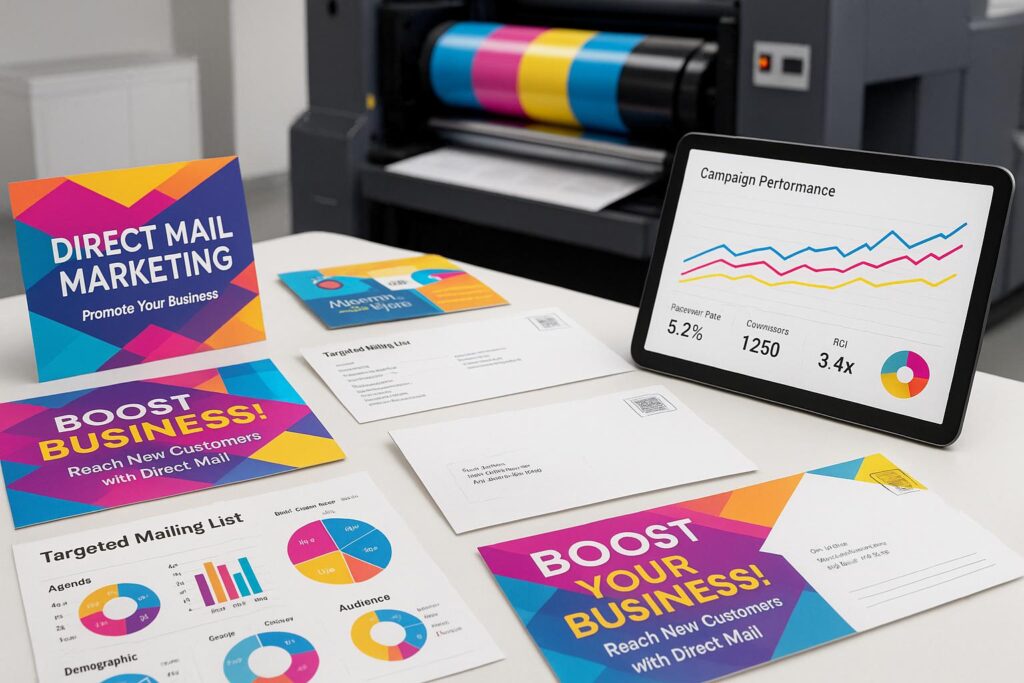
Direct mail marketing is a form of advertising in which businesses send printed promotional materials to people or organizations through the postal system.
Common direct mail formats include:
- Postcards
- Promotional letters
- Flyers
- Brochures
- Catalogs
- Discount coupons
- Business announcements
- Product and service offers
For local businesses, postcards are often a practical starting point because they are relatively simple to design, easy to distribute, and provide space for a headline, offer, business information, and call to action.
For example, a neighborhood cleaning company could send postcards to nearby homeowners offering a discount on their first professional cleaning service.
A restaurant might promote a new lunch menu, while a dental clinic could introduce its services to households in the surrounding area.
The main objective is to put a relevant business offer in front of potential customers who are likely to need it.
Why Direct Mail Marketing Can Work for Local Businesses
Local businesses do not always need to reach thousands of people across an entire country. Often, their best potential customers are located within a few miles of their business.
Direct mail allows businesses to focus their marketing efforts on specific geographic areas.
Here are some reasons to consider using it.
1. Reach Customers in Specific Neighborhoods
A business can select neighborhoods based on location, service coverage, and customer characteristics.
For example:
- A landscaping company can target homes with yards.
- A restaurant can reach households within its delivery area.
- A home cleaning company can target residential neighborhoods.
- A real estate agent can distribute postcards in selected property markets.
- A local gym can reach households within a convenient driving distance.
With USPS Every Door Direct Mail (EDDM), eligible businesses can select postal delivery routes instead of preparing an individual customer mailing list.
2. Give Customers a Physical Reminder
A postcard can remain on a kitchen counter, refrigerator, office desk, or noticeboard.
This gives customers an opportunity to review the offer again instead of relying on an online advertisement they may never see twice.
A well-designed postcard should communicate the business’s value quickly, even if someone looks at it for only a few seconds.
3. Promote Special Offers and Local Events
Postcards are useful for time-sensitive promotions.
Examples include:
- Grand opening discounts
- Seasonal sales
- Restaurant specials
- Holiday promotions
- Free consultations
- New service announcements
- Community events
- Customer appreciation offers
A clear deadline can encourage recipients to take action, provided the promotion is genuine and the conditions are easy to understand.
4. Support Other Marketing Channels
Direct mail does not have to replace digital marketing.
A postcard can include a website address, QR code, social media handle, or unique promotional code that connects offline advertising with online activity.
For example, a local bakery could send postcards featuring a QR code that opens its online menu.
Customers can then view products, check opening hours, or place an order.
5. Reach People Who May Not Follow Your Business Online
Some potential customers may not follow local businesses on social media or subscribe to marketing emails.
Direct mail offers another way to introduce your business to these households.
However, receiving a postcard does not guarantee that someone will read it or become a customer. The relevance of the offer, design, timing, and audience all matter.
How to Plan a Direct Mail Marketing Campaign
Before spending money on printing and postage, develop a simple campaign plan.
Step 1: Define Your Marketing Goal
Start by identifying what you want the campaign to achieve.
Possible objectives include:
- Attracting new customers
- Increasing store visits
- Generating phone calls
- Promoting a new service
- Increasing bookings
- Advertising a special offer
- Introducing a new business location
Avoid trying to achieve too many goals with one postcard.
For example, a local hair salon might focus on generating first-time appointments rather than advertising every service it offers.
A specific goal makes it easier to create a relevant message and measure performance.
Step 2: Identify Your Target Audience
Think about the people most likely to purchase your product or service.
Consider:
- Where potential customers live
- How far they are willing to travel
- Their likely needs
- Whether your service is relevant to homeowners, renters, families, or businesses
- Which neighborhoods fall within your service area
For example, a residential plumbing company may focus on households in the neighborhoods where it provides emergency and maintenance services.
A restaurant may choose delivery-friendly routes close to its location.
Do not select a mailing area simply because it contains many addresses. Focus on households that have a reasonable chance of becoming customers.
Step 3: Choose the Right Mailing Method
There are two common approaches for small local campaigns.
Option A: Every Door Direct Mail (EDDM)
USPS Every Door Direct Mail allows eligible businesses to reach households along selected postal routes without buying an individual mailing list.
The postcards use an approved postal customer address format, and businesses select delivery routes using the USPS EDDM tool.
EDDM Retail currently has a minimum of 200 mailpieces and a maximum of 5,000 pieces per day per ZIP Code. Qualifying pieces must also meet USPS size, weight, and preparation requirements.
This method can work well for businesses that want broad neighborhood coverage, such as restaurants, salons, retailers, and home service providers.
Option B: Addressed Direct Mail
With addressed direct mail, you send postcards to a selected list of individual addresses.
You may use an existing customer list, a properly sourced mailing list, or a mailing service.
This approach is useful when you want to reach a more specific audience, such as previous customers, business prospects, or selected property owners.
However, mailing list costs, address preparation, and postage can increase the campaign budget.
Step 4: Select a Postcard Size
Your postcard should be large enough to communicate the offer clearly without creating unnecessary printing or mailing costs.
Common postcard sizes include:
- 4 × 6 inches
- 5 × 7 inches
- 6 × 9 inches
- 8.5 × 11 inches
The best size depends on your design, mailing method, and budget.
A 6 × 9-inch postcard can provide a useful balance between space and simplicity. However, if you plan to use USPS EDDM Retail, make sure your chosen dimensions meet its specific flat-mail requirements.
For example, a postcard measuring 6.25 × 9 inches meets the EDDM Retail requirement that at least one dimension exceed 6.125 inches, assuming it also satisfies the remaining size and weight rules.
Always check the current USPS size requirements before ordering a large print run.
Step 5: Create a Clear and Attractive Postcard
Your postcard should explain what you offer and why someone should respond.
Include the following elements:
Business name and logo: Make it easy for recipients to identify your business.
Strong headline: Communicate the main benefit immediately.
Relevant image: Use a clear photograph or visual connected to your service or product.
Special offer: Give customers a reason to respond.
Call to action: Tell recipients exactly what to do next.
Contact information: Include your phone number, website, address, or booking details.
Promotion deadline: If applicable, specify when the offer expires.
Avoid filling the postcard with too much text. A simple design with one main message is often easier to understand.
Step 6: Choose the Right Mailing Time
Timing can influence how relevant your postcard feels to recipients.
Consider your industry and the needs of your customers.
Examples:
- Landscapers may promote seasonal services before busy outdoor maintenance periods.
- Restaurants may advertise special menus before holidays.
- Tax preparation businesses may promote appointments before tax deadlines.
- Retail stores may advertise seasonal promotions before major shopping periods.
- Cleaning companies may promote services before holiday gatherings or moving seasons.
Allow enough time for printing, preparation, postal delivery, and customers to respond.
A Realistic Postcard Example for a Local Business
Let’s use a fictional home cleaning company called BrightHome Cleaning Services.
The company wants to attract new residential customers in nearby neighborhoods.
Instead of running a large advertising campaign, it decides to distribute 1,000 promotional postcards.
Here is an example of the message it could use.
Sample Direct Mail Postcard
FRONT SIDE
BRIGHTHOME CLEANING SERVICES
A Cleaner Home Starts Here!
Professional home cleaning services for busy households.
NEW CUSTOMER OFFER
Get $25 OFF your first qualifying cleaning service.
- Regular home cleaning
- Deep cleaning
- Move-in and move-out cleaning
BOOK YOUR FIRST CLEANING TODAY!
Call: (555) 123-4567
Visit: www.example.com
Offer terms apply. See website for details.
BACK SIDE
More Time for What Matters.
Let our cleaning team help you enjoy a cleaner, more comfortable home.
Why choose BrightHome?
- Flexible appointment options
- Professional cleaning team
- Clear service packages
- Convenient online booking
Ready to schedule?
Scan the QR code to view our services and request a quote.
Serving selected neighborhoods in the local area.
New customers only. $25 discount applies to qualifying services. Promotion expires on [date].
This example gives recipients a clear reason to consider the service and explains how to respond.
The phone number, website, and QR code should be replaced with the business’s actual contact information before printing.
Direct Mail Marketing Budget Example: 1,000 Postcards
A campaign does not need to involve thousands of dollars to get started.
The following example shows how a small local business might plan a campaign using USPS EDDM Retail.
The figures below are illustrative planning estimates, not guaranteed printing or mailing quotes.
Example campaign budget
Assume BrightHome Cleaning Services wants to distribute 1,000 postcards to selected households.
| Expense | Estimated cost |
|---|---|
| Postcard design | $150 |
| Printing 1,000 postcards | $250 |
| USPS EDDM postage at $0.26 each | $260 |
| Preparation and delivery materials | $40 |
| Campaign tracking and miscellaneous costs | $50 |
| Total campaign budget | $750 |
<small>Budget assumptions: The postage calculation uses the current USPS EDDM Retail rate of $0.26 per qualifying piece. Printing, design, and preparation figures are illustrative estimates and will vary by provider, paper, size, finish, and location. Confirm the actual postal charge and all mailpiece requirements before purchasing.</small>
Understanding the budget
Design: $150
The business pays a designer to create a professional postcard with its logo, offer, service information, and contact details.
A business with in-house design skills may reduce this cost.
Printing: $250
The business estimates $0.25 per postcard for printing 1,000 pieces.
Actual quotes may be lower or higher depending on paper quality, postcard dimensions, printing quantity, and finishing options.
Postage: $260
At the current USPS EDDM Retail rate of $0.26 per qualifying piece:
1,000 postcards × $0.26 = $260.
Preparation and delivery materials: $40
This is an estimated allowance for campaign preparation materials and related handling expenses. Actual requirements and charges depend on the mailing arrangement.
Tracking and miscellaneous: $50
The business sets aside money for a unique promotional code, QR code setup, or other small campaign-related expenses.
What is the cost per postcard?
The total campaign budget is $750.
Divide that amount by 1,000 postcards:
$750 ÷ 1,000 = $0.75 per postcard.
This means the estimated all-in campaign cost is $0.75 per household reached.
The actual cost will depend on the final supplier quotes, postal charges, and preparation requirements.
How Many Customers Do You Need to Make the Campaign Profitable?
A business should not evaluate direct mail only by the number of postcards distributed.
The more important question is whether the campaign generates enough profitable sales to justify the investment.
Let’s continue with the BrightHome example.
Assume:
- Total campaign cost: $750
- Average first service revenue: $150
- Variable service costs per new customer: $60
- Contribution before campaign costs: $90 per customer
The business needs to generate enough new customers to cover its $750 marketing investment.
Break-even calculation:
$750 ÷ $90 = 8.33
The business therefore needs at least 9 new customers to cover the campaign cost based on the assumed contribution per customer.
Example campaign results
| New customers | Contribution per customer | Total contribution | Result after $750 campaign |
|---|---|---|---|
| 3 | $90 | $270 | -$480 |
| 6 | $90 | $540 | -$210 |
| 9 | $90 | $810 | +$60 |
| 12 | $90 | $1,080 | +$330 |
| 15 | $90 | $1,350 | +$600 |
These figures are illustrative and exclude other fixed business overheads and taxes.
The example demonstrates why businesses should measure profitable customer acquisition rather than simply counting phone calls or website visits.
If customers book recurring services, future contribution may improve the campaign’s overall value. However, repeat purchases should be measured rather than assumed.
How to Measure the Results of a Direct Mail Campaign
Without tracking, it is difficult to know whether your postcards generated new business.
Use simple tracking methods to connect customer responses with your mailing campaign.
1. Use a Unique Promotional Code
Create a campaign-specific code, such as:
CLEAN25
When a customer uses this code, you can identify that the sale came from the postcard.
Avoid reusing the same code across unrelated marketing campaigns if you want reliable comparisons.
2. Add a QR Code
A QR code can direct recipients to a campaign landing page, online booking form, special offer, or product menu.
Use a trackable URL with campaign parameters so your analytics platform can distinguish postcard visitors from other website traffic.
Test the QR code on several phones before printing.
3. Use a Dedicated Phone Number
A tracking phone number can help identify calls generated by the campaign.
This is especially useful for service businesses that receive most customer inquiries by telephone.
Make sure the tracking service forwards calls correctly and that someone is available to answer them.
4. Ask Customers How They Found You
Add a simple question to your booking form:
How did you hear about our business?
Possible answers include:
- Postcard
- Google search
- Social media
- Customer referral
- Other
This is a useful additional measurement method, although customer answers may not always be perfectly accurate.
5. Track the Full Customer Journey
Record more than the number of people who respond.
Useful metrics include:
- Number of postcards distributed
- Number of calls and website visits
- Number of inquiries
- Number of appointments booked
- Number of new paying customers
- Revenue generated
- Contribution after variable costs
- Cost per acquired customer
- Repeat purchases and customer retention
Review these numbers after the campaign has had sufficient time to generate responses.
Direct Mail Marketing Best Practices for Small Businesses
A well-planned campaign is more likely to produce useful results than a postcard sent without a clear strategy.
Use these practices to improve your campaign.
Keep the Message Simple
Do not try to promote every product and service on one postcard.
Choose one primary offer and explain its value clearly.
Make the Offer Relevant
A discount should make sense for your customers and business model.
A cleaning company might offer a discount on a first booking, while a restaurant might promote a meal combination.
Avoid offers that attract customers who are unlikely to become profitable.
Use Professional Images
Use high-quality images that represent the actual product or service.
A restaurant should show appetizing food, while a home improvement company might feature a relevant project photograph.
Avoid blurry images and overly crowded layouts.
Include a Strong Call to Action
Tell recipients what you want them to do.
Examples include:
- Call today to request a quote.
- Scan to book your appointment.
- Visit our store this weekend.
- Use this code to claim your discount.
- Schedule your free consultation.
Test Different Postcard Versions
If your budget allows, compare two postcard designs or offers.
For example:
- Version A offers $25 off.
- Version B offers a free consultation.
Use different promotional codes to track the results.
A controlled test can help identify which message produces more profitable customers.
Start With a Manageable Mailing Area
You do not need to mail every household in your city.
Start with a manageable group of routes that fit your service area.
Measure the results and expand only when the campaign demonstrates promising performance.
Coordinate Direct Mail With Digital Marketing
A postcard can reinforce your online presence.
Make sure your website, business listing, social media pages, and booking information are accurate before sending the campaign.
If a recipient searches for your business after receiving a postcard, consistent information can make it easier to trust and contact you.
Common Direct Mail Marketing Mistakes to Avoid
1. Sending Postcards to the Wrong Audience
A large mailing list does not automatically produce better results.
Focus on households and neighborhoods that match your service area and customer profile.
2. Using Too Much Text
Recipients may not spend much time reading your postcard.
Use a strong headline, one primary offer, a short explanation, and clear contact information.
3. Forgetting the Call to Action
A postcard that only describes a business may not give customers a reason to respond.
Explain the next step clearly.
4. Ignoring Printing and Postal Requirements
Incorrect postcard dimensions, missing postal markings, or improper preparation can cause delays or additional costs.
Review USPS requirements before printing the entire campaign.
5. Failing to Track Responses
Without a unique code, landing page, or other tracking method, it may be difficult to measure the campaign’s impact.
Set up tracking before distributing the postcards.
6. Expecting Immediate Results
Some recipients may respond quickly, while others may keep the postcard and contact the business later.
Give the campaign an appropriate response period and consider testing repeat mailings when the first campaign produces promising results.
7. Focusing Only on Revenue
Revenue alone does not show whether the campaign was profitable.
Account for the cost of delivering the service or product, discounts, and other variable costs when calculating campaign performance.
Is Direct Mail Marketing Better Than Digital Marketing?
Direct mail and digital marketing serve different purposes.
Direct mail is useful for reaching selected geographic areas with physical promotional material. Digital marketing can provide more flexible targeting, online engagement, and easier real-time campaign adjustments.
Here is a simple comparison.
| Marketing factor | Direct mail | Digital marketing |
|---|---|---|
| Physical visibility | Printed postcard | Screen-based advertisement |
| Geographic targeting | Postal routes or mailing lists | Location-based targeting |
| Tracking | Codes, QR links, tracking numbers | Digital analytics and conversion tracking |
| Creative format | Printed materials | Images, video, text, and interactive formats |
| Cost structure | Design, printing, postage, preparation | Advertising spend, content, and management |
| Best suited for | Local awareness and neighborhood offers | Online discovery, engagement, and lead generation |
Neither channel is automatically better for every business.
A local business may benefit from combining both. For example, it can send postcards to nearby households while running a small search or social media campaign to reinforce the same promotion.
The right choice depends on the audience, budget, offer, and ability to measure results.
Frequently Asked Questions About Direct Mail Marketing
1. What is direct mail marketing for local businesses?
Direct mail marketing involves sending printed promotional materials, such as postcards, flyers, and letters, to potential customers through the postal system. Local businesses use it to promote services, advertise special offers, and reach households in selected neighborhoods.
2. How much does a direct mail postcard campaign cost?
The cost depends on the postcard size, printing quantity, design, mailing method, postage, and preparation. In the example in this article, a 1,000-piece EDDM campaign has an illustrative total budget of $750, or $0.75 per postcard. Actual quotes will vary.
3. What is USPS Every Door Direct Mail?
Every Door Direct Mail (EDDM) is a USPS service that allows businesses to distribute eligible mailpieces to addresses along selected postal routes without preparing an individual customer mailing list. It is designed to help businesses reach local neighborhoods.
4. What is the minimum number of postcards for EDDM Retail?
USPS currently requires at least 200 mailpieces for an EDDM Retail mailing. The maximum is 5,000 pieces per day per ZIP Code. Other size, weight, and preparation requirements also apply.
5. What should I include on a direct mail postcard?
Include your business name, logo, a strong headline, relevant image, special offer, contact information, and a clear call to action. You may also add a QR code or unique promotional code to track responses.
6. Is direct mail marketing effective for small businesses?
It can be effective when the offer, audience, location, and campaign budget are well matched. Results should be measured using customer inquiries, bookings, sales, and profitability rather than the number of postcards distributed alone.
7. How many postcards should a small business send?
The right quantity depends on the available budget, service area, and number of potential customers. A small business may begin with a limited neighborhood mailing, measure the response, and expand if the results justify additional spending.
8. Can I use a QR code on a direct mail postcard?
Yes. A QR code can direct recipients to a website, booking page, online menu, or special promotion. Use a trackable campaign URL and test the code before printing.
9. How do I calculate the return on investment of direct mail?
Compare the campaign’s attributable contribution or profit with its total cost. A basic ROI formula is:
ROI = (Campaign profit − Campaign cost) ÷ Campaign cost × 100
Use consistent definitions of profit and campaign cost, and avoid treating total revenue as profit.
10. Should local businesses use direct mail and digital marketing together?
Yes, combining the two can create a consistent customer experience. A postcard can introduce a local offer, while a website, search advertisement, or social media page provides more information and an easy way to respond.
Conclusion
Direct mail marketing can be a practical way for local businesses to introduce their services, promote special offers, and reach potential customers in nearby neighborhoods.
A well-designed postcard does not need to be complicated. It should identify the business, communicate one clear benefit, present a relevant offer, and explain how recipients can take action.
The $750 budget example demonstrates how a small business might organize a 1,000-postcard campaign using USPS EDDM Retail. The actual cost will depend on printing quotes, postal requirements, and campaign preparation.
Most importantly, track every response and measure the number of profitable customers generated. Start with a manageable mailing area, learn from the results, and improve the next campaign.
With a clear audience, compelling postcard, realistic budget, and reliable tracking system, direct mail can become a useful part of a local business’s wider marketing strategy.