
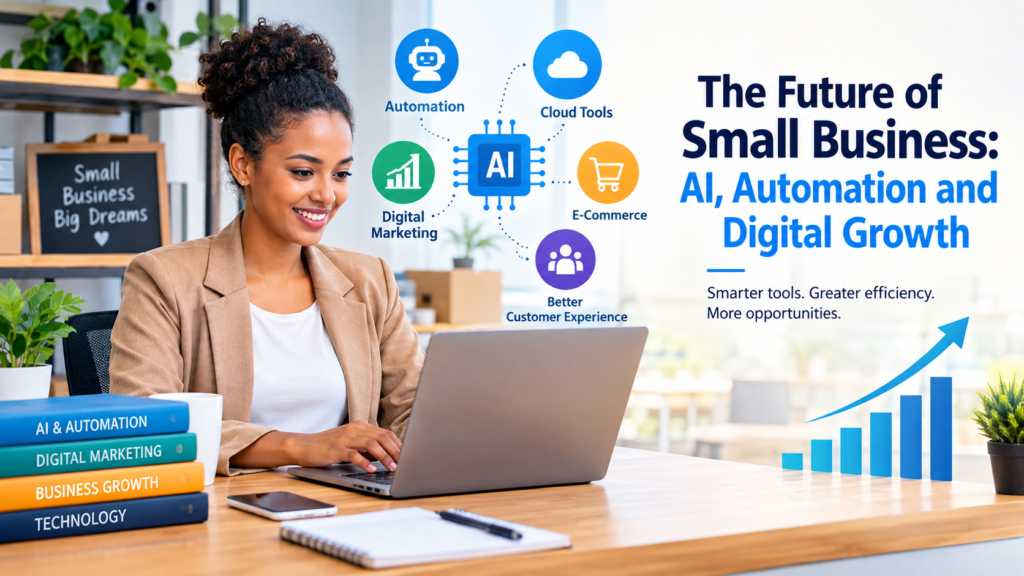

Small businesses are entering a period of significant technological change. Artificial intelligence (AI), automation, cloud software, digital marketing, online payments, and data-driven tools are becoming increasingly accessible to businesses that once had limited technology budgets.
The future of small business is not simply about adopting the newest technology. It is about finding practical ways to use technology to save time, improve customer experiences, make better decisions, and create sustainable growth.
AI and automation can help business owners handle repetitive tasks, understand customers, organize information, and support marketing activities. However, these technologies also introduce challenges involving cost, privacy, security, accuracy, and employee training.
For small businesses, the most effective approach is usually to start with clear business problems rather than technology itself.
How Technology Is Changing the Future of Small Business
Technology has already changed how small businesses communicate with customers, sell products, manage finances, and promote their services.
A local retailer can use an online store to reach customers beyond its immediate neighborhood. A service business can use online booking instead of managing every appointment manually. A small marketing team can use software to schedule campaigns and analyze results.
These changes are making digital tools an increasingly important part of everyday business operations.
The next stage is the combination of these tools with AI and automation.
The Role of AI in Small Business
AI refers to technologies that can perform tasks that normally require some form of human intelligence, such as analyzing information, generating content, recognizing patterns, or assisting with decisions.
For small businesses, AI does not necessarily mean building sophisticated systems from scratch. Many modern business applications include AI-powered features that can be used without advanced technical knowledge.
AI for Customer Service
AI-powered customer service tools can help businesses respond to common questions, organize inquiries, and provide information outside normal working hours.
For example, a business could use an AI assistant to answer frequently asked questions about:
- Opening hours
- Product availability
- Basic service information
- Appointment procedures
- Delivery policies
- Frequently requested documents
Human employees can then focus on more complicated or sensitive customer issues.
AI should support customer service rather than replace human judgment completely. Businesses need processes for reviewing inaccurate or inappropriate responses.
AI for Marketing
Marketing is another area where AI can assist small businesses.
AI tools can help with activities such as:
- Generating initial content ideas
- Organizing marketing campaigns
- Analyzing customer behavior
- Creating variations of advertising copy
- Summarizing marketing data
- Identifying patterns in performance
However, businesses should not publish AI-generated material without reviewing it. Human oversight remains important for accuracy, brand voice, originality, and customer trust.
AI for Business Analysis
Small businesses generate information through sales, customer interactions, website traffic, inventory, and other activities.
AI-powered analytics tools can help organize this information and identify patterns that may be difficult to notice manually.
For example, a retailer might analyze sales information to identify which products perform better during particular periods. A service provider might examine appointment data to understand busy periods and plan staffing accordingly.
The value comes from using the information to make better decisions—not simply from having an AI tool.
Automation Can Give Small Businesses More Time
Automation involves using technology to perform repetitive processes with limited manual intervention.
For a small business owner who handles many responsibilities personally, automation can reduce the amount of time spent on routine administrative work.
Examples of Useful Business Automation
Small businesses can consider automating:
- Appointment reminders
- Email confirmations
- Customer follow-ups
- Invoice notifications
- Marketing emails
- Social media scheduling
- Internal task notifications
- Basic reporting
- Lead organization
- Inventory alerts
For example, instead of manually sending every appointment reminder, a business can configure software to send reminders automatically after a customer books a service.
This does not eliminate the need for employees. It allows employees to spend more time on activities that require communication, creativity, judgment, and problem-solving.
Digital Marketing Will Remain Important
Having a good product or service is only part of building a modern business. Customers also need to be able to discover and evaluate the business.
Digital marketing gives small businesses several ways to reach potential customers.
Search Engine Optimization
SEO can help businesses make their websites easier for search engines and users to understand.
A useful SEO strategy should focus on answering genuine customer questions and providing clear information about products and services.
For example, a local plumbing company could publish helpful information about common plumbing problems, maintenance, service areas, and what customers should consider when choosing a plumber.
Social Media
Social media can help businesses communicate directly with their audiences and demonstrate their products, services, expertise, and company personality.
The best platform depends on the target audience and type of business. A business does not necessarily need to maintain an active presence on every social network.
Consistency and useful content are generally more valuable than simply posting frequently.
Email Marketing
Email remains useful for businesses that have permission to communicate with customers.
Businesses can use email to share:
- Product updates
- Helpful information
- Company news
- Offers
- Educational content
- Reminders
Good email marketing should provide a clear benefit to subscribers rather than sending unnecessary messages.
E-Commerce and Digital Payments
The growth of online commerce is also changing opportunities for small businesses.
A business can potentially sell through its own website, an online marketplace, social platforms, or a combination of channels.
Digital payment systems can also make transactions more convenient for customers.
However, expanding online requires careful planning. Businesses should consider payment fees, delivery costs, returns, customer support, cybersecurity, and local regulations before launching an online sales channel.
Cloud Software Is Becoming a Business Foundation
Cloud-based software allows businesses to access applications and information through internet-connected devices.
Small businesses can use cloud platforms for:
- Accounting
- Customer relationship management
- Project management
- File storage
- Communication
- Human resources
- Marketing
- Inventory management
One advantage is that businesses can often access their systems without maintaining their own physical servers.
Nevertheless, cloud services are not automatically risk-free. Businesses should review security settings, user permissions, backups, pricing, and service terms before choosing a platform.
The Benefits of AI and Automation for Small Businesses
When implemented appropriately, AI and automation can provide several potential benefits.
1. Saving Time
Automating repetitive tasks can reduce manual work and allow employees to focus on higher-value activities.
2. Improving Consistency
Automated processes can help businesses perform routine tasks consistently, provided that the underlying process has been designed correctly.
3. Supporting Better Decisions
Data analysis tools can make business information easier to understand and may help owners identify useful patterns.
4. Improving Customer Experience
Fast responses, convenient online services, reminders, and personalized communication can make interactions easier for customers.
5. Supporting Business Growth
Technology can make it easier to manage increasing volumes of customers, transactions, or information without increasing every manual task at the same rate.
These benefits are not guaranteed. Results depend on the quality of the technology, implementation, data, staff training, and business processes.
The Challenges Small Businesses Need to Consider
Technology can create problems when it is adopted without a clear plan.
Cost
Some tools have subscription fees, usage charges, implementation costs, or additional expenses for premium features.
Before purchasing software, businesses should calculate the total cost rather than looking only at the advertised monthly price.
Data Privacy
AI and cloud applications may process business or customer information.
Businesses should understand what information a service collects, how it is used, where appropriate, and what controls are available.
Sensitive information should not be entered into a tool simply because it is convenient.
Cybersecurity
More digital systems can also create more opportunities for security problems.
Businesses should use strong passwords, multi-factor authentication where available, appropriate access controls, software updates, backups, and employee security awareness practices.
Accuracy
AI systems can produce incorrect or incomplete information.
Important business decisions, financial information, legal matters, customer communications, and other sensitive content should receive appropriate human review.
Employee Training
Technology only creates value when people know how to use it.
Employees may need training when a business introduces new software or changes existing workflows.
How Small Businesses Can Prepare for the Future
Businesses do not need to transform everything at once.
A practical approach is to start with the areas where technology can solve a clearly identified problem.
Step 1: Identify Repetitive Tasks
Write down tasks that consume significant time every week.
Look for activities such as manual data entry, repetitive emails, appointment reminders, reporting, or document organization.
Step 2: Prioritize Business Problems
Do not start by asking, “Which AI tool should we buy?”
Instead, ask:
What problem are we trying to solve?
This simple change can prevent businesses from adopting unnecessary technology.
Step 3: Choose Appropriate Tools
Compare available solutions based on:
- Features
- Price
- Ease of use
- Security
- Integrations
- Customer support
- Scalability
- Contract terms
Businesses should check official product documentation for current pricing, features, and policies because software offerings can change.
Step 4: Start Small
Test one process before introducing technology across the entire organization.
For example, a business could automate appointment reminders before attempting to automate its complete customer service operation.
Step 5: Measure the Results
After implementation, compare the situation before and after the change.
Useful measurements might include:
- Time saved
- Number of errors
- Customer response time
- Operating costs
- Sales activity
- Employee workload
The appropriate measurement depends on the specific business process.
Step 6: Keep Human Oversight
Automation should not mean abandoning human responsibility.
Employees should know when they need to review an automated process, correct an AI-generated result, or personally handle a customer issue.
AI and Automation vs. Traditional Business Processes
| Area | Traditional Approach | AI/Automated Approach |
|---|---|---|
| Customer inquiries | Mostly manual responses | Automated responses for routine questions |
| Appointment reminders | Staff sends reminders | Software sends scheduled reminders |
| Marketing ideas | Manual research and brainstorming | AI can assist with research and ideation |
| Reporting | Manual data preparation | Automated reports and dashboards |
| Customer records | Manually updated | Information can be synchronized between systems |
| Decision-making | Primarily manual analysis | Data tools can identify patterns for review |
This comparison does not mean automated processes are always better. Some tasks are better handled personally, especially when they involve complex judgment, sensitive information, or important customer relationships.
What Will Human Workers Do in an AI-Enabled Small Business?
The future of small business is unlikely to be simply “people versus AI.”
In many situations, technology can handle repetitive tasks while people concentrate on responsibilities that require context, empathy, creativity, negotiation, leadership, and judgment.
For example, an automated system might organize customer inquiries, but an employee may still need to understand a customer’s specific situation and provide an appropriate solution.
The businesses that benefit most from technology may be those that combine efficient tools with strong human skills.
A Practical Technology Strategy for Small Businesses
A useful long-term strategy can be divided into several stages.
Foundation: Build a reliable website, business email system, digital payment options, secure data practices, and appropriate business software.
Efficiency: Identify repetitive tasks that can be automated.
Customer growth: Improve SEO, social media, email marketing, online sales, and customer relationship management.
Intelligence: Use analytics and AI tools to better understand information and support decisions.
Optimization: Regularly review software costs, performance, security, and business results.
This approach is more sustainable than constantly switching to new technology simply because it is trending.
Frequently Asked Questions
1. What is the future of small business with AI?
The future of small business is likely to involve greater use of AI for tasks such as customer support, marketing assistance, data analysis, and administrative work. The exact impact will vary by industry and business.
2. How can AI help a small business grow?
AI can support growth by helping businesses handle repetitive tasks, analyze information, create marketing ideas, respond to routine customer questions, and improve operational efficiency. Businesses still need human oversight and sound business strategies.
3. Is AI expensive for small businesses?
Costs vary significantly. Some tools offer free or low-cost options, while advanced business platforms can require substantial subscriptions or implementation expenses. Businesses should evaluate the total cost and expected practical value before adopting a tool.
4. Should every small business use AI?
No. AI is not necessary for every business process. A business should adopt AI when it solves a genuine problem or provides meaningful value. In some cases, a simple traditional process may be more appropriate.
5. What should a small business automate first?
Businesses should usually consider repetitive, predictable, and low-risk tasks first. Examples include appointment reminders, routine notifications, basic reporting, and certain administrative workflows. More sensitive processes should receive careful evaluation before automation.
Conclusion
The future of small business will increasingly be shaped by AI, automation, digital marketing, cloud software, e-commerce, and other technologies. But successful digital growth is not about adopting every new tool.
The better approach is to understand the business first, identify genuine problems, choose appropriate technology, and measure whether the investment actually improves operations or customer experiences.
AI can assist people. Automation can reduce repetitive work. Digital channels can expand how businesses reach customers. But technology works best when it is supported by good processes, trained employees, responsible data practices, and a clear business strategy.
For small businesses preparing for the years ahead, the goal should not simply be to become more digital. It should be to become more efficient, more responsive, and better equipped to serve customers in a changing market.