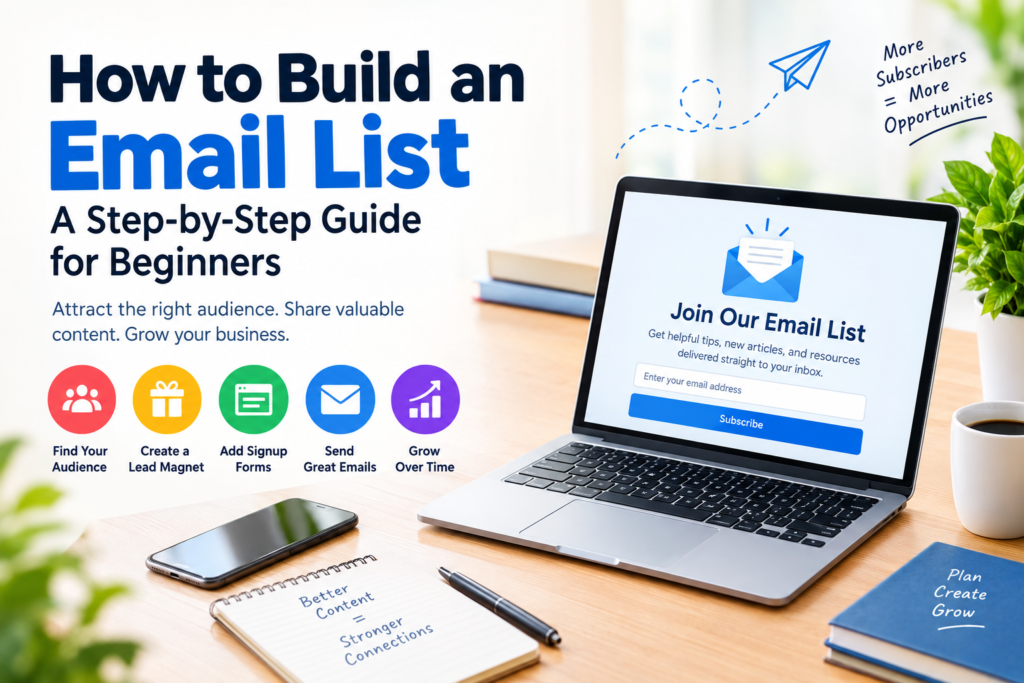

Building an email list is one of the most useful ways for a business, website, creator, or nonprofit organization to develop a direct communication channel with people who are interested in what it offers.
Unlike social media followers, website visitors, or search traffic, an email list gives you a permission-based way to communicate with subscribers directly. However, building a useful list is not simply about collecting as many email addresses as possible. The quality of your subscribers, the value you provide, and the way you obtain permission all matter.
If you are wondering how to build an email list, this guide explains the process from choosing an audience and creating an incentive to placing signup forms, sending useful emails, and maintaining a healthy list.
What Is an Email List?
An email list is a collection of people who have voluntarily provided their email addresses so they can receive communications from a business, organization, website, or creator.
Depending on the purpose of the list, subscribers might receive:
- Educational newsletters
- New articles or content updates
- Product announcements
- Event information
- Special offers
- Company updates
- Helpful resources
- Industry news and insights
A good email list is based on permission and relevance. Someone who signs up because they genuinely want your content is generally more valuable to your communication strategy than someone whose address was obtained without clear consent.
Why Build an Email List?
Email marketing can support several business and content goals, but it should be treated as a communication channel rather than a guaranteed source of sales.
Direct communication with your audience
Search engines and social platforms can change their algorithms, features, and policies. An email list provides another channel for communicating with people who have chosen to hear from you.
Encourage repeat visits
If you publish useful articles, guides, videos, or other resources, an email newsletter can remind interested readers when new content becomes available.
Build relationships over time
People may not be ready to purchase something the first time they visit a website. Helpful and relevant emails can give them an opportunity to learn more about your expertise and offerings.
Segment your audience
As your list grows, you may learn that subscribers have different interests. Segmentation can help you send more relevant messages instead of sending exactly the same email to everyone.
Support multiple marketing activities
An email list can complement content marketing, SEO, social media, webinars, product launches, and other legitimate marketing activities.
How to Build an Email List Step by Step
1. Define Who You Want to Attract
Before adding an email signup form to your website, identify the people you want to reach.
For example, a marketing website might target:
- Small business owners
- Freelancers
- Startup founders
- Marketing professionals
- Content creators
Your target audience affects what you offer in exchange for an email address and what type of content you send afterward.
A simple question can help:
What information would my ideal subscriber find genuinely useful?
The answer should guide your list-building strategy.
2. Choose a Clear Reason for People to Subscribe
Visitors need a reason to provide their email address.
A generic message such as “Subscribe to our newsletter” may work for an established publication, but a specific benefit can make the purpose of subscribing clearer.
Possible signup incentives include:
- A practical checklist
- A short guide
- A downloadable template
- An educational email series
- A useful worksheet
- A collection of resources
- Early access to selected content
- Regular industry tips
The incentive should be closely related to your website and audience.
For example, a website about project management could offer a simple project-planning checklist. A website about SEO could provide a basic website optimization checklist.
The goal is not to create the biggest possible incentive. It is to create something genuinely useful to the people you want as subscribers.
3. Use a Reliable Email Marketing Platform
An email marketing platform can help you collect subscribers, organize contacts, create campaigns, and manage unsubscribe requests.
When evaluating a platform, consider:
- Signup form functionality
- Contact management
- Automation features
- Audience segmentation
- Email templates
- Analytics and reporting
- Integration with your website
- Pricing as your list grows
- Compliance and privacy features
Different platforms have different pricing structures and features, so compare the current plans and policies directly on the provider’s official website before choosing one.
4. Create a Simple Signup Form
Your signup form should make the next step obvious.
A basic form might request:
Email address
First name — optional, if you have a useful reason to personalize messages.
Subscribe
Avoid asking for information that you do not actually need.
A complicated form can create unnecessary friction, especially for someone visiting your website on a mobile device.
Your signup message should also clearly explain what subscribers can expect.
For example:
Get practical marketing tips, useful resources, and new articles delivered to your inbox.
This tells visitors what they are signing up for without making unrealistic promises.
5. Add Signup Opportunities in Useful Locations
There is no single location that works for every website, so test different placements.
Common options include:
Homepage
Your homepage is often one of the first places visitors learn about your website. A clearly visible signup area can introduce your newsletter to relevant visitors.
Blog posts
A reader who finishes an article may already be interested in your subject. A relevant signup invitation at the end of the article can provide a natural next step.
Dedicated landing pages
A landing page can focus entirely on one resource or newsletter and explain its benefits without unrelated distractions.
Website header or footer
A signup option in a consistent website area can make your newsletter easy to find.
Resource pages
If you publish templates, guides, checklists, or other resources, these pages can be appropriate locations for an email signup.
The important principle is relevance. A signup form should feel like a useful part of the page rather than an interruption.
Create a Lead Magnet People Actually Need
A lead magnet is a resource offered to a visitor in exchange for joining an email list.
What Makes a Good Lead Magnet?
A useful lead magnet is usually:
- Relevant to the visitor
- Specific
- Easy to understand
- Practical
- Easy to access
- Connected to your main topic
For example, if your website teaches small businesses about marketing, possible lead magnets include:
Marketing planning checklist: A simple checklist for organizing a monthly marketing plan.
Content calendar template: A template that helps users plan articles and social content.
SEO audit checklist: A beginner-friendly list of website elements to review.
Email campaign planning worksheet: A document for organizing newsletter topics and campaigns.
A lead magnet does not need to be extremely long. A concise resource that solves a specific problem can be more useful than a large document that contains unnecessary information.
Write a Welcome Email
After someone subscribes, consider sending a welcome email explaining what they can expect.
A useful welcome email can include:
- A short thank-you message
- A reminder of what the subscriber signed up for
- A link to the promised resource, if applicable
- A brief introduction to your website or organization
- Information about what types of emails they will receive
Keep the message focused.
The first email is an opportunity to establish expectations rather than immediately sending a large amount of promotional material.
Example Welcome Structure
Subject: Welcome — Your Marketing Resources Are Here
Opening: Thank the subscriber for joining.
Value: Provide the promised resource.
Expectation: Explain how often you generally send emails and what topics you cover.
Next step: Suggest one useful article or resource.
This creates a clear beginning to the subscriber relationship.
Publish Content That Gives People a Reason to Stay
Getting someone to subscribe is only the beginning.
If your emails consistently provide little value, subscribers may stop opening them or unsubscribe.
Your newsletter could contain:
- Practical tutorials
- Original insights
- Helpful checklists
- New articles
- Industry explanations
- Case examples based on verified information
- Product or service updates
- Relevant resources
The content should match the expectations established when people subscribed.
For example, if someone signs up for weekly SEO tips, sending unrelated promotional emails may not meet their expectations.
Segment Your Email List
As your audience grows, subscribers may have different interests.
Segmentation allows you to organize subscribers based on information or actions that are relevant to your communications.
Possible segments include:
- Topic interests
- Customer versus non-customer
- Content preferences
- Signup source
- Geographic region, when relevant
- Engagement with particular content
For example, a software website might have separate interests for:
- SEO
- Email marketing
- Social media
- Content creation
- Analytics
Instead of sending every message to everyone, segmentation can help make communication more relevant.
However, collect only the information you need and explain how subscriber information will be used where required.
Make Your Signup Process Mobile-Friendly
Many people browse websites using smartphones and tablets.
A signup form should therefore be easy to use on smaller screens.
Check that:
- The form fits the screen
- Text is readable
- Fields are easy to tap
- Buttons are clearly visible
- The page loads properly
- The signup process does not contain unnecessary steps
Test the complete signup process yourself on different screen sizes before promoting it.
Use Ethical Email List-Building Practices
Learning how to build an email list is not just about increasing subscriber numbers. How you collect addresses matters.
Do Not Buy Random Email Lists
Purchased lists can contain people who never asked to hear from you. They may also contain outdated or inappropriate contacts.
A permission-based list is generally a better foundation for long-term communication.
Make the Subscription Purpose Clear
People should understand what they are signing up for.
If you collect an email address for a newsletter, explain that clearly. If you are offering a downloadable resource and the resource also results in ongoing emails, make that relationship understandable.
Provide an Easy Unsubscribe Option
Subscribers should be able to stop receiving marketing emails through a clear unsubscribe mechanism.
Email regulations vary by country and situation, so businesses should review the rules that apply to their audience and operations.
Respect Privacy
Your privacy notice should explain relevant information about how personal data is collected and used.
Depending on where your business and subscribers are located, privacy and marketing laws may impose additional requirements. For current legal requirements, consult applicable official government or regulatory sources or qualified legal professionals.
Common Mistakes to Avoid
Asking for Too Much Information
If all you need is an email address, requesting a long list of personal details can discourage signups.
Start with the information necessary for your specific purpose.
Sending Too Many Emails
More emails do not automatically create better results.
A useful schedule depends on your audience and the type of content you publish. Focus on consistency and value rather than sending messages simply to maintain a high frequency.
Making the Signup Promise Too Vague
Visitors should understand why they should subscribe.
Instead of:
Join our mailing list.
Try something more specific:
Receive practical weekly marketing tips and new guides.
The second example communicates what the subscriber can expect.
Making Unrealistic Claims
Avoid promises such as guaranteed sales, guaranteed business growth, or guaranteed income.
Email marketing can support a broader marketing strategy, but results depend on factors such as audience, content, offer, industry, execution, and other business conditions.
Ignoring Inactive Subscribers
Over time, some subscribers may stop engaging with your emails.
Review your list periodically and consider an appropriate re-engagement process. Your email platform may provide tools for identifying inactive contacts.
Do not assume that every old address remains interested simply because it is still stored in your database.
Email List Building vs. Social Media Followers
Email and social media serve different purposes.
| Email List | Social Media Audience |
|---|---|
| Direct communication channel | Platform-based communication |
| Subscribers provide an email address | Users follow or interact with an account |
| Useful for newsletters and targeted campaigns | Useful for public content and community interaction |
| Can support segmentation | Audience tools depend on the platform |
| Requires responsible data management | Subject to platform policies and algorithms |
This does not mean you need to choose one over the other.
A business can use social media to introduce people to its content while using email to maintain ongoing communication with subscribers who choose to join the list.
How to Grow an Email List Without Annoying Visitors
List building should improve the user experience rather than interfere with it.
Try these approaches:
Offer value before asking
Give visitors useful information first. A relevant signup invitation can then feel like a natural extension of the content.
Match the offer to the page
A visitor reading an SEO article may be more interested in an SEO checklist than an unrelated business resource.
Keep forms simple
Do not create unnecessary barriers between the visitor and the resource.
Avoid misleading buttons
A button should accurately describe what happens after it is clicked.
Test different approaches
You can experiment with signup copy, form placement, lead magnets, and page design while monitoring meaningful results.
The objective should be to learn what your audience finds useful, not simply to maximize clicks.
How to Measure Email List Growth
Subscriber count is useful, but it is not the only measurement that matters.
Consider tracking:
- New subscribers
- Unsubscribes
- Subscriber growth over time
- Email delivery performance
- Opens, where the measurement is available and appropriate
- Clicks
- Conversions relevant to your business
- Engagement by audience segment
Email metrics can have technical limitations, and individual metrics should not always be interpreted in isolation.
For example, a larger list is not necessarily better if many subscribers are inactive or uninterested in your content.
A smaller audience that genuinely wants your information can still be useful.
A Simple Email List-Building Strategy
If you are starting from zero, you do not need a complicated system.
Try this basic process:
Step 1: Define your target audience.
Step 2: Choose one specific problem you can help them solve.
Step 3: Create a useful free resource related to that problem.
Step 4: Set up an email marketing platform.
Step 5: Create a simple signup form.
Step 6: Add the form to relevant website pages.
Step 7: Send a useful welcome email.
Step 8: Publish valuable content consistently.
Step 9: Monitor subscriber engagement.
Step 10: Improve your strategy based on what you learn.
This approach gives you a manageable foundation that can become more sophisticated as your audience grows.
Frequently Asked Questions
1. How do I build an email list from scratch?
Start by defining your audience, creating something genuinely useful for them, and providing a clear signup opportunity through your website or other relevant channels. Use a reliable email marketing platform to collect and manage subscribers with appropriate permission.
2. Can I build an email list without a website?
Yes. Depending on your business, you can use landing pages, online communities, events, webinars, social media, or other channels that allow people to voluntarily subscribe. A website can make content publishing and list building easier, but it is not the only possible channel.
3. Should I buy an email list?
Buying a list of unrelated contacts is generally not a good foundation for permission-based email marketing. Building your own audience allows people to voluntarily subscribe and makes it easier to establish clear expectations about your communications.
4. What should I offer to get people to subscribe?
Offer something relevant and genuinely useful to your target audience. Examples include checklists, templates, guides, worksheets, educational email series, or access to useful resources.
5. How often should I send emails?
There is no universal frequency that works for every audience. Choose a schedule you can maintain while providing useful content. Make the expected frequency reasonably clear during signup and adjust based on subscriber feedback and engagement.
Conclusion
Learning how to build an email list is fundamentally about creating a useful reason for people to voluntarily stay connected with your business or content.
Start with a clearly defined audience, offer something valuable, create a simple signup process, and communicate what subscribers should expect. As your list grows, focus on relevant content, responsible data management, segmentation, and meaningful engagement rather than chasing subscriber numbers alone.
A successful email strategy is built gradually. By consistently respecting your audience’s time, privacy, and interests, you can create an email channel that supports your broader content and marketing efforts over the long term.