
Starting a business does not always require a large office, expensive equipment, or a substantial amount of capital. For many beginners, the bigger challenge is identifying an idea that matches their skills, available resources, local market, and ability to manage risk.
The good news is that there are many small business ideas you can start with limited resources. Some can begin from home, while others rely primarily on skills, a smartphone, a computer, or access to a local network of customers.
However, a low-cost business is not automatically easy or guaranteed to succeed. Every business requires planning, customer research, consistent effort, and careful financial management.
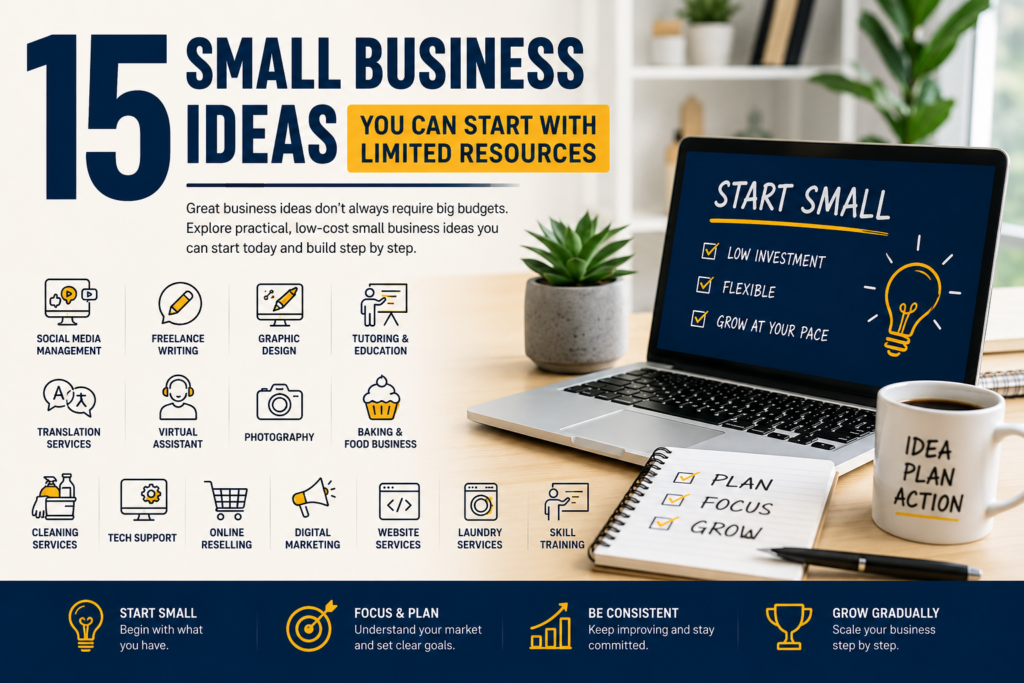
Below are 15 practical ideas worth considering, along with their advantages, limitations, and suggestions for getting started.
What Makes a Good Low-Resource Business Idea?
Before choosing an idea, consider four important questions:
- What skills do you already have? Starting with an existing skill can reduce training costs.
- What resources are available to you? Consider your phone, computer, internet connection, transportation, workspace, tools, and professional network.
- Who are your potential customers? A business needs a clearly defined group of people who have a reason to pay for the product or service.
- What can you realistically manage? A simple business that you can operate consistently may be more practical than an ambitious idea that requires resources you do not have.
It is also useful to separate startup costs from ongoing costs. A business might be inexpensive to launch but still require regular spending on transportation, internet, supplies, marketing, or software.
15 Small Business Ideas You Can Start With Limited Resources
1. Social Media Management
Many small organizations and businesses need help maintaining their social media presence.
If you understand platforms such as Facebook, Instagram, TikTok, LinkedIn, or other relevant channels, you can offer services such as:
- Creating content calendars
- Writing captions
- Designing simple posts
- Scheduling content
- Responding to basic customer inquiries
- Monitoring engagement
You can begin with a small number of clients and expand your services as your skills improve.
Potential advantage: You can operate remotely in many cases.
Limitation: Clients may expect regular availability, so clear working hours and responsibilities are important.
2. Freelance Writing
If you have strong writing skills, freelance writing can be started with relatively few physical resources.
Possible services include:
- Blog articles
- Website content
- Product descriptions
- Business profiles
- Newsletters
- Social media content
- Editing and proofreading
Building a portfolio can be more important initially than having an elaborate website. You can create several sample pieces that demonstrate your ability to potential clients.
Tip: Choose a few areas you understand well rather than trying to write about everything.
3. Graphic Design Services
Businesses regularly need visual materials such as social media graphics, flyers, business cards, presentations, menus, and promotional materials.
Beginners can start by developing basic design skills and using accessible design software. As experience grows, you can specialize in areas such as branding, presentation design, or social media graphics.
Potential advantage: Many projects can be completed remotely.
Limitation: Competition can be significant, so quality, reliability, communication, and specialization matter.
4. Tutoring or Educational Support
If you are knowledgeable in a particular subject, tutoring can be a practical service business.
You could offer support in:
- Mathematics
- Languages
- Computer skills
- School subjects
- Professional software
- Study skills
Depending on your location and target customers, tutoring can take place online or in person.
Tip: Define the level and subject you teach clearly so potential customers know exactly what you offer.
5. Translation Services
People and organizations often need documents, business materials, websites, or communications translated between languages.
If you are fluent in two or more languages, translation may be a useful service to explore.
Accuracy is especially important. Do not accept technical, legal, medical, or other specialized translation work unless you have the appropriate knowledge and can understand the terminology.
Potential advantage: The main resource is your language ability.
Limitation: Professional translation requires more than literal word-for-word conversion; context and cultural meaning matter.
6. Virtual Assistant Services
A virtual assistant provides administrative support remotely.
Depending on your skills, services could include:
- Data entry
- Calendar management
- Email organization
- Internet research
- Document formatting
- Appointment scheduling
- Basic customer support
This type of business can be particularly suitable for people who are organized and comfortable using computers.
Tip: Start with a clearly defined service package instead of offering every possible administrative task.
7. Photography Services
If you already own a capable camera or smartphone and have photography skills, you can explore small photography assignments.
Potential customers may need:
- Product photos
- Event photography
- Portraits
- Business photos
- Social media content
You can begin with smaller projects and build a portfolio over time.
Limitation: Equipment, transportation, storage, editing software, and backup systems can become significant expenses as the business grows.
8. Homemade Food or Baking Business
Food businesses can start on a small scale by producing selected items for a defined customer group.
Examples include:
- Baked goods
- Snacks
- Prepared meals
- Traditional foods
- Specialty desserts
Before starting, check the food safety, licensing, registration, and other requirements that apply in your location.
Tip: Begin with a manageable menu rather than producing too many products at once. This can make purchasing, preparation, quality control, and customer service easier.
9. Cleaning Services
Cleaning is a service people and organizations may need regularly.
You could specialize in:
- Residential cleaning
- Office cleaning
- Move-in or move-out cleaning
- Small commercial spaces
A small operation can begin with basic supplies and grow gradually as the customer base develops.
Potential advantage: Repeat customers may provide more predictable demand than one-time projects.
Limitation: Physical work, transportation, supplies, and scheduling need to be considered carefully.
10. Mobile Phone and Computer Support
People who are comfortable with technology can provide basic technical assistance.
Services might include:
- Software installation
- Basic computer setup
- Device configuration
- File organization
- Printer setup
- Basic troubleshooting
- Digital literacy training
Only provide services within your actual technical ability. Avoid handling sensitive customer information unnecessarily and use appropriate security practices.
11. Online Reselling
Reselling involves purchasing products and selling them to customers at a price that covers costs and leaves an appropriate margin.
You could start with a narrow product category rather than maintaining a large inventory.
Examples might include:
- Clothing
- Household products
- Accessories
- Stationery
- Personal-care items where permitted
- Small electronics accessories
Before purchasing inventory, research demand, supplier reliability, transportation costs, storage requirements, and return policies.
Important: Profit is not simply the difference between purchase price and selling price. Consider all relevant costs.
12. Digital Marketing Services
Small businesses may need assistance with their online presence but may not have an internal marketing team.
Depending on your experience, you could offer:
- Basic SEO support
- Content planning
- Social media marketing
- Email marketing
- Website content
- Digital advertising support
If you provide marketing services, avoid promising guaranteed rankings, guaranteed sales, or guaranteed advertising results. Marketing performance depends on many factors.
13. Website Setup Services
People and small organizations often need basic websites but may not know how to create or maintain them.
If you have web development or website-building skills, you could offer:
- Basic business websites
- Landing pages
- Website updates
- Content uploads
- Website maintenance
- Basic search optimization
Start with projects that match your technical ability and communicate clearly about what is included in your service.
14. Laundry or Ironing Services
Where there is local demand, laundry or ironing can become a small service business.
A home-based operation may begin by serving a limited number of customers within a manageable area.
Before starting, calculate the costs of:
- Water
- Electricity
- Detergent
- Packaging
- Transportation
- Equipment maintenance
- Your time
The business needs to charge enough to cover these expenses while remaining reasonable for the target market.
15. Personal or Business Skills Training
If you have a strong professional skill, you may be able to teach it to individuals or small groups.
Examples include:
- Microsoft Office
- Basic computer literacy
- Communication skills
- Digital marketing
- Graphic design
- Data analysis
- Entrepreneurship basics
Training can be offered through small in-person sessions or online meetings, depending on the subject and available technology.
Tip: Create a simple course outline before charging customers. It helps define what learners will receive and keeps the training organized.
How to Choose the Right Business Idea
Having many options can make the decision harder. A simple evaluation framework can help.
Start With Your Existing Skills
List the skills you can already use confidently. Then identify which ones solve a problem for another person or business.
For example, someone who is good at writing may consider content services, while someone with strong computer skills might explore virtual assistance or technical support.
Research Local Demand
A good idea still needs customers.
Talk to potential customers, examine competitors, and look for problems that people are already trying to solve. Ask questions such as:
- What services are people currently buying?
- What complaints do customers have about existing providers?
- Can you provide a more convenient service?
- Can you serve a specific customer group?
- What price range appears realistic?
Market research does not guarantee success, but it can help reduce avoidable mistakes.
Start With a Small Test
You do not necessarily need to build a complete business immediately.
Consider testing the idea with a small number of customers. This can help you learn:
- Whether people are interested
- Which services they value
- How much time each job requires
- What customers are willing to pay
- What operating problems appear
Use the results to improve the business before making larger commitments.
How to Manage a Business With Limited Resources
Keep Initial Expenses Under Control
Avoid purchasing equipment or subscriptions simply because they appear professional.
Ask whether each expense directly helps you deliver the product or service.
A basic setup that works reliably is often more useful than expensive equipment that does not generate additional value.
Separate Business and Personal Money
Even for a very small business, keep track of business income and expenses separately where possible.
Record:
- Sales
- Operating expenses
- Supplies
- Transportation
- Marketing costs
- Equipment purchases
- Outstanding payments
Good records make it easier to understand whether the business is actually profitable.
Build a Simple Customer Acquisition Process
You do not need a complicated marketing system at the beginning.
A basic process could be:
Identify a customer → explain the problem you solve → show examples of your work → provide clear pricing or a quotation → deliver the service → request appropriate feedback → improve.
Consistency is more important than using every available marketing channel.
Protect Your Reputation
For a small business, trust can be one of its most valuable assets.
Be clear about:
- What you offer
- What the customer will receive
- Delivery times
- Prices
- Payment terms
- Cancellation policies
- What is outside the scope of the service
Do not promise something you cannot reliably deliver.
Common Mistakes to Avoid
Starting Without Understanding the Customer
An idea may sound attractive but still have weak demand in your particular market.
Research before investing heavily.
Underpricing Your Work
Low prices can attract attention, but consistently charging less than your actual costs is not sustainable.
Calculate the time and expenses involved in delivering each service.
Offering Too Many Services
A new business can become difficult to manage when it tries to serve everyone.
Start with a focused offer and expand when there is a clear reason to do so.
Ignoring Record Keeping
Small businesses can lose track of expenses surprisingly quickly.
Even a basic spreadsheet or accounting system can help you monitor cash flow and identify unnecessary costs.
Spending Too Much on Branding Too Early
A professional identity is useful, but a logo, website, or promotional material should support the business rather than consume resources that are needed for operations.
Frequently Asked Questions
1. What is the easiest small business to start with limited resources?
There is no single easiest business for everyone. Service businesses such as writing, tutoring, virtual assistance, social media management, and translation can be relatively accessible because they may rely more on existing skills than expensive equipment.
2. Can I start a business from home?
Yes. Many service-based businesses can be operated from home, depending on local regulations, the type of service, and your working environment. Food-related and other regulated businesses may have additional requirements.
3. How much money do I need to start a small business?
There is no universal amount. Startup costs depend on the business model, location, equipment, inventory, licenses, marketing, and operating expenses. The best approach is to create a basic startup budget before spending money.
4. Should I start a business online or locally?
It depends on your customers and the service you provide. Online businesses can reach customers beyond your immediate area, while local businesses may benefit from personal relationships and community demand. Some businesses can combine both approaches.
5. How can I know whether a business idea is worth pursuing?
Test the idea before making a large investment. Speak with potential customers, study competitors, estimate your costs, and try to secure a small number of initial customers. The goal is to gather evidence before committing significant resources.
Conclusion
Starting a small business with limited resources is possible, but choosing a low-cost idea is only the beginning. The strongest opportunities are usually those that connect your existing skills and resources with a genuine customer need.
Whether you choose freelance writing, tutoring, digital marketing, cleaning, reselling, website services, or another idea from this list, start small and keep your costs under control. Research your market, track your finances, communicate clearly with customers, and improve your service based on real feedback.
Most importantly, avoid treating any business idea as a guaranteed path to income. A sustainable business is built through useful products or services, responsible decisions, customer trust, and consistent execution.