
You receive 20 inquiries, but only a few people book a call. Where should you start? Check what happens after someone gets in touch. If qualified prospects struggle to find an appointment, bringing in more traffic may add inquiries without fixing the booking problem.
Here’s how to build a sales funnel for a service business, with an example you can work through. You’ll map the steps from inquiry to signed agreement, decide what to count at each stage, and use the numbers to pick one improvement. A spreadsheet is enough to get started.
What is a sales funnel for a service business?
A service sales funnel shows how many prospective clients reach each step on the way to buying. For example, people discover a service, inquire, qualify for a call, receive a proposal, and decide whether to sign.
Your sales pipeline tracks individual opportunities and what needs to happen next. Your sales funnel summarizes how those opportunities move through the stages as a group. The same spreadsheet can support both if each opportunity has a clear record of when it reached each stage.
1. Start with one service and one buyer
Choose one offer with a clear boundary. A web studio offering a two-page website refresh might focus on independent businesses with an existing site and an upcoming launch or promotion.
Write down what makes an inquiry worth following up. The studio might look for an existing website, a request that fits the service, and a workable deadline. If the request is for a full e-commerce build, mark it separately. That makes the funnel easier to interpret and gives the buyer a clearer response.
Pick one main next step to offer prospects, such as requesting a quote or booking a short scope call. Explain what they’ll need to bring and what they’ll learn.
2. Define what counts at each stage
Use stages that reflect how people actually buy your service. Give each one a clear test so two people on your team would count it the same way.
| Stage | What counts | What to give the buyer |
|---|---|---|
| Inquiry received | A distinct sales opportunity contacts you about the service. | A clear response and an explanation of what happens next |
| Qualified inquiry | The opportunity meets your service, timing, and other fit criteria. | An invitation to the next step or a short request for missing information |
| Discovery call completed | The prospect attends and you discuss their requirements. | A summary of what you understood and when they’ll hear back |
| Proposal sent | You send a written offer with scope, price, and next steps. | A way to ask questions or confirm a decision |
| Client won | The prospect meets the buying milestone you defined, such as signing an agreement. | Confirmation and the first onboarding step |
You can track visits, referrals, and ad clicks separately to understand where inquiries start. For the worked example, measurement begins with the inquiry because some prospects arrive by email or referral and never visit the site. If you sell fixed-price services directly, swap the discovery and proposal stages for the steps buyers actually take.
3. Build your tracker and calculate conversion rates
Keep one row per opportunity. A prospect who emails and fills in your form about the same job should have one record. If they later inquire about a separate project, give that opportunity a new ID.
Copy this tab-separated header row into cell A1 of a spreadsheet. If the values appear in a single cell, use the spreadsheet’s split-text feature with Tab as the separator.
Opportunity ID Source Service Inquiry date Qualified date Call booked date Call completed date Proposal sent date Won date Current status Next action Follow-up date Reason closed or lostKeep booked calls and completed calls separate. If five people book and only two attend, the problem is different from having only two people book in the first place. Leave dates blank until the event happens, and record a reason when you close an opportunity without a sale.
Use the same group of inquiries from start to finish
For a stage-to-stage conversion rate, divide the number that reached the next stage by the number that reached the previous stage, then multiply by 100. Use a group defined by when inquiries arrived and follow the same group through each stage.
For example, track inquiries received in May through a stated review date. Keep open cases visible if they’re still deciding. Comparing all calls held in May with all proposals sent in May can mix different groups and mislead you, especially when decisions take several weeks. If a stage has zero opportunities, show the rate as unavailable.
Worked example for a website refresh service
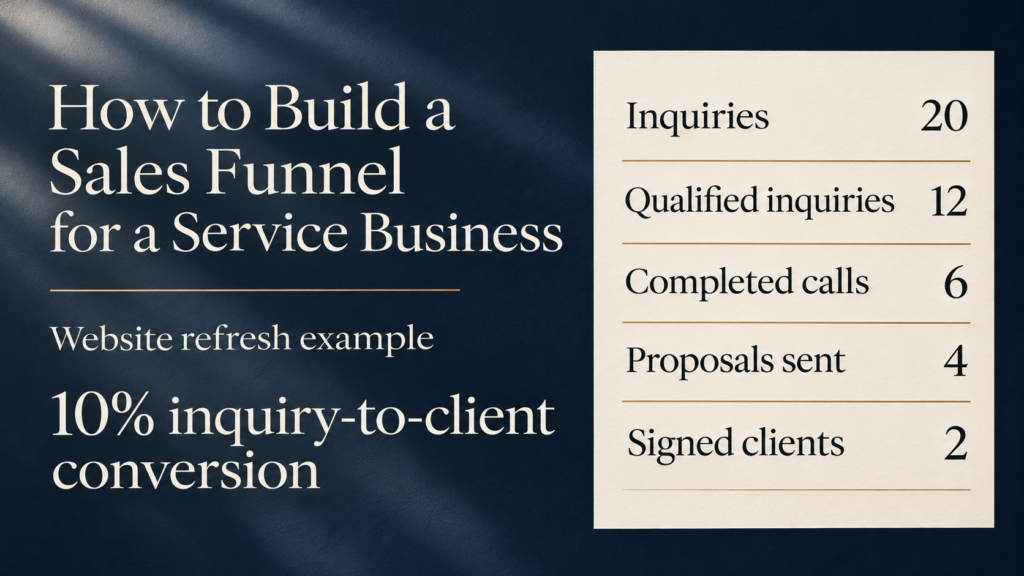
A fictional web studio tracks 20 new inquiries for one service and reviews their progress six weeks after the inquiry period ends. By the review date, all opportunities are closed as won, lost, or unqualified. The figures are illustrative.
| Stage | Opportunities | Rate from previous stage |
|---|---|---|
| Inquiries received | 20 | — |
| Qualified inquiries | 12 | 60% |
| Discovery calls completed | 6 | 50% |
| Proposals sent | 4 | About 67% |
| Agreements signed | 2 | 50% |
Overall, 2 of 20 inquiries became clients, a 10% inquiry-to-client conversion rate. The studio checks the step from qualified inquiry to completed call. Its tracker shows eight qualified prospects booked a call and six attended. Four qualified prospects never booked, and two who booked didn’t attend.
Turn the drop-off into one test
The studio learns from follow-up notes that several people who never booked struggled to find a time. For the next group of qualified prospects, it adds a late-afternoon booking slot and keeps the rest of the response the same. At the next review, it checks both the share who booked and the share who attended.
If bookings rise but attendance falls, review the reminder and rescheduling process before adding more slots. If both improve, check whether the change also brings more proposals or signed work. Small samples can justify another test while still leaving uncertainty about the cause.
What to improve when people stop moving forward
| Where progress stalls | What to check first |
|---|---|
| Inquiries rarely qualify | Check whether your service page explains the buyer, scope, location, and pricing or quote process. |
| Qualified leads rarely book | Check how quickly you reply, how you invite them, and which times are available. |
| Calls are booked but rarely attended | Check confirmations, reminders, time zones, and the rescheduling link. |
| Calls rarely lead to proposals | Check whether the call confirms the need, decision process, and a realistic scope. |
| Proposals rarely turn into signed work | Ask why prospects declined or delayed. Look for recurring questions about price, scope, timing, or internal approval. |
When you can, change one thing at a time and note changes in lead source, staffing, or availability. Comparing groups is more useful when you know what else differed.
Frequently asked questions
1. Do I need a CRM to build a sales funnel?
A spreadsheet can work for a small team with a manageable number of inquiries. A CRM is worth comparing when several people need to update opportunities or when follow-up reminders are easy to miss.
2. How many stages should a service sales funnel have?
Use the steps where the team makes a decision or the buyer takes a meaningful action. Add a stage only if tracking it helps you decide what to improve. Booked and completed calls are useful as separate fields when attendance is a concern.
3. What is a good conversion rate for a service business?
Use your own baseline and compare similar offers, channels, and review periods. A useful rate is one you can explain and use to assess delivery capacity and sales costs. A high rate based on a handful of deals can change quickly.
4. How often should I review the funnel?
Check open opportunities weekly so each one has a next step. Review stage totals after the group has had time to make a decision. If your sales cycle takes months, label interim figures and revisit them later.
5. Should every inquiry receive a proposal?
Send a proposal when you have enough information to offer a workable scope and price. If the inquiry is outside your scope, a brief explanation or referral can be more useful to the prospect.
Conclusion
Pick one service and write down what qualifies an inquiry and what counts as a win. Track the same group from first contact through its decision. Then look at the stage where people stop, check why it happens, and make one change you can measure on the next group.