
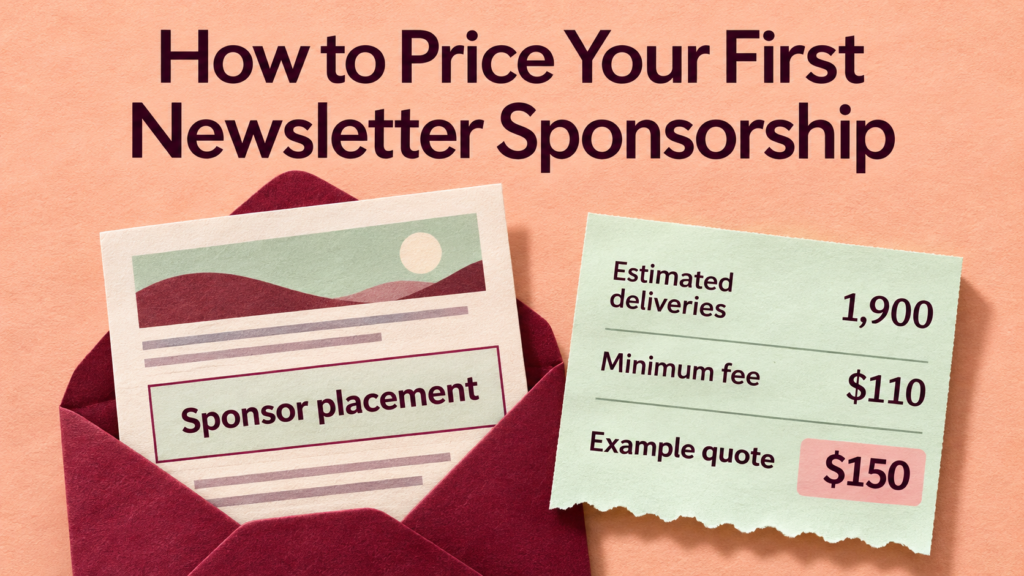

A sponsor asks what it costs to advertise in your newsletter. You know how many subscribers you have, but you have never sold a placement. The useful starting point is to decide exactly what the sponsor would buy and what you can report afterward. A short mention near the bottom of an issue and a prominent placement with custom copy take different amounts of work and give the sponsor different exposure.
Here’s how to price your first newsletter sponsorship using the audience data you already have, a minimum fee that accounts for your time, and a quote that explains what the sponsor gets.
1. Define the placement before you price it
Start with one placement you can describe in a sentence. For example, offer a clearly labeled sponsor block in one regular issue, with up to 80 words, one tracked link, one copy approval round, and a short report after sending.
| Placement | What the sponsor gets | What to price separately |
|---|---|---|
| Short mention | A few lines and a link in a secondary position | Custom copy or added distribution |
| Main sponsor block | A prominent labeled section in a regular issue | Category exclusivity, extra creative, or additional issues |
| Dedicated send | An email primarily about the sponsor’s offer | Additional production and the effect on your regular sending schedule |
Decide who writes the copy, where the placement appears, and how many revisions are included. If a sponsor wants a social post or a permanent placement in your web archive, include it in writing and decide whether it belongs in the base offer.
2. Use the audience data you can explain
Pull data from several recent issues comparable to the one you plan to sell. If you have five recent issues with 1,850, 1,890, 1,900, 1,920, and 1,940 delivered emails, the median is 1,900. Use that as a planning estimate and disclose the range if a sponsor asks what delivery typically looks like.
Keep subscriber counts, delivery, and clicks separate
Your total subscriber count describes the list. Recent delivered emails give you a better basis for estimating the size of a comparable send. Delivery counts also have limits. A delivered email does not establish that the recipient saw the sponsor block.
Use prior clicks on comparable links as context if you have them, and explain how your email platform reports them. Automated activity can affect engagement reports. A popular editorial link is also a different placement from a paid sponsor link. For your first campaign, show the evidence you have and describe what you’ll measure after the send.
Explain why the audience fits the sponsor
Describe your readers in terms the sponsor can use. For example, a newsletter about bookkeeping workflows may be a good fit for a tool built for independent bookkeepers. If audience information comes from a signup survey, say so and explain how much of the list answered when that matters. A clear audience description gives a sponsor more to evaluate than a list size alone.
3. Set a minimum fee, then compare pricing models
Add the time needed for sponsor communication, copy preparation, approvals, link testing, scheduling, and reporting. Multiply the estimated time by the hourly amount you use to value your work, then add any direct campaign costs. Include time spent on revisions where you expect them.
| Model | How it works | When it fits |
|---|---|---|
| Flat fee | One price for a defined placement | You can describe the deliverables, but have limited sponsor performance history |
| CPM based on delivered emails | Price per 1,000 delivered emails | Both sides agree on the delivery metric and how the final count affects billing |
| Performance-based | Payment depends on an agreed outcome, such as a qualified lead | Both sides can track the outcome and agree on attribution and exclusions |
A flat fee is a practical starting point for one issue. It gives the sponsor a clear total and gives you a way to cover the work involved. If a sponsor asks for a CPM, specify the denominator. A CPM calculated on delivered emails describes email distribution. It does not measure ad impressions.
4. Work through the numbers before you quote
Imagine you publish a weekly newsletter about tools for small service businesses. Recent issues delivered to a median of 1,900 addresses. You estimate two hours to handle a sponsor block and value that time at $50 per hour. Direct campaign costs are $10.
| Calculation | Illustrative amount |
|---|---|
| Time cost | 2 hours × $50 = $100 |
| Direct cost | $10 |
| Minimum fee for the estimated work | $100 + $10 = $110 |
| Example quote for one main sponsor block | $150 |
| Implied cost per 1,000 delivered emails | $150 ÷ 1,900 × 1,000 ≈ $78.95 |
The $150 quote is an example, and the $78.95 figure is its implied delivery-based CPM. Neither figure is a market benchmark. The quote leaves $40 above the estimated time and direct costs. General business overhead, taxes, or unexpected work could reduce that amount.
If a sponsor offers $90, compare that with the $110 minimum for the proposed placement. You could quote a shorter mention if it takes less work and still fits your newsletter. If the sponsor needs the full placement, keep the scope and fee tied together.
5. Send a quote the sponsor can evaluate
Include the issue date, placement, copy deadline, expected distribution, and reporting plan. Say whether the estimate is based on a median, average, or recent range. Agree on what happens if the issue is delayed or the placement is omitted.
Sample first sponsorship quote
Placement — One clearly labeled sponsor block in our next available weekly issue, near the top of the email.
What’s included — Up to 80 words, one tracked link, one copy approval round, and a report seven days after the send.
Estimated distribution — About 1,900 delivered emails, based on the median of five recent issues.
Price — USD 150 for one issue.
Reporting — Delivered emails and clicks recorded for the sponsor link. Please confirm the issue date and supply your offer, destination URL, and any required copy at least three business days before sending.
Confirm payment timing and the approval deadline before you reserve the slot. If the sponsor wants conversion reporting, agree on who will track it and which data they can share. Your email report can describe clicks it recorded. A sale on the sponsor’s website may require separate tracking on their side.
6. Review the first campaign before changing your rate
After the send, record the quoted fee, actual time spent, delivered emails, sponsor-link clicks, and any feedback the sponsor shares. Compare the actual production time with your estimate. If approvals took longer than expected, revise the scope or fee for the next quote.
One campaign can give you evidence about your workflow. Several comparable campaigns can help you judge whether the placement, audience fit, and price are working together. If a sponsor declines, ask which part of the offer mattered to them. A budget mismatch, a poor audience fit, and a scheduling conflict call for different responses.
Frequently asked questions
Can I sell a sponsorship with a small newsletter?
Yes, if you can describe the audience and find a sponsor with a relevant offer. Start with a clearly defined single-issue placement and report your distribution honestly. There is no universal subscriber threshold.
Should I use subscriber count or open rate to calculate my price?
Use recent deliveries to estimate distribution and consider audience fit, placement, and production effort when setting the fee. If you share open data, describe it as an engagement measure from your platform. It does not tell you how many people saw the sponsor block.
How can I price a sponsorship if I have no past sponsor clicks?
Offer one fixed-price placement with clear deliverables and use recent newsletter delivery data as context. Explain what you’ll report after the campaign so the sponsor knows what evidence they’ll receive.
Should I discount my first sponsorship?
A limited introductory rate can make sense if it covers the work and you state exactly what it includes. Another option is to offer a smaller placement at a lower price. Calculate the work for either offer before quoting it.
Should I sell a package of multiple issues right away?
Start with one issue if the format and approval process are new to you. If you sell a package, spell out the issue dates, fee per placement or total fee, reporting schedule, and what happens if a send moves.
Conclusion
Price a placement you can describe and deliver. Use comparable sends to estimate distribution, account for the time you’ll spend, and put the fee and reporting plan in writing. After the campaign, use what you learned about the work and the sponsor’s response to set the next rate.