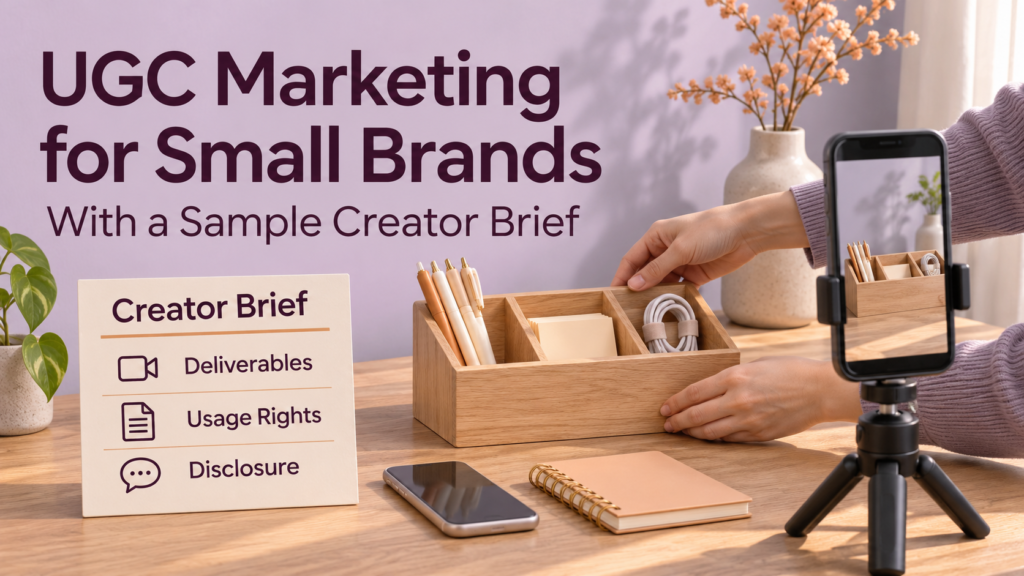

A shopper can read that a desk organizer has three compartments and still wonder whether it holds a phone, notebook, and loose cables. A short creator video can answer that question in seconds. Show the organizer on a real desk, put those items inside, and let the shopper see what fits.
UGC marketing for small brands can start with one product, one creator, and one question. This guide shows how to choose that question, agree on how the brand can use the video, and measure the result. It includes a sample brief for a fictional desk accessories brand.
What is UGC marketing?
UGC stands for user-generated content. It can include a customer’s photo, a product demonstration, or a video review. Small brands also commission creators to make videos in a similar format. A commissioned video is paid content, even when it looks like an everyday product demonstration. FTC guide to disclosing brand relationships
| Content arrangement | Where it usually starts | What the brand should clarify |
|---|---|---|
| A customer posts on their own | The customer’s account | Ask for permission before reusing the content. |
| A creator makes an asset for the brand | The brand’s account or another agreed channel | Agree on the deliverables and where and how long the brand can use them. |
| A creator publishes a sponsored post | The creator’s account | Agree on the post, disclosure, timing, and any separate reuse rights. |
Buy the work that serves your goal. If you need a video for your product page, prioritize how well the creator shows the product. If you also want distribution to the creator’s audience, include a post on their account in the agreement.
How to run a first UGC campaign
1. Pick one shopper question and one destination
Start with a common question from product page inquiries, support messages, or customer feedback. If shoppers ask what fits in an organizer, brief the creator to show it holding familiar objects. If they ask how to assemble it, commission a demonstration of that process.
Choose where the video will appear and what you want viewers to do next. A product page video may need to help a shopper decide whether to add the item to their cart. A social video might first need to earn a click to that page.
2. Choose a creator who can show the product clearly
Ask for examples of similar demonstrations. Look at whether the creator makes the item easy to see, records clear sound, and explains what they’re doing. For an asset you’ll publish on your brand account, those skills may matter more than audience size.
Agree on the fee, what the creator will receive, when they can try the product, and how to handle a genuine problem with it. Give the creator room to describe what they actually observe. Set payment around the agreed production work and deliverables. Avoid making it contingent on a positive review. FTC guidance on endorsements
3. Specify the content without scripting the opinion
Include a list of shots and the facts the creator can verify. Give them a clear opening idea, such as “Here’s what fits in this organizer,” and let them phrase it naturally. For a video with a phone compartment, ask them to show which phone and case they used so the viewer can judge the fit.
List the deliverables, including video length, orientation, captions, and whether you need alternate openings or raw footage. Agree on a draft deadline and the number of revision rounds. Use revisions to correct factual errors, fix missing shots, or improve clarity.
4. Agree on usage and disclosure before filming
Write down which accounts and channels may publish the clip, how long the permission lasts, and which edits the brand may make. Discuss paid ads, website placement, raw footage, and posting through the creator’s account as separate permissions. Paying for production alone does not establish the full scope of reuse. Make sure any music, fonts, images, and other third-party materials are cleared for the intended use. U.S. Copyright Office guidance on works made for hire
For marketing directed at U.S. consumers, the FTC says a material connection, such as payment or a free product, should be disclosed clearly when it would affect how people evaluate the endorsement. For video endorsements, put the disclosure in the video where viewers can see it. If the endorsement is both visual and audible, disclose in both ways. Use plain language and keep relevant disclosures in edited versions. FTC disclosure guidance for social media influencers · FTC Endorsement Guides questions and answers
5. Review the video and measure one meaningful action
Before publishing, check that the product is shown accurately, the disclosure is easy to read and hear where appropriate, and the captions and link work. Verify that every placement fits the permission you agreed to. Save the agreement and track the usage end date.
Choose a metric tied to the original goal. Product page visits can help you compare social clips that aim to generate those visits. If the goal is a sale, track purchases where your setup allows it. Treat clicks as evidence of interest and use purchase data to evaluate sales.
Sample UGC creator brief you can adapt
This is a fictional brief for Harbor Desk Co. The fee and schedule illustrate how to write the terms clearly.
| Brief item | Sample wording |
|---|---|
| Product and audience | Three-compartment desk organizer for people working at small desks. |
| Goal | Show what fits and encourage viewers to visit the product page. |
| Opening shot | Start with a phone, notebook, and cable on a real desk. Suggested opening: “Here’s what fits in this desk organizer.” |
| Required shots | Show all three compartments. Place the items inside one at a time. End with a clear view of the filled organizer. If an item doesn’t fit, show that honestly. |
| Product claims | Describe the items you tested. Use only verified measurements supplied by the brand. Avoid broad claims such as “fits every phone.” |
| Deliverables | One 25–35 second vertical 9:16 MP4 with captions. Raw footage and alternate edits are outside this brief. |
| Disclosure | For this paid demonstration, display and say “Harbor Desk Co. paid me to make this video” near the beginning. Keep the disclosure visible long enough to read and repeat it clearly in the post caption. |
| Timeline and revisions | First draft within seven calendar days of receiving the product. One round of consolidated feedback, with delivery within three calendar days of receiving it. |
| Fee and payment | USD 300 for the agreed deliverable and usage. Payment within 14 days of final delivery. |
| Usage | Brand may post the finished clip on its own Instagram and TikTok accounts for 90 days from the first publication. Brand may add captions or trim the clip without changing its meaning or removing the disclosure. Paid ads, website use, and creator-account posting need a separate agreement. At the end of the term, remove the posts or agree on an extension. |
| Call to action | “See the organizer and check its dimensions on our product page.” |
Send the brief alongside the written agreement and product information. Before work begins, both sides should be able to answer three questions. What will be delivered? When is it due? Where can the brand use it?
How to tell whether the first video worked
Suppose the brand publishes the creator clip and, separately, its own product video. For placements that support clickable links, it uses a different tracked link for each clip and compares the results over the same period.
| Organic video | Impressions | Reported outbound clicks | Clicks divided by impressions |
|---|---|---|---|
| Creator demonstration | 2,000 | 40 | 2.0% |
| Brand product video | 2,000 | 24 | 1.2% |
These figures are illustrative. The creator clip drew more outbound clicks in this example. The posts may have reached different audiences or run at different times, so treat the comparison as a reason to test the format again. If both clips draw visits but shoppers still ask about fit, check whether the product page answers the same question the videos raise.
Frequently asked questions
1. Can a small brand start UGC marketing with one creator?
Yes. Start with one product and one video that answers a common buyer question. Agree on the deliverables and usage, then use what you learn to brief a second video.
2. What should I pay a UGC creator?
Request quotes based on the work. A short organic video, several edits, raw footage, and six months of ad use can carry different prices. Compare fees against the same deliverables and usage terms.
3. Can I repost a customer’s photo if they tagged the brand?
Ask for written permission and specify where you want to share it. If you plan to use it in advertising or on a product page, include those placements in your request. U.S. Copyright Office guidance on obtaining permission
4. Does a free product need to be disclosed?
Under FTC guidance, creators should disclose that they received a free product when they mention it in an endorsement. A plain statement such as “The brand sent me this product for free” helps viewers understand the connection. FTC disclosure guidance
5. Can I turn an organic creator video into a paid ad?
Check the agreement for paid placements, duration, and permitted edits. If the original deal covered organic posts, agree on new usage before running ads. Review music and any other licensed material for the new placement.
Conclusion
Choose one question your customers ask and brief a creator to answer it on camera. Set the fee, deliverables, usage, and disclosure before filming. After publishing, check whether viewers took the action you wanted and use that result to shape the next brief.