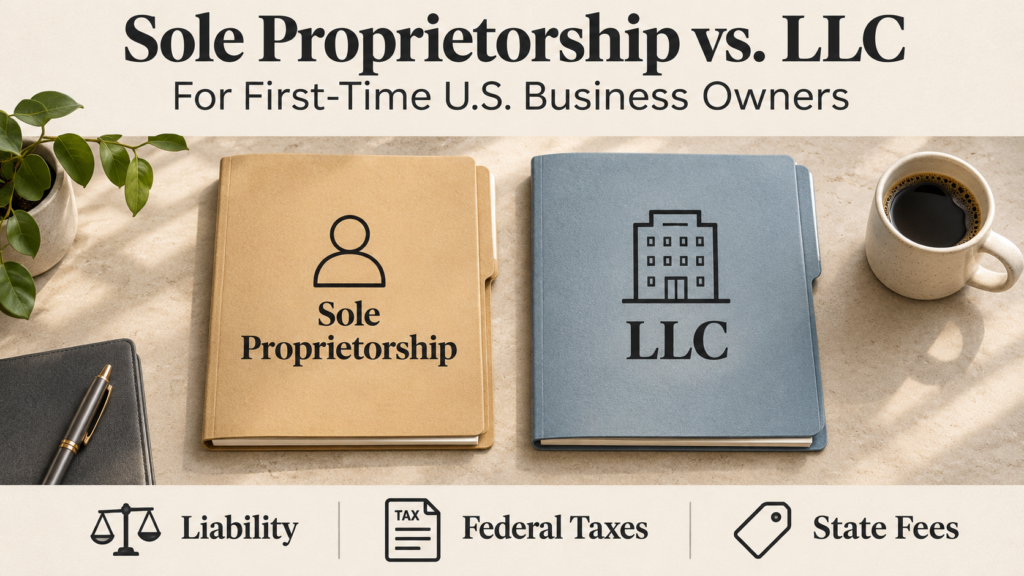

Deciding between a sole proprietorship and an LLC starts with the work you plan to do. A freelance editor working from home may prioritize simple setup. An owner who works in customers’ homes, hires employees, or signs a commercial lease may give more weight to liability and contract terms. In either case, check the cost of forming and maintaining an LLC in your state before deciding.
A sole proprietorship is usually simpler to start. An LLC adds a state filing and can provide a layer of separation between the business and the owner’s personal assets. Federal income tax treatment can be similar for a sole proprietor and an individual who owns a single-member LLC. U.S. Small Business Administration startup guidance · IRS overview of LLC tax classification
Sole proprietorship vs. LLC at a glance
| Decision | Sole proprietorship | Single-member LLC |
|---|---|---|
| Ownership | One owner | One member owns the LLC. LLCs can also have multiple members. |
| Setup | An individual can generally start without forming a separate entity. Trade name filings, tax registrations, and licenses may still apply. | File formation documents with the state and meet its registered agent and other requirements. |
| Liability | The owner is personally responsible for business debts and obligations. | State law generally limits the owner’s personal liability for LLC obligations, subject to exceptions. |
| Federal income taxes | An individual owner generally reports business income and expenses on their personal return, commonly on Schedule C. | The IRS generally treats the owner and the LLC as one taxpayer for federal income tax unless the LLC elects corporate treatment. An individual owner generally uses the relevant schedule on their personal return. |
| Ongoing costs | Vary with permits, registrations, and the type of business. | Can include state reports, renewal fees or taxes, and registered agent costs if you hire a service. |
SBA guidance on business structure and registration · IRS guidance on single-member LLCs
What changes when you form an LLC?
Liability and contracts
An LLC can help separate the owner’s personal assets from obligations owed by the business. The protection depends on state law and the circumstances. For example, if you personally guarantee a business loan or lease, you can still be responsible for paying under that guarantee. Your own wrongful acts can also create personal liability. Check what proposed contracts require before you sign. Washington’s LLC statute provides one state-law example of how an owner can remain liable for their own conduct or assume LLC obligations by agreement. SBA guidance on business structure · Washington LLC liability statute
Keep contracts, invoices, bookkeeping, and banking consistent with the entity that actually does the work. Sign LLC contracts using the LLC’s legal name and state your role. Consider insurance that fits the risks of the work, such as accidental damage at customer sites or claims about professional services. SBA guidance on business banking and insurance
Federal taxes
For federal income tax, the IRS generally treats a single-member LLC as a disregarded entity unless it elects corporate treatment. If an individual owns the LLC and runs an ordinary trade or business, the business income and expenses generally go on the owner’s personal return, commonly on Schedule C. The IRS generally applies self-employment tax to that owner’s business earnings in the same manner as for a sole proprietor. Simply filing to form an LLC generally does not change that default treatment. Employment and certain excise taxes follow separate rules. IRS single-member LLC guidance · IRS guidance on LLC tax consequences
An LLC with multiple members generally defaults to partnership treatment for federal income tax. An eligible LLC may elect a different tax treatment. If you’re comparing an S corporation election, include payroll, accounting, and filing costs in the decision. Owners who work for an S corporation are subject to reasonable compensation rules when applicable. IRS guidance on LLC classification · IRS guidance on S corporation compensation
State costs and paperwork
Price the first year and a typical renewal year. Check the state’s formation fee, required reports, and any minimum tax. Include optional registered agent service fees only if you expect to hire one. Ask whether your business must also register in another state where it operates before choosing a formation state. SBA startup and registration guidance
For example, California’s Franchise Tax Board lists an $800 annual tax for LLCs that do business in or are organized in California, subject to applicable rules and exceptions. Use your own state’s official fee schedule. The California figure illustrates why the formation fee alone can be an incomplete comparison. California Franchise Tax Board LLC guidance
Two examples for first-time owners
A freelance editor testing a service
A freelance editor plans to take on two clients while keeping another job. There is no office lease, and the editor wants to keep fixed costs low while testing demand. A sole proprietorship may suit that starting point. The editor can confirm local registration requirements, use a written agreement, keep separate records, and review what insurance covers the work.
If a larger client later requires contracts with a registered entity, the editor can revisit the choice. Confirm when the client expects the new entity to take over billing and whether a new agreement is required.
A cleaning business working at customer properties
A solo cleaner visits customers’ homes and plans to hire an employee. With regular site visits and the possibility of property damage or injury claims, the owner may have more reason to consider an LLC, along with insurance priced for the work. Before filing, the owner can compare state charges, read the insurer’s exclusions, and check employee and licensing requirements.
If the owner signs a personal guarantee on a vehicle or lease, include that obligation in the decision. Evaluate the business structure, insurance, and contract terms together.
A decision checklist before you register
- Write down the work you’ll do and the obligations you’ll take on. Include debt, leases, employees, customer visits, inventory, or access to other people’s property.
- Check state and local requirements. Price formation and ongoing LLC filings. Check trade name rules, licenses, and tax registrations for your activity under either structure.
- Compare insurance and contracts. Ask what coverage fits the work and whether a lender or landlord requires a personal guarantee.
- Plan your bookkeeping and taxes. Decide how you’ll track business transactions. Confirm what you need for banking, payroll, and taxes before changing the entity or its tax classification.
- Pick a point to revisit the decision. Hiring, signing a lease, adding a co-owner, or bidding for a larger contract can change which structure fits.
SBA guidance on launching a business
Frequently asked questions
1. Can I start as a sole proprietor and form an LLC later?
Yes. Plan when the LLC will begin operating and review what needs updating, including contracts, permits, bank accounts, and payment processors. Ask the issuing agency or provider how to move the activity to the LLC. Updating each record can be a separate step. SBA registration guidance
2. Does forming an LLC automatically lower my taxes?
A single-member LLC generally keeps the same default federal income tax treatment as the individual owner’s unincorporated business. State taxes and fees can change the overall cost. If you’re considering a tax election, compare the expected tax outcome with the cost of payroll and additional filings. IRS LLC classification
3. Do I need an EIN for either structure?
It depends on how the business is taxed, whether it has employees, and whether it has certain excise tax obligations. A bank or state agency may also request an EIN. Check the IRS rules for your situation. If you need an EIN, apply directly with the IRS for free. IRS EIN guidance · IRS single-member LLC guidance
4. Does a DBA give me liability protection?
A DBA records a name you use to do business. The liability rules come from the underlying business structure and applicable law. If you file a DBA as a sole proprietor, you continue to operate as a sole proprietor. SBA guidance on business names and structures
5. Do I still need insurance if I form an LLC?
Consider what a claim would cost the business and which risks an insurance policy would cover. LLC liability rules affect who may be responsible for an obligation. Insurance may pay for covered claims or defense costs, subject to the policy’s terms and limits. SBA guidance on business insurance
Conclusion
Compare the work you plan to do, the obligations you’ll sign, and the first-year and ongoing costs in your state. A sole proprietorship can suit a one-owner business that needs a simple start. An LLC may fit when the business needs legal separation and the owner is prepared to maintain it. Revisit the choice before taking on an employee, a lease, or a new partner.