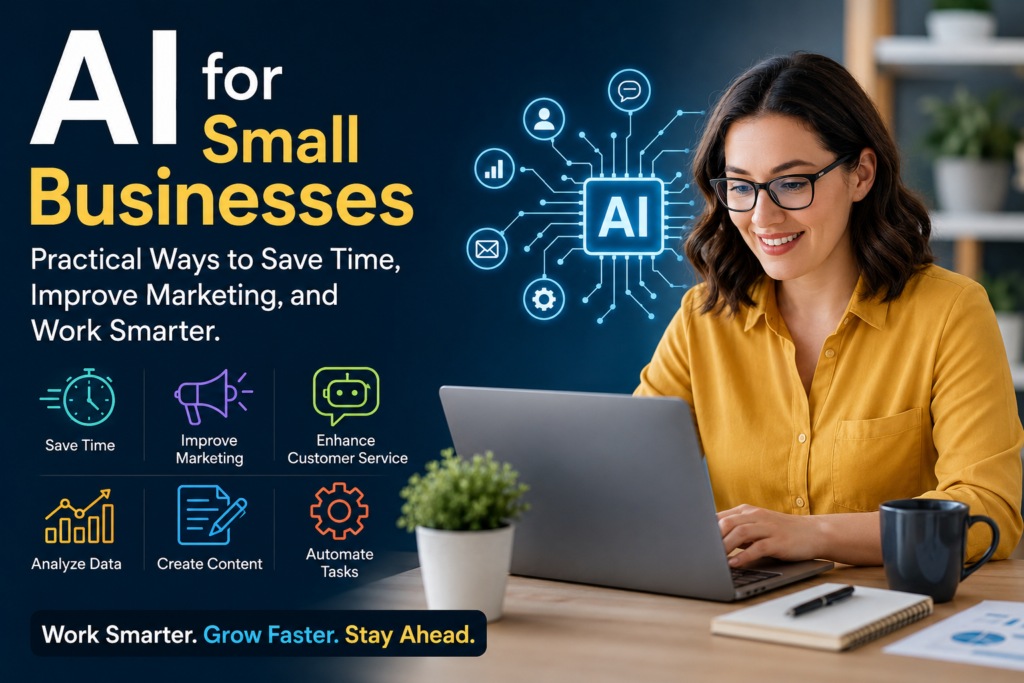

Artificial intelligence (AI) is no longer limited to large technology companies or specialized research laboratories. Today, small businesses can use AI-powered tools to support everyday tasks such as writing, marketing, customer communication, research, planning, and data analysis.
For a small business owner, the value of AI is not necessarily about replacing people. In many situations, it is about helping people complete repetitive tasks more efficiently and spend more time on activities that require human judgment, creativity, communication, and decision-making.
However, AI is not a magic solution. It can produce inaccurate information, misunderstand instructions, and generate content that requires careful review. Businesses also need to consider privacy, security, copyright, and the responsible handling of customer information.
This guide explains practical ways small businesses can use AI, where it can provide value, what its limitations are, and how to introduce it responsibly.
What Is AI for Small Businesses?
AI for small businesses refers to using artificial intelligence tools to assist with business activities.
These tools can perform or support tasks such as:
- Drafting written content
- Summarizing information
- Generating ideas
- Analyzing data
- Creating marketing materials
- Organizing information
- Answering common customer questions
- Translating or improving text
- Supporting business research
- Automating certain repetitive workflows
The exact capabilities depend on the AI system being used.
The important point is that AI should generally be treated as a business assistant rather than an unquestionable source of truth.
A business owner can use AI to produce a first draft, identify ideas, or organize information, while a person remains responsible for checking the result.
Why Should Small Businesses Consider AI?
Small businesses often operate with limited time, staff, and resources. Owners may have to handle marketing, customer service, administration, sales, and operations at the same time.
AI can potentially help reduce the amount of time spent on repetitive tasks.
For example, instead of starting a marketing article from a blank page, a business owner could ask an AI tool to suggest an outline. The owner can then review the suggestions, add business-specific knowledge, correct mistakes, and create the final article.
This approach uses AI for assistance while keeping human oversight at the center.
1. Save Time on Repetitive Tasks
One of the most practical applications of AI is helping with repetitive work.
Examples include:
- Creating draft emails
- Summarizing meeting notes
- Organizing information
- Creating content outlines
- Generating brainstorming ideas
- Rewriting text for clarity
- Preparing draft descriptions
Saving time on these activities can allow business owners and employees to focus on higher-value work.
2. Support Digital Marketing
AI can assist businesses with many parts of their digital marketing process.
For example, it can help generate:
- Blog topic ideas
- Social media concepts
- Content calendars
- Product descriptions
- Email newsletter drafts
- Advertisement variations
- Frequently asked questions
However, businesses should avoid publishing AI-generated material without reviewing it.
Good marketing content should reflect the company’s actual products, services, customers, experience, and values.
3. Improve Customer Communication
AI can help businesses prepare responses to common questions.
For example, a company may use AI to draft answers about:
- Opening hours
- Services
- Delivery procedures
- Appointment processes
- Return policies
- General product information
Businesses should be particularly careful when AI is used for customer-facing communication. Incorrect information can create confusion and damage trust.
For important or sensitive questions, a human employee should review the response before it is sent.
10 Practical Ways Small Businesses Can Use AI
1. Create Content Ideas
Coming up with new content ideas can be difficult when a business needs to publish regularly.
AI can help brainstorm topics based on a company’s products, services, and audience.
For example, a home-improvement company could ask AI to generate article ideas around:
- Choosing the right flooring
- Preparing a home for renovation
- Common maintenance mistakes
- Questions customers should ask before hiring a contractor
The business should then select topics that are genuinely useful to its audience.
2. Draft Social Media Posts
AI can help create initial drafts for social media content.
A business could provide information about a new service and ask for several possible post formats.
The final post should still be reviewed for:
- Accuracy
- Tone
- Brand identity
- Pricing
- Dates
- Contact information
AI should not be trusted to automatically know current business information unless that information has been supplied and verified.
3. Write and Improve Emails
Business owners frequently write emails to customers, suppliers, employees, and partners.
AI can help create a professional first draft or improve clarity.
For example, a short instruction such as:
“Write a polite email explaining that an order will be delayed.”
can produce a starting point that the user can then personalize.
The business should check names, dates, prices, commitments, and other important details before sending the message.
4. Summarize Long Information
AI can be useful for summarizing lengthy documents, meeting notes, reports, or internal information.
A summary can help a business owner quickly identify:
- Main points
- Action items
- Questions
- Decisions
- Important themes
However, summaries should not automatically replace reviewing important original documents, particularly when contracts, financial documents, legal information, or other high-consequence material are involved.
5. Analyze Business Data
AI can assist with interpreting structured business information.
For example, a business could use an appropriate AI system to help identify patterns in:
- Sales records
- Customer feedback
- Website performance
- Inventory information
- Marketing results
The quality of the analysis depends heavily on the quality and completeness of the underlying data.
AI-generated conclusions should therefore be checked against the original data.
6. Research Customer Questions
Businesses can use AI to brainstorm questions customers might have about their products or services.
For example, a computer retailer might identify questions such as:
- Which laptop is suitable for office work?
- How much storage does a typical user need?
- What should customers consider before buying a monitor?
These questions can become useful website content or customer education materials.
AI can help identify possibilities, but businesses should verify factual information using reliable sources before publishing it.
7. Translate and Improve Business Communication
AI language tools can help businesses create initial translations or improve writing.
This can be particularly useful when communicating with customers who speak different languages.
However, important legal, contractual, medical, financial, or official documents may require qualified human translation or professional review rather than relying solely on AI.
8. Create Business Templates
AI can help create reusable templates for routine business communication.
Examples include:
- Customer inquiry responses
- Meeting agendas
- Internal announcements
- Follow-up emails
- Content briefs
- Project checklists
- Basic customer feedback forms
Templates can make routine communication more consistent while still allowing employees to personalize each message.
9. Brainstorm New Business Ideas
Entrepreneurs can use AI as a brainstorming partner.
For example, a person interested in starting a local business could ask AI to compare different business concepts based on factors such as:
- Target customers
- Required skills
- Possible operating costs
- Competition
- Marketing channels
- Operational requirements
AI should be used to generate possibilities rather than treated as proof that a business idea will succeed.
Real-world market research remains important.
10. Build a Simple Content Calendar
Consistency can be challenging for small businesses.
AI can help create a draft monthly content calendar containing ideas for:
- Blog articles
- Social media posts
- Educational videos
- Email newsletters
- Product announcements
The business can then modify the calendar according to its actual campaigns, seasonal activities, customers, and resources.
AI and Digital Marketing: How They Work Together
AI and digital marketing are closely connected.
A business using digital marketing may have to create content, analyze performance, research customer questions, manage campaigns, and communicate with audiences.
AI can support some of these tasks.
For example:
Business goal → Audience research → Content ideas → Draft content → Human review → Publishing → Performance measurement → Improvement
AI can assist at several points in this process, but the business remains responsible for the strategy and final decisions.
AI Can Help With SEO—but It Does Not Replace Quality
AI can generate topic ideas, suggest headings, identify related questions, and help organize content.
However, simply producing large quantities of AI-generated articles is not a reliable content strategy.
A strong article should provide information that is useful to readers, demonstrate appropriate expertise, contain accurate information, and be relevant to the audience.
The goal should be better content, not simply more content.
AI Tools for Small Businesses
There are many categories of AI-powered tools available to businesses.
Writing and Productivity Tools
Useful for:
- Drafting
- Editing
- Summarizing
- Brainstorming
- Organizing information
Design and Creative Tools
Useful for:
- Creating visual concepts
- Generating design ideas
- Preparing marketing materials
- Editing images
Customer Service Tools
Useful for:
- Frequently asked questions
- Initial customer support
- Routing inquiries
- Drafting responses
Data and Analytics Tools
Useful for:
- Finding patterns
- Summarizing datasets
- Creating analytical questions
- Supporting reporting
Businesses should evaluate tools carefully rather than selecting them solely because they are popular.
Important considerations include:
- Cost
- Ease of use
- Data privacy
- Security
- Integration with existing systems
- Accuracy
- Customer support
- Contract terms
What Are the Risks of Using AI in Business?
AI can provide useful assistance, but responsible use requires understanding its limitations.
1. AI Can Make Mistakes
AI systems can generate information that sounds convincing but is incorrect.
This is sometimes described as an AI “hallucination.”
For business use, important facts should be verified before publication or action.
2. Privacy and Confidentiality
Businesses should be careful about entering confidential information into AI systems.
Potentially sensitive information can include:
- Customer personal information
- Passwords
- Financial information
- Confidential contracts
- Private employee information
- Business secrets
Before using an AI service, businesses should understand its data-handling practices and applicable privacy requirements.
3. Security Risks
AI tools can become part of a broader business technology environment.
Businesses should use appropriate account security, access controls, strong passwords, and other reasonable security practices.
Employees should also understand what information they are permitted to share with AI tools.
4. Copyright and Intellectual Property
AI-generated material can raise questions about ownership, licensing, and the use of third-party material.
Businesses should review the terms of the AI service they use and ensure that published materials are appropriate for their intended use.
Where necessary, professional legal advice may be appropriate.
5. Overdependence on AI
A business can become less effective if employees stop thinking critically and simply accept AI outputs.
AI should support human skills rather than eliminate the need for judgment.
AI vs. Traditional Business Work
AI does not have to replace existing business processes.
A better way to think about it is:
| Traditional Approach | AI-Assisted Approach |
|---|---|
| Start every document from scratch | Generate a draft and edit it |
| Brainstorm manually | Use AI for additional ideas |
| Read long notes to identify action items | Generate a summary for review |
| Create every content idea manually | Generate ideas and select the useful ones |
| Analyze information manually | Use AI to identify possible patterns, then verify |
| Write repetitive responses | Create response templates for review |
The AI-assisted approach can save time, but human review remains important.
How to Start Using AI in a Small Business
You do not need to introduce AI everywhere at once.
Step 1: Identify Repetitive Tasks
Make a list of activities that consume time without requiring significant strategic judgment.
Step 2: Select One Suitable Use Case
Start with a relatively low-risk activity, such as brainstorming, drafting internal documents, or creating content outlines.
Step 3: Establish Basic Rules
Decide what employees can and cannot enter into AI systems.
For example, confidential customer information may need to remain outside general-purpose AI tools.
Step 4: Review the Results
Compare AI-assisted work with your existing process.
Ask:
- Did it save time?
- Was the result accurate?
- Did it require substantial editing?
- Did it improve the final output?
- Were there privacy or security concerns?
Step 5: Expand Carefully
If the initial use case works well, consider applying AI to another appropriate business process.
This gradual approach can help businesses learn what works without making unnecessary changes across the entire organization.
How to Get Better Results From AI
The quality of an AI response often depends on the information provided to the system.
Instead of writing:
“Write a marketing post.”
provide more context:
“Write a professional 100-word social media post for a small local bakery introducing its new breakfast menu. Use a friendly tone and include a simple invitation to visit the shop. Do not make claims about health benefits.”
The second instruction provides clearer context and constraints.
Businesses can improve AI-assisted work by specifying:
- The objective
- Target audience
- Desired format
- Tone
- Length
- Important facts
- Restrictions
- Examples where appropriate
Always review the result before using it publicly.
How Much Does AI Cost for a Small Business?
AI costs vary considerably.
Some services provide free access with limitations, while others use subscriptions, usage-based pricing, business plans, or other pricing structures.
The cost can also include:
- Employee training
- Integration
- Software subscriptions
- Data preparation
- Security measures
- Professional support
Businesses should evaluate the total cost and practical benefit, rather than assuming that the most expensive AI tool is the best option.
A simple tool that solves one recurring problem may provide more practical value than a complex system that employees rarely use.
Common Mistakes Businesses Should Avoid
Using AI Without Human Review
AI-generated information should be checked, especially when accuracy matters.
Entering Confidential Information
Employees should understand the organization’s rules about sensitive and confidential data.
Publishing Generic AI Content
Readers can often benefit more from content that includes genuine business knowledge, useful examples, clear explanations, and original insights.
Buying Too Many AI Tools
Using several tools with overlapping features can increase costs and complexity.
Start with a specific problem and choose a tool that addresses it.
Expecting AI to Run the Business
AI can assist with tasks, but important business decisions require context, accountability, experience, and human judgment.
Frequently Asked Questions
1. Is AI useful for small businesses?
Yes. AI can assist small businesses with tasks such as writing, brainstorming, summarization, customer communication, marketing, and data analysis. The usefulness depends on the business and how the technology is implemented.
2. Can AI replace employees in a small business?
AI can automate or assist with certain tasks, but that does not mean it can replace all human work. Many business activities require judgment, communication, creativity, accountability, and knowledge of the specific organization.
3. Is AI-generated content good for SEO?
AI can assist with content creation, but using AI alone does not make content valuable or successful in search results. Businesses should focus on accurate, useful, original, people-first content and review AI-generated material carefully.
4. Is it safe to put customer information into an AI tool?
Not necessarily. Businesses should understand the specific AI service’s data practices, security controls, terms, and applicable privacy requirements before entering customer or confidential information. Sensitive information should be handled cautiously.
5. What is the easiest way for a small business to start using AI?
Start with one repetitive, relatively low-risk task. For example, use AI to brainstorm content ideas, draft routine emails, summarize internal notes, or create document outlines. Measure whether it actually saves time and improves the workflow before expanding its use.
Conclusion
AI can be a practical addition to a small business when it is used thoughtfully. It can help with repetitive work, content creation, marketing, research, communication, and certain forms of data analysis.
But effective AI adoption is not simply about finding the newest tool. Businesses need to identify real problems, choose appropriate solutions, protect sensitive information, verify important outputs, and maintain human oversight.
The best starting point is often a small one: choose a repetitive task, test an AI-assisted workflow, measure the result, and improve the process based on experience.
Used responsibly, AI can become a useful assistant that helps small businesses work more efficiently while allowing people to remain responsible for the decisions that matter.