
Marketing teams are expected to produce more content across more channels than ever. Blog posts, email campaigns, social media updates, product descriptions, advertisements, landing pages, and other marketing materials can take significant time to research and write.
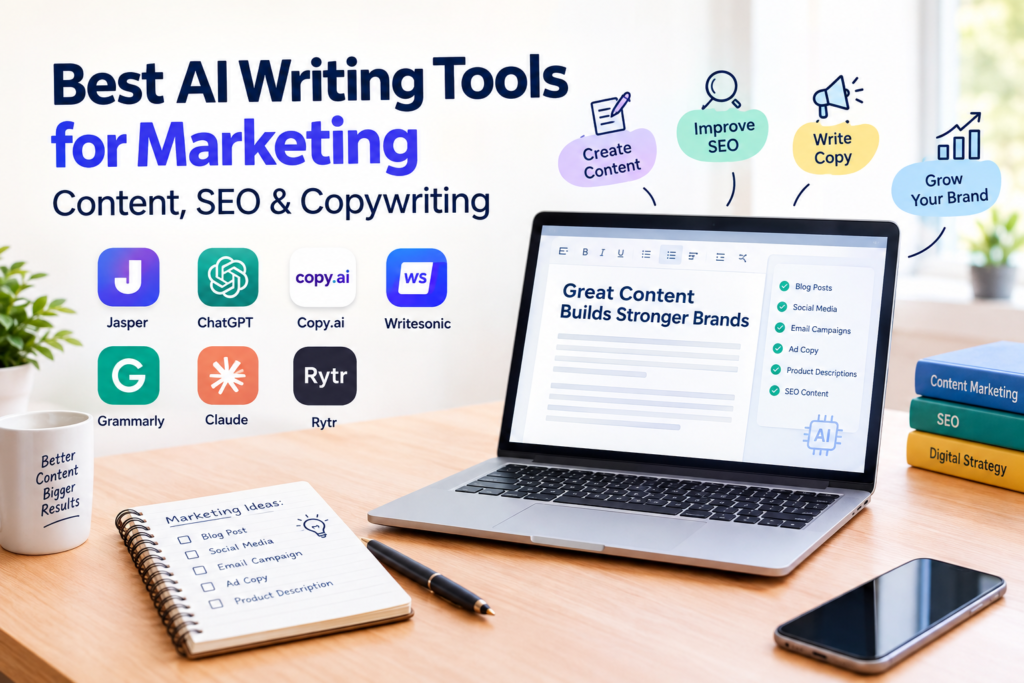
The Best AI Writing Tools for Marketing can help reduce the time spent on repetitive writing tasks. However, an AI tool should be treated as a writing assistant rather than a replacement for marketing expertise. Good results still depend on a clear strategy, accurate information, brand guidelines, human editing, and an understanding of the target audience.
This guide compares several popular AI writing and marketing platforms, explains what each is useful for, and highlights the limitations marketers should consider before choosing one.
What Are AI Writing Tools for Marketing?
AI writing tools use artificial intelligence to help users create, rewrite, organize, or improve written content.
For marketers, these tools can assist with tasks such as:
- Creating blog post outlines
- Drafting marketing articles
- Writing social media captions
- Generating email ideas
- Creating advertising copy
- Rewriting existing content
- Improving grammar and clarity
- Developing product descriptions
- Brainstorming headlines
- Adapting content for different audiences
- Repurposing longer content into shorter formats
Some platforms are general-purpose AI assistants, while others are specifically designed around marketing workflows, brand voice, SEO, or content production.
Best AI Writing Tools for Marketing at a Glance
There is no single tool that is best for every marketer. The right choice depends on the type of content you create and how much workflow support you need.
| Tool | Best For | Key Strength |
|---|---|---|
| Jasper | Marketing teams and brand-focused content | Brand voice and marketing workflows |
| ChatGPT | Flexible writing and brainstorming | Broad range of writing tasks |
| Copy.ai | Go-to-market and sales workflows | Workflow automation |
| Writesonic | SEO-focused content production | Content and SEO-oriented features |
| Grammarly | Editing and improving existing content | Grammar, clarity, tone, and rewriting |
| Claude | Long-form drafting and refinement | Natural writing and detailed instructions |
| Rytr | Simple and budget-conscious writing assistance | Straightforward short-form content |
Features and pricing can change, so check each provider’s official website before subscribing.
1. Jasper
Jasper is an AI platform built specifically around marketing work. Its current platform includes features for brand voice, style guidelines, audience information, knowledge, marketing workflows, and AI agents.
One of Jasper’s useful features for marketing teams is its Brand Voice capability. Users can provide examples of their existing content so the system can better reflect the desired tone and style.
Best for
Jasper can be particularly useful for:
- Marketing departments
- Agencies
- Brand teams
- Multi-channel campaigns
- Businesses producing content at scale
Advantages
- Designed specifically for marketing use cases
- Brand voice and style controls
- Marketing-focused workflows
- Supports different content formats
- Useful for maintaining consistency across teams
Limitations
Jasper may be more than a solo marketer needs if the main requirement is simply generating occasional blog ideas or rewriting a few paragraphs.
Businesses should also review current pricing and included features before purchasing because software plans can change.
2. ChatGPT
ChatGPT is a general-purpose AI assistant that can also be useful for marketing writing. It can help draft content, rewrite existing material, adjust tone, organize ideas, and turn rough notes into clearer communication.
For marketers, its flexibility is one of its biggest advantages.
Best for
ChatGPT can be useful for:
- Brainstorming content ideas
- Creating outlines
- Drafting blog posts
- Writing email variations
- Creating social media concepts
- Rewriting content
- Developing campaign ideas
- Summarizing marketing information
- Creating first drafts
Advantages
- Flexible for many types of marketing tasks
- Useful for brainstorming and drafting
- Can adapt writing to different audiences
- Helpful for transforming existing material
- Suitable for both simple and more complex writing tasks
Limitations
Because it is general-purpose, it may require more detailed instructions than a specialized marketing platform. Marketers also need to fact-check important claims and make sure the final content follows their brand guidelines.
3. Copy.ai
Copy.ai has developed beyond basic copy generation and now emphasizes go-to-market (GTM) workflows. Its platform allows users to create workflows that combine research, content generation, and integrations for marketing and sales processes.
Best for
Copy.ai may be suitable for teams working on:
- Sales and marketing operations
- Repetitive content workflows
- Lead-related processes
- Go-to-market campaigns
- Marketing automation
Advantages
- Workflow-oriented approach
- Useful for repeatable marketing processes
- Can combine multiple AI actions
- Designed for broader GTM operations
Limitations
If you only want a simple AI writer for occasional blog posts, a workflow-focused platform may offer more functionality than you actually need.
4. Writesonic
Writesonic is another option for marketers interested in AI-assisted content creation and SEO-oriented workflows.
It can be useful when a content team needs to move from an idea or brief toward a structured article draft.
Best for
Writesonic may be worth considering for:
- SEO content
- Blog articles
- Marketing content
- Content teams
- Website publishing workflows
Advantages
- Focus on content production
- Useful for structured long-form content
- SEO-related functionality
- Can support content teams producing articles regularly
Limitations
AI-generated articles still require editorial review. Search optimization does not automatically make an article useful, accurate, original, or valuable to readers.
Before subscribing, review the current feature set and pricing because these can change over time.
5. Grammarly
Grammarly is especially useful when the main challenge is improving existing writing rather than producing a complete article from scratch.
Its current AI writing tools can help with drafting, rewriting, tone, grammar, clarity, and word choice.
Best for
Grammarly is useful for:
- Editing marketing copy
- Improving grammar
- Checking clarity
- Adjusting tone
- Refining emails
- Polishing website copy
- Reviewing social media content
Advantages
- Strong editing capabilities
- Useful for polishing existing drafts
- Tone and clarity suggestions
- Helpful for professional communication
Limitations
Grammarly is not necessarily the best standalone solution for every long-form content workflow. It can work particularly well as an editing layer alongside another AI writing platform.
6. Claude
Claude can be useful for marketers who want assistance with long-form drafting, rewriting, brainstorming, and working with detailed instructions.
Its usefulness comes from being a flexible writing assistant rather than a marketing-only platform.
Best for
Claude can assist with:
- Long-form articles
- Content editing
- Brainstorming
- Brand messaging drafts
- Marketing research organization
- Rewriting and refinement
Advantages
- Flexible writing assistance
- Useful for detailed instructions
- Can help organize complex ideas
- Suitable for drafting and editing
Limitations
Like other general AI assistants, Claude does not eliminate the need for human review. Marketers should verify factual claims, product information, statistics, and other details before publishing.
7. Rytr
Rytr is designed as a straightforward AI writing assistant for creating different types of short-form and marketing content.
It can be considered by individuals who want a simpler writing tool without the broader workflow requirements of enterprise marketing platforms.
Best for
Rytr may suit:
- Freelancers
- Bloggers
- Small businesses
- Solo marketers
- Short-form content creation
Advantages
- Simple approach
- Useful for short-form content
- Suitable for brainstorming and first drafts
- Can be easier to approach for beginners
Limitations
Users with complex team workflows, advanced brand management requirements, or extensive marketing operations may eventually need a more specialized platform.
How to Choose the Best AI Writing Tool for Marketing
Instead of choosing a tool simply because it appears on a “best” list, start by identifying your actual writing problems.
1. Identify the Content You Produce Most Often
Think about your regular workload.
Do you primarily create:
- Blog posts?
- Social media content?
- Email campaigns?
- Advertisements?
- Product descriptions?
- Landing pages?
- Sales materials?
A tool that works well for social media copy may not be the best option for a large SEO content operation.
2. Consider Brand Voice
Brand consistency becomes more important when several people or AI tools contribute to your content.
Look for features that allow you to provide:
- Brand guidelines
- Tone preferences
- Examples of existing content
- Product information
- Audience information
- Words or phrases to avoid
For example, Jasper provides dedicated brand voice and brand intelligence features designed to apply brand information to generated content.
3. Check Editing Requirements
The best AI-generated draft is not necessarily the best final article.
Before publishing, review:
- Facts
- Names
- Numbers
- Links
- Product claims
- Grammar
- Tone
- Repetition
- Originality
- Brand consistency
A tool that produces a slightly less impressive first draft but saves substantial editing time may be more useful than one that produces longer text that requires extensive correction.
4. Consider SEO Features Carefully
Some AI writing platforms include SEO-related features, but SEO should not be reduced to inserting keywords into an article.
A strong marketing article should:
- Address a genuine reader need
- Use a clear structure
- Answer relevant questions
- Provide useful information
- Use descriptive headings
- Avoid unnecessary repetition
- Demonstrate expertise where appropriate
- Be factually accurate
AI can assist with parts of this process, but it should not replace editorial judgment.
5. Compare the Total Cost
Do not compare tools based only on their monthly subscription price.
Consider the total workflow.
For example, a marketing team may need:
- An AI writing tool
- An SEO platform
- An editing tool
- Image creation software
- Project management software
A more expensive writing platform may make sense if it replaces several other tools, while a lower-cost general AI assistant may be sufficient for a small business.
Always check the provider’s current pricing page before making a purchase.
A Practical AI Writing Workflow for Marketers
AI becomes more useful when it is part of a controlled workflow rather than an automatic publishing system.
Step 1: Start With a Clear Brief
Define:
- Target audience
- Topic
- Search intent
- Main objective
- Desired tone
- Content format
- Key information
- Call to action
A detailed brief generally gives the AI more useful direction than a vague request.
Step 2: Research the Subject
Gather reliable information before asking AI to draft.
For product-related content, use official product documentation. For current information, verify details using reliable and up-to-date sources.
Step 3: Create an Outline
Ask the tool to organize the subject into logical sections.
Review the outline before generating the full draft.
Step 4: Generate a First Draft
Use the AI to overcome the blank page and create a working draft.
Do not assume the first output is ready for publication.
Step 5: Add Human Expertise
This is one of the most important steps.
Add:
- Original insights
- Relevant examples
- Accurate product information
- Your brand’s perspective
- Useful explanations
- Real-world context
The goal should be to make the content more useful, not simply longer.
Step 6: Fact-Check the Content
AI systems can produce incorrect information or outdated details.
Verify important claims before publishing, especially:
- Prices
- Features
- Statistics
- Dates
- Product specifications
- Legal or regulatory information
- Company information
Step 7: Edit for Readers
Read the article as if you were the target customer.
Remove unnecessary sentences, repetition, vague claims, and unsupported statements.
Step 8: Optimize and Publish
Only after the content is useful and accurate should you review SEO elements such as:
- Title
- Headings
- Meta description
- URL
- Internal links
- Relevant keywords
- Image descriptions
Benefits of Using AI Writing Tools for Marketing
Faster First Drafts
AI can help marketers move from a blank page to a structured draft more quickly.
More Ideas
When a campaign needs multiple concepts, AI can help brainstorm headlines, angles, content formats, and variations.
Easier Content Repurposing
A long article can be transformed into shorter formats such as social posts, email ideas, or content briefs.
Consistent Formatting
Templates and reusable instructions can help teams maintain a consistent structure across recurring content.
Support for Small Marketing Teams
Small teams may use AI to handle some repetitive writing tasks while keeping strategic decisions and final approval with people.
Limitations and Risks of AI Writing
AI writing tools are useful, but they are not perfect.
AI Can Make Factual Errors
Generated content may contain incorrect information, outdated details, or unsupported claims.
Human fact-checking remains important.
Content Can Sound Generic
If every article uses the same predictable wording and structure, the result may feel repetitive.
Adding original information and a distinct brand voice can make the content more useful.
AI Does Not Replace Marketing Strategy
An AI writer can generate copy, but it does not automatically know:
- Your business priorities
- Your customers’ real concerns
- Your competitive position
- Your conversion process
- Your brand’s long-term strategy
Those decisions still require human judgment.
Privacy Should Be Considered
Before uploading confidential business information, review the AI provider’s privacy, security, and data-handling policies.
Businesses should avoid sharing sensitive information unless they understand how the service handles that data.
How to Get Better Results From AI Writing Tools
Give Specific Instructions
Instead of asking:
“Write a marketing article.”
Provide information about the audience, objective, topic, tone, structure, and required information.
Provide Brand Context
If the platform supports brand guidelines or knowledge, provide accurate information about your business.
Ask for Structure Before Full Content
Creating an outline first makes it easier to identify missing sections or unnecessary topics.
Use AI for Assistance, Not Automatic Publishing
A strong workflow is usually:
Research → Brief → AI Draft → Human Review → Fact-Check → Edit → SEO Review → Publish
This approach keeps the marketer in control.
Which AI Writing Tool Should You Choose?
The answer depends on your needs.
Choose Jasper if your marketing team prioritizes brand consistency, marketing workflows, and content production across channels. Its current platform is heavily focused on marketing operations and brand intelligence.
Choose ChatGPT if you want a flexible general-purpose AI assistant for brainstorming, drafting, rewriting, and many other marketing tasks.
Choose Copy.ai if your main interest is connecting AI with repeatable go-to-market workflows and sales or marketing processes.
Choose Writesonic if SEO-oriented content production is an important part of your workflow.
Choose Grammarly if you already write your content yourself and mainly need help with grammar, clarity, tone, and polishing.
Choose Claude if you want a flexible assistant for detailed writing, long-form drafts, and content refinement.
Choose Rytr if you want a simpler option for basic marketing and short-form writing tasks.
Frequently Asked Questions
1. What is the best AI writing tool for marketing?
There is no universal winner. Jasper is a strong option for marketing teams focused on brand consistency and marketing workflows, while ChatGPT and Claude offer broader writing flexibility. Writesonic may be useful for SEO-oriented content, and Grammarly is particularly useful for editing.
2. Can AI writing tools replace marketing writers?
Generally, they are better viewed as assistants rather than replacements. AI can help with drafting and repetitive tasks, while marketers provide strategy, research, judgment, fact-checking, brand knowledge, and final editorial decisions.
3. Are AI-written marketing articles good for SEO?
AI can help create structured and useful drafts, but simply generating an article does not guarantee search visibility. Content should provide genuine value, satisfy the reader’s intent, be accurate, and be edited before publication.
4. Should marketers use more than one AI writing tool?
They can, depending on their workflow. For example, one platform may be useful for generating a draft while another is better for editing. However, using multiple subscriptions is not automatically better. Choose tools based on actual needs.
5. What should I check before paying for an AI writing tool?
Review the current pricing, usage limits, features, integrations, privacy policies, cancellation terms, and available support. Most importantly, test the tool with a real marketing task before committing to a long-term subscription.
Conclusion
The Best AI Writing Tools for Marketing are not necessarily the tools that generate the most words or promise the fastest content production. The better choice is the platform that fits your actual workflow and helps you create clearer, more useful, and more consistent marketing content.
Jasper is worth considering for marketing teams that need strong brand and workflow controls. ChatGPT and Claude offer flexible assistance across many writing tasks. Copy.ai is oriented toward go-to-market workflows, while Writesonic can be useful for SEO-focused content production. Grammarly is particularly valuable for editing and polishing existing drafts.
Whatever tool you choose, keep human review at the center of the process. Use AI to assist with research organization, brainstorming, drafting, rewriting, and repetitive work—but verify important information and make the final content genuinely useful to your audience.