
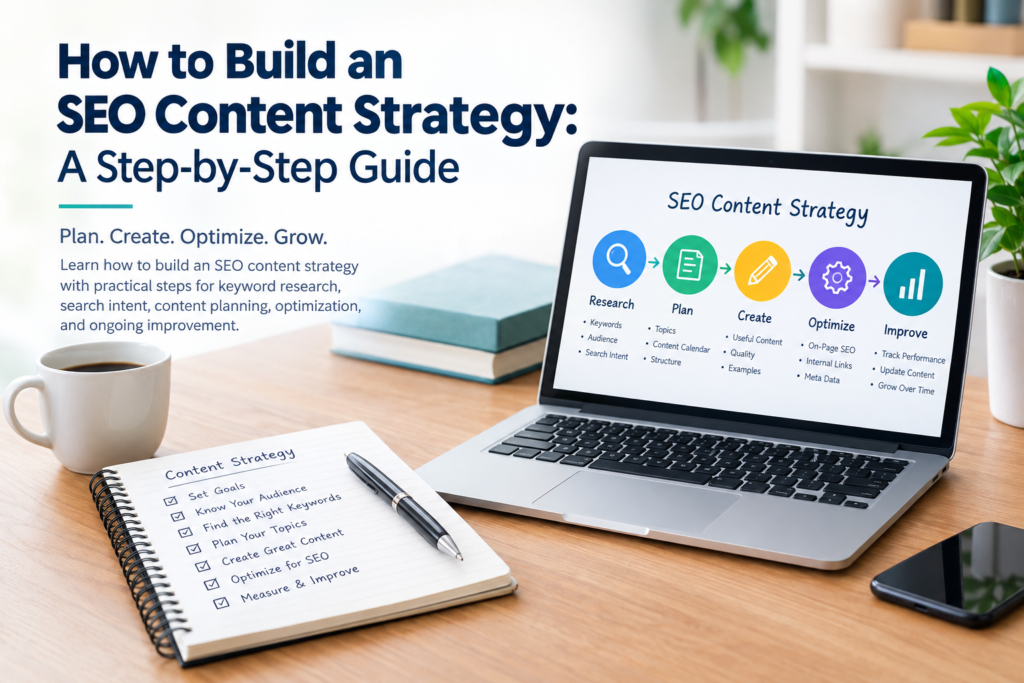

Creating content without a clear plan can quickly become inefficient. A business may publish blog posts regularly but still struggle to reach the right audience, answer important questions, or support its broader marketing goals.
That is why learning how to build an SEO content strategy is important for businesses, publishers, and content teams that want their websites to be useful, organized, and discoverable in search engines.
An effective SEO content strategy is more than choosing keywords and publishing articles. It involves understanding your audience, identifying relevant topics, matching content to search intent, creating genuinely useful resources, maintaining quality, and reviewing performance over time.
This guide explains how to build an SEO content strategy from the ground up, including keyword research, topic planning, content creation, optimization, measurement, and common mistakes to avoid.
What Is an SEO Content Strategy?
An SEO content strategy is a structured approach to planning, creating, optimizing, publishing, and maintaining website content with both users and search engines in mind.
The purpose is not simply to rank for as many keywords as possible. Instead, the strategy should help your website consistently provide useful answers, information, guidance, or solutions for the people you want to reach.
A basic SEO content strategy connects several elements:
- Audience needs
- Business goals
- Search topics and keywords
- Search intent
- Content formats
- Website structure
- Internal linking
- Content quality
- Performance measurement
- Content updates
For example, a software company might create content that explains how to choose accounting software, compares different approaches, answers common implementation questions, and provides practical guidance for small businesses.
The exact strategy will vary depending on the website, industry, audience, resources, and goals.
Why an SEO Content Strategy Matters
Publishing content without a strategy can lead to several problems.
You may cover the same topic repeatedly, create content that attracts the wrong audience, target topics that do not fit your business, or spend significant time producing articles that provide limited value.
A documented strategy helps create consistency.
It Helps You Understand Your Audience
Good content begins with understanding what readers need.
Instead of asking only, “What keyword should we target?” consider questions such as:
- What problems does our audience have?
- What information are they looking for?
- What questions do they ask before making a decision?
- What level of knowledge do they have?
- Which topics are important to their goals?
- What information would make the subject easier to understand?
These questions can lead to more useful content ideas than keyword volume alone.
It Creates a More Organized Website
A strategy can help you organize related topics into logical groups.
For example, a marketing website could have a broader topic around SEO and supporting content about:
- Keyword research
- Technical SEO
- On-page SEO
- Content optimization
- Internal linking
- SEO reporting
- Local SEO
- Content strategy
This type of organization can make the website easier for visitors to navigate and easier for search engines to understand.
It Helps You Prioritize Content
Most websites have limited time and resources.
A content strategy helps determine which topics deserve attention first instead of publishing articles simply because they are easy to produce.
How to Build an SEO Content Strategy Step by Step
A practical strategy can be developed through a series of connected steps.
1. Define Your Content Goals
Start by determining what you want your content to accomplish.
Different websites may have different objectives. For example, content may be designed to:
- Educate potential customers
- Answer existing customers’ questions
- Build topical expertise
- Support product or service discovery
- Generate qualified leads
- Strengthen brand visibility
- Help users complete tasks
- Support other marketing activities
Your goals should influence the types of topics you create.
For example, an article designed to educate beginners may be very different from a comparison page intended for people evaluating several software products.
A useful content strategy does not treat every page as if it has the same purpose.
2. Define Your Target Audience
The next step is to understand who you are creating content for.
Create a simple audience profile based on information relevant to your business.
Consider:
- Industry or profession
- Experience level
- Common challenges
- Goals
- Questions
- Buying considerations
- Preferred content formats
- Problems your website can realistically help solve
Avoid creating an imaginary audience based on unsupported assumptions.
Use information from customer conversations, website analytics, support questions, sales teams, surveys, or other legitimate sources when available.
Example
Suppose you operate a website focused on software for small businesses.
Your audience may include business owners who want to:
- Reduce repetitive administrative work
- Manage customer information
- Track invoices
- Improve team collaboration
- Understand software options
- Choose tools within a limited budget
Those needs can become the foundation for your content plan.
3. Choose Your Core Topics
Before collecting hundreds of individual keywords, identify the major subjects your website should be associated with.
These are sometimes called pillar topics or content pillars.
For a marketing website, core topics might include:
- SEO
- Content marketing
- Email marketing
- Social media marketing
- Marketing automation
- Lead generation
- Analytics
The topics should be closely connected to your audience and the purpose of your website.
A website should not publish unrelated content simply because a particular topic appears popular.
4. Conduct Keyword Research
Keyword research helps identify the words and phrases people use when searching for information.
However, keywords should be treated as clues about user needs rather than targets to insert repeatedly into an article.
Look for a mixture of:
- Broad topics
- Specific questions
- Long-tail searches
- Problem-focused phrases
- Comparison searches
- “How to” searches
- Definition searches
- Product or service research queries
For example, a broad keyword might be:
SEO content strategy
More specific searches could include:
- How to create an SEO content strategy
- SEO content planning process
- How to plan content for SEO
- SEO content calendar
- Content strategy for small business
The specific opportunities will depend on your audience and niche.
5. Understand Search Intent
One of the most important parts of learning how to build an SEO content strategy is understanding search intent.
Search intent refers to the underlying purpose behind a search.
Common categories include:
Informational Intent
The person wants to learn something.
Examples:
- What is technical SEO?
- How does keyword research work?
- What is a content audit?
Navigational Intent
The person is looking for a particular website, page, or resource.
Examples might include searches for a specific company’s website or documentation page.
Commercial Investigation
The person is researching options before making a decision.
Examples:
- Best CRM software for small business
- Project management software comparison
- Email marketing tools for startups
Transactional Intent
The person is ready to take an action such as purchasing, subscribing, downloading, or signing up.
Understanding intent helps determine the appropriate content format.
A question asking “What is SEO?” usually requires educational content. A query comparing two software products may require a detailed comparison instead.
6. Map Topics to the Customer Journey
Not every visitor is at the same stage.
Your content strategy can include material for different stages of the decision process.
Awareness
The reader is identifying a problem or learning about a subject.
Useful formats include:
- Beginner guides
- Definitions
- Educational articles
- Problem-solving content
Consideration
The reader understands the problem and is evaluating possible approaches.
Useful formats include:
- Comparisons
- Detailed guides
- Checklists
- Software evaluations
- Use-case articles
Decision
The reader is closer to taking action.
Useful formats may include:
- Product information
- Pricing explanations
- Implementation guides
- Service comparisons
- Frequently asked questions
Retention and Support
Existing customers or users may need help after making a decision.
Useful content can include:
- Tutorials
- Troubleshooting guides
- Documentation
- Best-practice articles
- Advanced guides
This approach prevents a website from producing only introductory content.
7. Build Topic Clusters
Instead of treating every article as an isolated page, organize related content around broader subjects.
For example:
Pillar topic: SEO Content Strategy
Supporting articles could include:
- How to Conduct Keyword Research
- How to Identify Search Intent
- How to Create a Content Calendar
- How to Optimize Blog Posts
- How to Build an Internal Linking Strategy
- How to Conduct a Content Audit
The pages can be connected through relevant internal links.
The purpose is to create a useful resource structure for readers rather than artificially connecting pages just to influence rankings.
8. Create a Content Calendar
A content calendar turns your strategy into an actionable publishing plan.
Your calendar might include:
| Content Topic | Search Intent | Format | Priority | Target Date | Status |
|---|---|---|---|---|---|
| SEO Content Strategy | Informational | Guide | High | October 5 | Planned |
| Keyword Research Guide | Informational | Tutorial | High | October 12 | Planned |
| SEO Tools Comparison | Commercial | Comparison | Medium | October 19 | Research |
| Content Audit Guide | Informational | Guide | Medium | October 26 | Planned |
You can manage a calendar using a spreadsheet, project management system, or another tool that fits your workflow.
The important part is maintaining a clear process.
9. Create Content That Satisfies the Reader’s Need
Once the topic has been selected, focus on solving the reader’s problem.
A strong article should answer the main question early and then provide enough detail to make the information useful.
Before publishing, ask:
- Does the article answer the intended question?
- Is the explanation easy to understand?
- Does it provide practical information?
- Are important limitations explained?
- Are examples relevant?
- Are claims supported where necessary?
- Does the article avoid unnecessary repetition?
- Is the information current enough for the subject?
Content quality should come before word count.
A 1,200-word article that completely answers a question can be more useful than a much longer article filled with repetition.
10. Optimize the Content Naturally
Once the article is useful, apply basic on-page SEO.
Important elements include:
Title
Create a clear title that communicates what the page is about.
Introduction
Explain the problem or question and tell readers what they can expect from the article.
Headings
Use descriptive H2 and H3 headings to organize information.
URL
Keep the URL relatively short, descriptive, and relevant to the page.
Internal Links
Link to related pages when the additional information genuinely helps the reader.
Images
Use relevant, useful images where they improve understanding.
Add descriptive alternative text when appropriate.
Metadata
Write a useful meta description that accurately describes the page. Avoid treating it as an opportunity to make unsupported promises.
11. Use Internal Linking Strategically
Internal links help visitors discover related information on your website.
For example, an article about SEO content strategy could naturally link to related resources about keyword research, content audits, or internal linking.
Good internal linking should make navigation easier.
Avoid adding large numbers of irrelevant links simply because they contain keywords.
The anchor text should also describe the destination naturally.
For example:
Learn more about keyword research for beginners.
This is generally clearer than using awkward, repetitive keyword phrases throughout the page.
12. Establish a Content Quality Review Process
Before publishing, review every article.
A simple editorial checklist can cover:
Accuracy
- Are factual statements correct?
- Are time-sensitive claims current?
- Are sources reliable when sources are needed?
Clarity
- Is the language easy to understand?
- Are paragraphs reasonably short?
- Are technical concepts explained?
Originality
- Does the article provide its own useful structure and explanation?
- Is it more than a collection of generic statements?
User value
- Does it solve the intended problem?
- Are practical examples included where useful?
SEO
- Is the topic clear?
- Are headings descriptive?
- Is the focus keyword used naturally?
- Are internal links relevant?
Editorial quality
- Are spelling and grammar correct?
- Are unnecessary claims removed?
- Are headings properly organized?
13. Publish Consistently, but Do Not Chase Volume
Consistency is useful, but publishing more articles is not automatically better.
A small website may have limited editorial resources. Producing fewer, well-researched articles can be more manageable than publishing large amounts of shallow content.
Choose a publishing schedule that your team can realistically maintain.
For example, a small business might publish one high-quality article each week and spend additional time updating important existing pages.
The appropriate schedule depends on the website and available resources.
14. Measure Content Performance
After publishing, review how the content performs.
Useful measurements may include:
- Organic search traffic
- Search impressions
- Search clicks
- Click-through rate
- Engagement metrics
- Conversions
- Leads
- Sign-ups
- Assisted conversions
- Internal-link activity
The right metrics depend on the purpose of the page.
For an educational article, traffic and engagement may be useful indicators. For a product comparison page, conversions or qualified visits may be more relevant.
Do not assume that a single metric tells the entire story.
15. Update Existing Content
SEO content strategy is not finished when an article is published.
Some subjects change over time. Software features, pricing, regulations, industry practices, and technical information can become outdated.
Review important content periodically and update it when necessary.
An update might involve:
- Correcting outdated information
- Replacing broken links
- Adding useful information
- Removing irrelevant sections
- Improving explanations
- Updating screenshots
- Reviewing examples
- Improving internal links
Do not change an article merely to make it appear “fresh.” Updates should provide genuine value.
Common SEO Content Strategy Mistakes
Even a well-planned strategy can become ineffective when basic principles are overlooked.
Targeting Keywords Instead of People
A keyword is not the real objective. The reader’s need is.
Start with the question or problem and use keyword research to understand how people search for that information.
Creating Too Many Similar Articles
Publishing several pages that address essentially the same question can create unnecessary duplication.
Before creating a new article, review your existing content.
Ask:
Do we already have a page that adequately answers this question?
If so, improving that page may be more useful than creating another similar one.
Writing Only for Search Engines
Content should be understandable and useful to humans.
Avoid awkward keyword repetition, unnecessary headings, excessive formatting, and paragraphs written primarily to include search phrases.
Ignoring Search Intent
A page can target a relevant phrase and still fail to satisfy the user’s actual need.
Always examine what type of information the searcher is likely seeking.
Publishing Without Reviewing Accuracy
Outdated information can reduce the usefulness of an article, especially in areas that change frequently.
Establish a review process for important content.
Focusing Only on New Content
A growing website should not necessarily publish new articles indefinitely.
Existing pages may contain valuable information that can be improved, consolidated, expanded, or updated.
How to Build an SEO Content Strategy on a Small Budget
You do not necessarily need a large content team to create a structured strategy.
A smaller website can start with:
- A clearly defined audience
- A small number of core topics
- Basic keyword research
- A simple content calendar
- A consistent editorial checklist
- Relevant internal links
- Regular performance reviews
Free or already-available tools can often handle basic planning and measurement.
As the website grows, additional tools may help with keyword research, content management, analytics, collaboration, and reporting.
The important consideration is whether a tool solves a real problem rather than whether it has the largest number of features.
SEO Content Strategy vs. Content Marketing Strategy
These concepts overlap, but they are not exactly the same.
| SEO Content Strategy | Broader Content Marketing Strategy |
|---|---|
| Strong focus on search discovery | Broader focus on audience and business goals |
| Uses search behavior as an important input | May include many distribution channels |
| Often emphasizes search intent and website structure | Can include email, social media, events, and other channels |
| Includes on-page SEO considerations | May extend beyond website optimization |
| Measures organic search performance among other metrics | Can measure performance across multiple channels |
A business may use both approaches together.
SEO can help people discover useful content through search, while broader content marketing can distribute that content through additional channels.
Frequently Asked Questions
1. What is the first step in building an SEO content strategy?
The first step is to define your audience and content goals. Once you understand who you are helping and what you want the content to accomplish, you can identify relevant topics and search opportunities.
2. How often should I publish SEO content?
There is no universal publishing frequency that works for every website. Choose a schedule that allows you to consistently produce accurate, useful content. Quality, relevance, and sustainability are more important than publishing simply to increase volume.
3. How many keywords should an article target?
There is no fixed number. A page should primarily focus on one clear topic and naturally cover related terms that help explain that topic. Avoid forcing keywords into the content when they do not improve the reader’s experience.
4. Should every blog post target a keyword?
Search research can be useful for many pages, but not every piece of content needs to be built around a high-volume keyword. Some content may primarily serve existing customers, answer important questions, support other pages, or address a specialized audience.
5. How long does it take for an SEO content strategy to work?
There is no guaranteed timeframe. Results can vary significantly depending on factors such as the website’s existing authority, competition, content quality, technical condition, topic, search demand, and consistency. SEO should generally be treated as an ongoing process rather than a short-term campaign with guaranteed results.
Conclusion
Learning how to build an SEO content strategy starts with a simple principle: create content around real audience needs rather than around keywords alone.
A practical strategy connects your business goals with audience questions, relevant topics, search intent, useful content, logical website structure, and ongoing measurement.
Start with a manageable group of core topics. Research the questions your audience is actually asking, organize related content, create genuinely useful resources, and review your existing pages regularly.
Most importantly, treat SEO as part of a broader commitment to providing clear and trustworthy information. Search visibility can change over time, but useful content gives your website a stronger foundation for serving readers and supporting long-term marketing goals.