
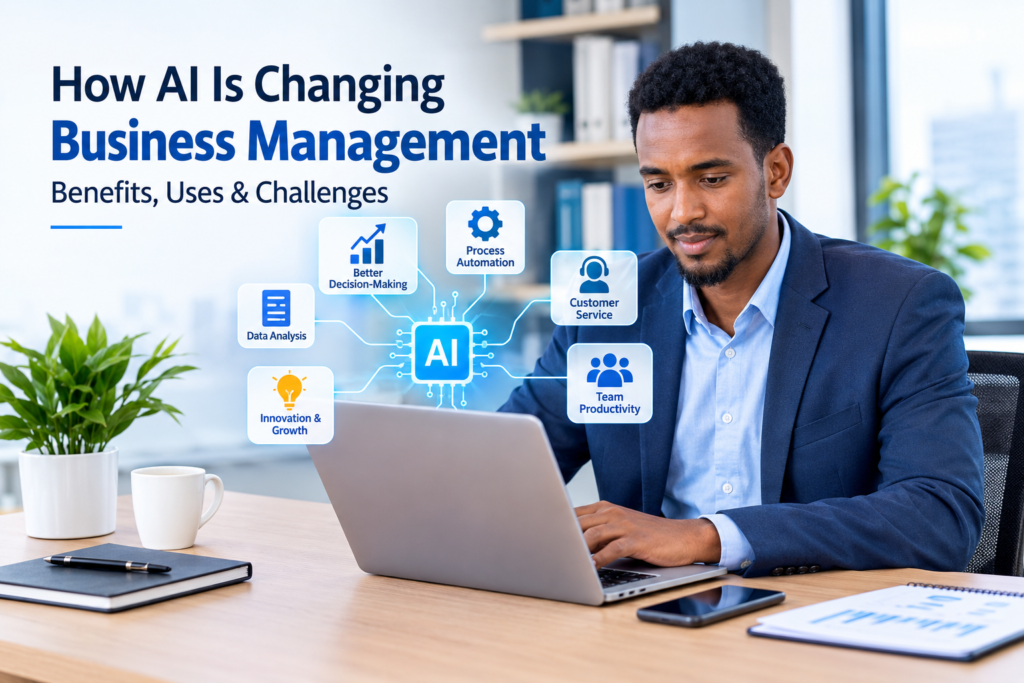

Artificial intelligence is becoming an increasingly practical part of modern business management. Companies are using AI to analyze information, automate repetitive tasks, support customer service, improve forecasting, and help managers make better-informed decisions.
How AI is changing business management is not simply a question of replacing manual work with software. The bigger change is how managers collect information, organize workflows, communicate with teams, and respond to business problems.
For small businesses, startups, and larger organizations, AI can provide useful capabilities that were previously difficult or expensive to access. However, AI also introduces important challenges, including data privacy, security, accuracy, costs, employee training, and the need for human oversight.
This guide explains how AI is changing business management, where it can provide practical value, and what businesses should consider before adopting AI-powered tools.
What Does AI Mean in Business Management?
AI in business management refers to the use of artificial intelligence technologies to support business activities such as planning, analysis, communication, customer service, operations, and decision-making.
AI systems can process large amounts of information and identify patterns or generate outputs based on the data and instructions they receive. Depending on the tool, this may include generating text, summarizing documents, analyzing data, answering customer questions, identifying trends, or automating parts of a workflow.
AI does not remove the need for managers. Instead, it can provide managers with additional tools for handling information and routine processes.
For example, a manager might use AI to summarize a lengthy report before reviewing the original document, while still making the final decision based on verified information and business requirements.
How AI Is Changing Business Management
The impact of AI can be seen across several areas of management.
1. Automating Repetitive Administrative Work
Many managers spend significant time on repetitive tasks such as organizing information, drafting routine communications, preparing summaries, and updating records.
AI-powered software can assist with some of these activities.
Examples include:
- Summarizing meeting notes
- Drafting routine emails
- Organizing documents
- Creating initial reports
- Extracting information from documents
- Categorizing customer inquiries
- Preparing task lists
- Assisting with scheduling
Automation can give employees more time to focus on activities requiring judgment, communication, creativity, and problem-solving.
However, automated output should be reviewed when mistakes could affect customers, employees, finances, compliance, or other important business decisions.
2. Supporting Better Business Decisions
Managers often need to make decisions using information from sales, finance, customer feedback, operations, and other sources.
AI can help organize and analyze this information. Depending on the system and available data, it may identify patterns, summarize trends, or help managers explore different scenarios.
For example, a retail business could analyze historical sales information to understand which products perform differently during particular periods.
The important distinction is that AI can support decision-making without necessarily being the decision-maker.
Managers still need to consider factors that may not be represented in the available data, such as changing market conditions, business relationships, employee concerns, legal requirements, and organizational priorities.
3. Improving Customer Service
Customer service is another area where AI is changing business operations.
AI-powered chatbots and virtual assistants can respond to common questions, provide basic information, and direct customers to appropriate resources.
For example, an online store might use an AI assistant to help customers find information about:
- Product availability
- Delivery processes
- Returns
- Account questions
- Store policies
- Frequently asked questions
A well-designed system can handle straightforward requests while allowing employees to take over more complicated cases.
Businesses should make it clear when customers are interacting with an automated system, particularly when a conversation involves sensitive information or requires human judgment.
4. Changing How Managers Analyze Data
Business managers have access to more information than ever, but having data is not the same as being able to use it effectively.
AI can help managers work with business data by identifying patterns, organizing information, and generating summaries.
For instance, a manager could use an AI-enabled analytics platform to examine sales data and ask questions about changes in performance.
The quality of the result depends heavily on the quality of the underlying data.
If records are incomplete, outdated, duplicated, or incorrectly entered, an AI system may produce an inaccurate analysis.
This makes data quality and data governance increasingly important parts of modern business management.
5. Supporting Marketing Management
AI is also changing how marketing teams plan and manage campaigns.
Businesses can use AI-assisted tools for tasks such as:
- Generating content ideas
- Drafting marketing copy
- Segmenting customer information
- Analyzing campaign performance
- Summarizing customer feedback
- Researching topics
- Personalizing certain communications
AI can speed up parts of the marketing workflow, but human review remains important. Marketing content should be accurate, relevant, original, and appropriate for the intended audience.
Businesses should also avoid publishing automatically generated content without checking it for factual errors, misleading statements, or poor-quality information.
6. Improving Employee Productivity
AI can act as a productivity assistant for employees and managers.
For example, employees may use AI to summarize documents, organize ideas, create first drafts, analyze information, or explain complex concepts.
This can change the role of managers. Instead of spending most of their time checking routine work, managers may increasingly focus on reviewing important outputs, setting priorities, coaching employees, and making decisions.
The result depends on how the technology is introduced. AI works best when employees understand its purpose and know when human review is required.
Benefits of AI in Business Management
AI can offer several potential advantages when it is implemented appropriately.
Increased Efficiency
Automating repetitive processes can reduce the amount of manual work involved in certain workflows.
Faster Access to Information
AI tools can summarize and organize information, making it easier for managers to review large amounts of material.
Improved Workflow Consistency
Automation can help organizations apply standardized processes to routine tasks.
More Time for Strategic Work
When routine activities are reduced, employees may have more time for planning, problem-solving, customer relationships, and other higher-value activities.
Support for Small Businesses
Smaller companies can use cloud-based AI tools for tasks such as writing, customer support, scheduling, data analysis, and project management without necessarily building their own AI systems.
The actual value, however, depends on the business problem, the quality of implementation, and the cost of the tool.
Challenges and Risks of Using AI in Business
AI is not a solution to every management problem. Businesses should consider its limitations before introducing it into important workflows.
Accuracy and Reliability
AI-generated information can contain errors. A professional-looking response is not necessarily a correct response.
Important information should therefore be checked against reliable sources and original documents.
Data Privacy
Businesses often handle customer, employee, financial, and operational information.
Before entering business information into an AI service, organizations should understand how the service handles data and whether its practices meet applicable privacy, contractual, and regulatory requirements.
Sensitive information should not be shared with an AI tool unless the organization has an appropriate basis and safeguards for doing so.
Cybersecurity
AI tools become another part of an organization’s technology environment.
Businesses should consider access controls, account security, vendor security practices, data handling, and employee awareness when adopting AI services.
Employee Skills and Training
Introducing an AI tool does not automatically improve productivity.
Employees need to understand what the tool can and cannot do, how to verify its outputs, and which information should not be entered into it.
Implementation Costs
Some AI services have subscription, integration, training, or maintenance costs.
A business should compare the expected value of a tool with its total cost rather than adopting AI simply because it is popular.
Overdependence on Automation
Some business decisions require context, judgment, empathy, negotiation, or accountability.
Organizations should avoid treating AI output as automatically correct, particularly for decisions that significantly affect people or the business.
AI vs. Traditional Business Management
AI does not necessarily replace traditional management practices. Instead, it can complement them.
| Area | Traditional Approach | AI-Assisted Approach |
|---|---|---|
| Data analysis | Manual review and spreadsheets | Automated analysis and summaries |
| Customer support | Mainly handled by employees | AI can handle routine questions |
| Report preparation | Manual drafting | AI-assisted drafting and summarization |
| Marketing | Manual research and content planning | AI-assisted research and ideation |
| Scheduling | Manual coordination | Automated scheduling tools |
| Decision-making | Manager reviews available information | AI can help organize and analyze information |
| Quality control | Human review | AI-assisted checks plus human review |
The right approach depends on the task. AI may be useful for repetitive, information-heavy activities, while humans remain essential for judgment, accountability, relationships, and complex decisions.
How Small Businesses Can Start Using AI
Businesses do not need to introduce AI across every department at once.
A practical approach is to start with one clearly defined problem.
Step 1: Identify a Repetitive Task
Look for activities that consume employee time without requiring significant human judgment.
Examples might include routine document summaries, meeting-note organization, or frequently asked customer questions.
Step 2: Define the Desired Outcome
Before selecting a tool, determine what improvement you actually want.
For example:
- Reduce time spent preparing routine reports
- Organize customer inquiries
- Improve document search
- Speed up content drafting
- Make business data easier to analyze
Step 3: Evaluate Available Tools
Compare tools based on features, pricing, security, integrations, usability, and data-handling practices.
Avoid selecting software solely because it has many AI features.
Step 4: Start With a Controlled Test
Use a small pilot before introducing the tool throughout the organization.
This allows the business to identify problems and determine whether the tool actually improves the workflow.
Step 5: Create Review Procedures
Define which AI-generated outputs require human approval.
For example, financial reports, customer communications, contracts, and important management decisions may require additional review.
Step 6: Measure the Results
Track practical indicators such as time saved, error rates, employee adoption, customer experience, and operating costs.
If the tool does not produce meaningful value, the business can adjust the workflow or reconsider whether the technology is appropriate.
How AI Is Changing the Role of Managers
As AI takes on more routine information-processing tasks, management responsibilities may increasingly focus on areas where human judgment is important.
Managers still need to:
- Set organizational priorities
- Make accountable decisions
- Manage employees
- Communicate expectations
- Resolve conflicts
- Evaluate risks
- Build relationships
- Protect confidential information
- Review important AI-generated outputs
- Ensure technology is used responsibly
This means AI literacy can become an important management skill.
A manager does not necessarily need to become an AI engineer. However, understanding the strengths, weaknesses, and appropriate uses of AI can help managers make better technology decisions.
Practical Tips for Responsible AI Adoption
Businesses can reduce unnecessary risks by establishing clear internal practices.
Create an AI Use Policy
Explain which AI tools employees may use and what types of information should not be entered into them.
Keep Humans in the Loop
Important decisions should have appropriate human oversight.
Verify Important Information
AI-generated facts, calculations, summaries, and recommendations should be checked when accuracy matters.
Protect Business Data
Review the security and privacy practices of AI vendors before using them with business information.
Train Employees
Employees should understand responsible AI use, verification, privacy, cybersecurity, and organizational requirements.
Review Tools Regularly
AI services change quickly. Businesses should periodically review whether their tools remain useful, secure, affordable, and appropriate.
What Is the Future of AI in Business Management?
AI is likely to become increasingly integrated into business software rather than existing only as a separate application.
Businesses may encounter AI capabilities inside customer relationship management platforms, accounting systems, project-management software, communication tools, analytics platforms, and other workplace applications.
The long-term impact will depend not only on the technology itself but also on how organizations manage it.
Businesses that treat AI as a practical business tool—rather than an automatic solution to every problem—can focus on finding appropriate use cases, maintaining data quality, protecting information, and keeping people involved in important decisions.
Frequently Asked Questions
1. How is AI changing business management?
AI is changing business management by helping organizations automate repetitive tasks, analyze information, support customer service, assist employees, and improve access to business insights. It can support managers but does not eliminate the need for human judgment.
2. Can AI replace business managers?
AI can automate some management-related tasks, but management involves responsibilities such as leadership, communication, accountability, negotiation, and strategic judgment. These activities still require human involvement.
3. What are the main benefits of AI for businesses?
Potential benefits include improved efficiency, faster information processing, workflow automation, customer-service support, data analysis, and assistance with routine tasks. The value varies according to the business and how the technology is implemented.
4. What are the biggest risks of using AI in business?
Important risks include inaccurate outputs, privacy concerns, cybersecurity issues, inappropriate automation, employee misuse, integration challenges, and unnecessary costs. Businesses should establish appropriate controls before using AI for important processes.
5. Should a small business start using AI?
A small business can consider AI when it addresses a clear business need. Starting with a limited, low-risk workflow can help the business evaluate whether the technology saves time, improves quality, or provides another measurable benefit before expanding its use.
Conclusion
How AI is changing business management is ultimately a story about how organizations work with information, technology, and people.
AI can help businesses automate repetitive activities, organize information, support customers, analyze data, and assist employees. At the same time, it introduces challenges involving accuracy, privacy, security, costs, and responsible use.
The most practical approach is not to adopt AI simply because it is new. Businesses should identify specific problems, evaluate appropriate tools, test them carefully, protect business information, and maintain human oversight where judgment matters.
Used thoughtfully, AI can become a useful part of modern business management while allowing managers and employees to remain responsible for the decisions that matter most.