
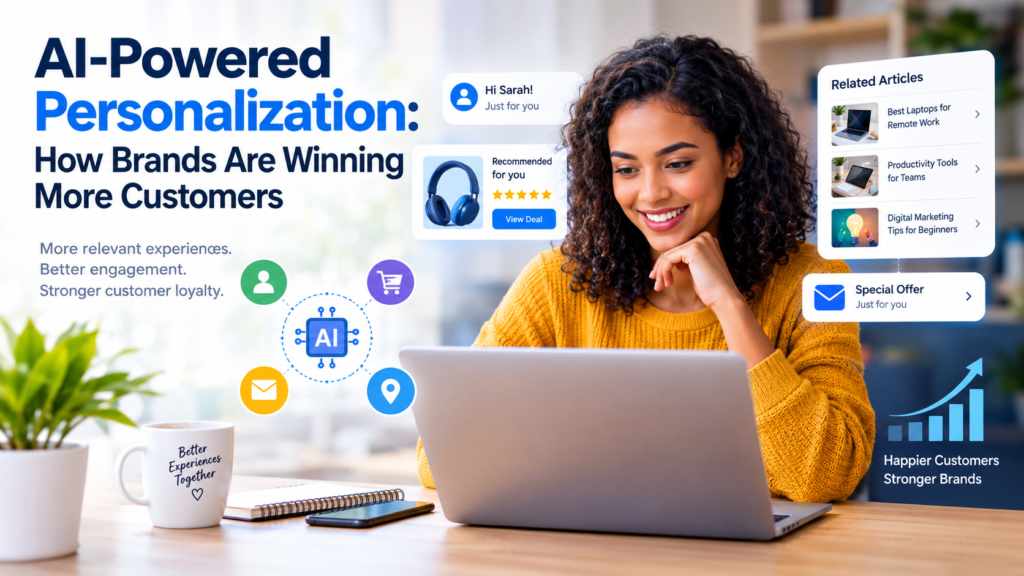

Customers interact with brands across websites, search engines, social media, email, mobile apps, and online stores. With so many choices available, delivering the same message to everyone can make marketing feel generic.
AI-powered personalization is changing how businesses approach this challenge. Instead of relying only on broad audience segments, businesses can use artificial intelligence to analyze customer signals and help deliver content, recommendations, offers, and experiences that are more relevant to individual users or groups.
When implemented responsibly, personalization can make digital experiences easier to navigate and marketing messages more useful. However, AI personalization is not a magic solution. Businesses need accurate data, clear objectives, privacy-conscious practices, and ongoing testing to make it work effectively.
This guide explains what AI-powered personalization means, how it works, its benefits and limitations, and practical ways brands can use it in their marketing strategies.
What Is AI-Powered Personalization?
AI-powered personalization is the use of artificial intelligence and machine learning technologies to tailor marketing content or customer experiences based on available information about users and their interactions with a brand.
Traditional personalization might use simple rules such as:
- Showing a customer’s first name in an email
- Recommending products based on a previous purchase
- Sending different emails to new and returning customers
- Displaying content based on location or language
AI can take personalization further by identifying patterns across larger amounts of data and helping marketers determine which content or experience may be most relevant.
For example, an online retailer could analyze browsing activity, previous purchases, product interactions, and other permitted signals to recommend products that are more closely aligned with a customer’s interests.
The goal is not simply to show more personalized content. The goal is to make the customer’s experience more relevant and useful.
How AI-Powered Personalization Works
AI personalization generally depends on several connected processes.
1. Collecting Relevant Customer Data
A personalization system needs information to make useful recommendations or decisions.
Depending on the business and its privacy practices, data may include:
- Website interactions
- Purchase history
- Product searches
- Content engagement
- Email interactions
- Customer preferences
- Subscription information
- Customer service interactions
Businesses should collect only information that is appropriate for their purpose and handle it according to applicable privacy requirements.
2. Analyzing Customer Behavior
AI systems can identify patterns within available data.
For example, a customer who repeatedly reads articles about a particular software category may be more interested in related educational content than someone who has never interacted with that subject.
The system can use behavioral signals to help marketers understand customer interests and identify meaningful audience groups.
3. Predicting Relevant Content or Actions
AI can then help determine what content, product, message, or recommendation may be appropriate for a particular customer or audience.
For example:
Customer behavior: Frequently views project-management content.
Potential personalization: Show related guides, product comparisons, or relevant software recommendations.
This does not mean the AI knows exactly what the customer wants. Its output is based on available signals and should be evaluated rather than blindly accepted.
4. Delivering the Experience
The personalized experience can appear in different marketing channels, including:
- Websites
- Email campaigns
- Mobile applications
- Online stores
- Advertising platforms
- Customer portals
- Content recommendation systems
The best channel depends on where customers already interact with the business.
5. Testing and Improving
Personalization should be treated as an ongoing process.
Businesses can compare different experiences and monitor useful indicators such as engagement, conversion rates, repeat visits, customer satisfaction, and unsubscribe rates.
If a personalization strategy does not improve the customer experience or business objective, it should be adjusted rather than continued simply because AI is involved.
Why Brands Are Investing in Personalization
Personalization has become an important part of modern digital marketing because customers often expect online experiences to be relevant to their needs.
AI can help marketers manage personalization at a scale that would be difficult to achieve entirely through manual processes.
More Relevant Customer Experiences
A visitor searching for beginner-level information may benefit from introductory content, while an experienced customer may prefer advanced guides or product comparisons.
Personalization can help present the right level of information without requiring every visitor to navigate the same journey.
Better Content Discovery
Large websites can contain thousands of pages, products, or resources.
Recommendation systems can help visitors discover content that is related to what they are already viewing.
For a business website, this could mean suggesting:
- Related blog articles
- Product comparisons
- Tutorials
- Case studies
- Guides
- Frequently asked questions
This can make the website easier to explore.
More Relevant Email Marketing
Instead of sending exactly the same email to every subscriber, marketers can use customer interests and engagement patterns to create more relevant campaigns.
For example, a software company might send different educational content to users interested in project management, customer relationship management, or marketing automation.
More Efficient Marketing Operations
AI can assist marketers with tasks such as audience analysis, content recommendations, campaign segmentation, and experimentation.
This does not necessarily eliminate human involvement. Instead, it can reduce some repetitive analytical work and allow marketing teams to spend more time on strategy, creativity, and customer understanding.
Practical Examples of AI-Powered Personalization
AI personalization can be used across many areas of marketing.
E-Commerce Recommendations
An online store can recommend products based on permitted behavioral signals such as previous purchases or product interactions.
For example, someone who has purchased a laptop might receive recommendations for compatible accessories or educational content about maintaining their device.
The recommendation should be genuinely relevant rather than simply designed to increase the number of products displayed.
Personalized Website Content
A business website can present different content depending on the visitor’s interests or previous interactions.
A visitor who frequently reads articles about email marketing might see related resources more prominently during future visits.
Personalized Email Campaigns
AI can help marketers determine which topics or products may be relevant to different subscribers.
Rather than creating hundreds of individual campaigns manually, a marketing team can establish audience groups and use automation to deliver appropriate content.
Personalized Customer Journeys
AI can also help businesses understand where customers are within their buying journey.
For example:
New visitor → Educational content
Interested visitor → Product information
Returning visitor → Comparison or demonstration content
Existing customer → Support and educational resources
The exact journey varies by industry, but the principle is the same: provide useful information based on the customer’s current needs.
AI Personalization vs. Traditional Personalization
AI-powered personalization and traditional personalization have the same broad objective: making experiences more relevant.
The main difference is how personalization decisions are created.
| Traditional Personalization | AI-Powered Personalization |
|---|---|
| Often relies on predefined rules | Can identify patterns in data |
| Usually uses defined audience segments | Can support more dynamic segmentation |
| Requires marketers to create many rules | Can automate parts of analysis |
| Often works well for simple scenarios | Can handle more complex patterns |
| Easier to understand and control | Requires stronger monitoring and governance |
Neither approach is automatically better in every situation.
For a small business with a limited audience, straightforward rules may be sufficient. A larger business with extensive customer interactions may benefit from more advanced AI capabilities.
How to Build an Effective AI Personalization Strategy
Businesses do not need to personalize everything at once.
A practical approach is to start with a specific customer problem.
Step 1: Define the Objective
Begin with a clear question.
Do you want to:
- Help customers discover relevant products?
- Improve content engagement?
- Make email campaigns more relevant?
- Improve website navigation?
- Reduce unnecessary messages?
- Support customer retention?
A clear objective makes it easier to determine whether personalization is actually helping.
Step 2: Identify Useful Data
Determine which customer information is genuinely necessary.
Avoid collecting large amounts of data simply because an AI system can process it.
The most valuable data is not necessarily the largest amount of data. It is information that is relevant, reliable, appropriately obtained, and useful for the specific marketing objective.
Step 3: Choose a Suitable Use Case
Start with a manageable application.
For example, a content website could begin with related-article recommendations rather than attempting to personalize every part of the visitor experience.
Starting small makes testing and troubleshooting easier.
Step 4: Establish Privacy and Governance Practices
Personalization depends heavily on customer data, so privacy should be considered from the beginning.
Businesses should understand the laws and regulations that apply to their operations and customers.
They should also consider:
- What information is being collected
- Why it is being collected
- How long it is retained
- Who can access it
- How customers can manage relevant choices
- Whether third-party tools receive the information
Privacy should not be treated as an afterthought.
Step 5: Test the Experience
Compare personalized experiences with suitable alternatives.
For example, a business could test whether recommending related articles improves meaningful engagement compared with showing a generic list.
Testing helps separate assumptions from actual results.
Step 6: Keep Humans Involved
AI-generated recommendations can be useful, but marketers should review important decisions.
Human oversight is especially important when personalization affects sensitive topics, pricing, customer eligibility, or other high-impact decisions.
Common Challenges of AI-Powered Personalization
AI personalization has significant potential, but businesses should understand its limitations.
Poor Data Can Produce Poor Results
AI systems depend on the quality of their inputs.
Incorrect, outdated, incomplete, or poorly structured data can lead to irrelevant recommendations and ineffective campaigns.
Before investing heavily in advanced personalization, businesses should make sure their basic data practices are reliable.
Too Much Personalization Can Feel Uncomfortable
Personalization can become counterproductive when customers feel that a brand knows too much about them.
A business does not need to use every available piece of information simply because it can.
Useful personalization should provide clear value to the customer.
Privacy Requires Careful Management
Customer data needs responsible handling.
Businesses should follow applicable privacy laws, provide appropriate disclosures, and review the data practices of third-party platforms they use.
Requirements vary by jurisdiction and business model, so organizations should consult current official guidance when necessary.
AI Can Make Incorrect Assumptions
An AI system may interpret a temporary behavior as a long-term preference.
For example, someone may browse a product category because they are researching a gift rather than because they personally want that type of product.
This is why personalization should be flexible and continuously evaluated.
Personalization Can Increase Complexity
A sophisticated personalization system may require:
- Data integration
- Analytics infrastructure
- Marketing automation
- Technical expertise
- Testing
- Monitoring
- Privacy and security controls
For smaller businesses, a simple segmentation strategy may provide better value than building a highly complex system.
Best Practices for Responsible AI Personalization
A strong personalization strategy should balance business goals with customer value.
Focus on Customer Value
Before personalizing an experience, ask:
Does this make the customer’s experience better?
If the answer is unclear, personalization may not be necessary.
Use Relevant Signals
Not every available data point deserves to influence a marketing decision.
Use information that has a reasonable connection to the experience you are trying to improve.
Avoid Over-Personalization
A personalized experience should feel helpful, not intrusive.
For example, recommending related products based on a recent purchase can be useful. Referencing unrelated personal information may create an uncomfortable experience.
Provide Appropriate Transparency
Customers should be able to understand how their information is being used when required by applicable law and platform policies.
Clear privacy information can also help establish trust.
Monitor Results
Track whether personalization is actually improving the intended outcome.
Useful measures may include:
- Engagement
- Conversion rate
- Customer retention
- Revenue per customer
- Content consumption
- Email unsubscribe rates
- Customer feedback
The appropriate metric depends on the campaign’s objective.
Maintain Human Oversight
AI should support marketing decisions, not automatically replace judgment.
Marketing teams should review unusual results, monitor for errors, and make adjustments when personalization is not working as intended.
How Small Businesses Can Use AI Personalization
AI personalization is not limited to large companies.
A small business can start with relatively simple applications.
For example, a small online store could:
- Group customers according to broad interests.
- Recommend related products.
- Create separate email campaigns for different customer interests.
- Show related blog content on product pages.
- Test personalized recommendations against a standard experience.
- Review performance regularly.
A small business does not need an expensive enterprise system to begin experimenting with useful personalization.
The key is choosing a practical use case and measuring whether it delivers value.
The Future of AI-Powered Personalization
AI personalization is likely to become increasingly integrated into digital marketing platforms, customer relationship systems, e-commerce tools, analytics platforms, and content management systems.
The technology may make it easier for businesses to create more dynamic customer journeys across multiple channels.
However, the future of personalization will not depend only on increasingly sophisticated AI models.
Trust, transparency, data quality, privacy, and customer expectations will remain important.
Businesses that focus only on what AI can technically do may overlook what customers actually want.
The stronger approach is to combine automation with human judgment and use personalization where it solves a genuine customer problem.
Frequently Asked Questions
What is AI-powered personalization in marketing?
AI-powered personalization uses artificial intelligence to analyze available customer signals and help deliver more relevant content, recommendations, messages, or experiences to users.
How does AI improve personalized marketing?
AI can analyze patterns across customer interactions and help marketers segment audiences, recommend content, and automate parts of personalized customer journeys. The quality of the outcome depends on the data, technology, strategy, and human oversight involved.
Is AI personalization suitable for small businesses?
Yes. Small businesses can begin with simple applications such as personalized email segments, related-content recommendations, product suggestions, or targeted customer journeys. The best starting point is usually a specific problem rather than a complex technology project.
What are the risks of AI-powered personalization?
Potential challenges include inaccurate recommendations, poor-quality data, privacy concerns, excessive personalization, technical complexity, and incorrect assumptions about customer preferences.
How can businesses use AI personalization responsibly?
Businesses should collect and use appropriate data, follow applicable privacy requirements, focus on genuine customer value, maintain transparency where required, test personalization carefully, and keep humans involved in important decisions.
Conclusion
AI-powered personalization can help brands create more relevant and useful customer experiences by combining customer data, automation, and artificial intelligence.
From personalized email campaigns and product recommendations to customized website experiences, there are many practical ways businesses can apply the technology.
However, effective personalization is not about using as much customer data or AI as possible. It is about using appropriate information to solve real customer problems while respecting privacy and maintaining trust.
Brands that start with clear objectives, reliable data, responsible practices, and continuous testing can build personalization strategies that are useful for both customers and the business.
The most effective approach is simple: use AI to make marketing more relevant, not more intrusive.