
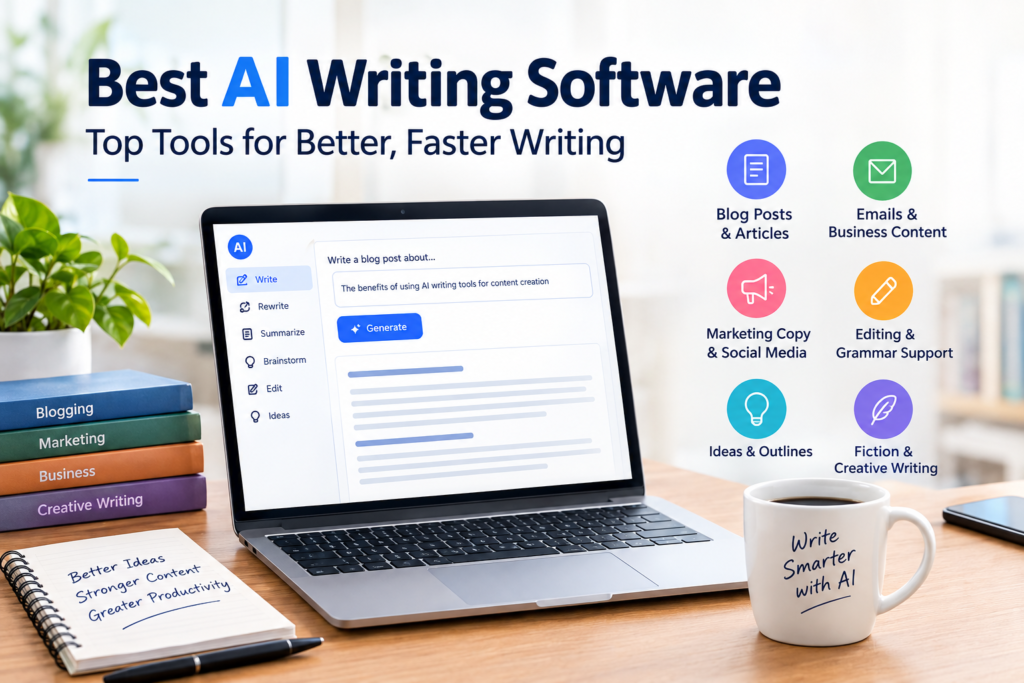

AI writing software has become a practical part of modern content creation. Instead of starting every document from a blank page, writers can use AI to brainstorm ideas, create outlines, draft text, improve clarity, adjust tone, summarize information, and rewrite existing content.
However, choosing the best AI writing software is not simply about finding a tool that can generate text. Different applications are designed for different jobs. A general-purpose AI assistant may be useful for brainstorming and drafting, while an editing-focused platform may be more useful for improving grammar and tone. Marketing teams may need brand controls, whereas fiction writers may need tools designed specifically for characters, plots, and long-form storytelling.
This guide compares several widely used AI writing platforms and explains what each type of tool is designed to do. The goal is not to suggest that one application is perfect for everyone, but to help you identify the software that matches your writing workflow.
Note: AI software changes frequently. Features, plans, limits, and availability can change, so check each provider’s official website before purchasing a subscription.
What Is AI Writing Software?
AI writing software uses artificial intelligence to help users create, edit, organize, or improve written content.
Depending on the platform, you may be able to use AI writing software for:
- Blog posts and articles
- Emails
- Business documents
- Social media posts
- Product descriptions
- Marketing copy
- Reports
- Brainstorming
- Outlines
- Rewriting and editing
- Summaries
- Creative writing
- Fiction and storytelling
- Grammar and spelling improvements
Modern AI writing tools are generally more useful when they are given clear instructions and relevant context. For example, instead of asking an AI tool to “write an article about project management,” you can specify the audience, topic, length, tone, structure, important points, and information that must be included.
OpenAI’s current writing guidance similarly recommends defining the goal, audience, format, context, and constraints, then reviewing and refining the generated draft rather than treating it as a final authority.
How We Looked at the Best AI Writing Software
There is no single feature that determines whether an AI writing tool is useful. Before choosing software, consider several factors.
1. Writing quality and control
Look for tools that allow you to control tone, structure, length, audience, and writing style.
2. Editing capabilities
Some platforms concentrate more heavily on rewriting, grammar, spelling, clarity, and tone than others.
3. Content types
Consider whether you need blog articles, business emails, advertising copy, social content, academic-style writing, or fiction.
4. Research and factual accuracy
AI-generated text can contain errors. If your content includes statistics, laws, technical information, product specifications, or other important facts, you should verify those details using reliable sources.
5. Brand and team features
Businesses may need brand voice controls, style guides, shared workspaces, permissions, and collaboration features.
6. Cost and usage limits
A tool may have free access but restrict certain features, usage, models, or output volume. Check the current pricing and plan limitations before subscribing.
7. Privacy
Think carefully before entering confidential business information, personal data, unpublished documents, or sensitive material into an AI service. Review the provider’s current privacy and data-use policies.
Best AI Writing Software to Consider
1. ChatGPT — Flexible General-Purpose AI Writing
ChatGPT is a general-purpose AI assistant that can support many types of writing.
For writing tasks, it can help with drafting, rewriting, summarizing, brainstorming, organizing ideas, changing tone, and turning rough notes into structured documents. OpenAI specifically describes writing workflows such as planning, drafting, revising, and packaging content for different formats.
What it can be useful for
- Blog outlines
- Articles
- Emails
- Reports
- Brainstorming
- Rewriting
- Summaries
- Business communication
- Social media copy
- Content planning
Advantages
- Flexible for many writing tasks
- Useful for brainstorming and drafting
- Can work conversationally through multiple revisions
- Can adapt writing to different audiences and formats
Limitations
ChatGPT can produce incorrect information, so important factual claims should be checked. The quality of the result also depends heavily on the instructions and context provided.
Best suited to: People who want one flexible AI assistant for a wide variety of writing tasks.
2. Grammarly — Writing, Editing, and Clarity
Grammarly is particularly focused on improving written communication.
Its current AI writing tools can generate drafts, rewrite existing text, improve clarity, adjust tone, and help correct grammar, spelling, and punctuation. Grammarly also offers AI-powered writing functionality through its Docs environment.
What it can be useful for
- Emails
- Business communication
- Reports
- Blog writing
- Editing
- Grammar correction
- Tone adjustment
- Rewriting
Advantages
- Strong focus on editing and communication
- Useful when you already have a draft
- Can help improve clarity and tone
- Available across different writing environments
Limitations
Grammarly may not be the right choice if your main requirement is highly specialized long-form content generation or fiction-focused writing.
Best suited to: Professionals, students, and anyone who wants AI assistance combined with writing and editing support.
3. Jasper — Marketing and Brand-Focused Writing
Jasper is designed heavily around marketing content and business workflows.
Jasper currently provides marketing-oriented writing capabilities, including a document editor, content templates, rewriting tools, brand voice functionality, and tools designed for marketing teams.
Its Brand Voice and Style Guide capabilities are designed to help teams maintain consistent language and formatting. Some advanced style-management features depend on the plan.
What it can be useful for
- Marketing campaigns
- Website copy
- Advertising copy
- Social media content
- Brand messaging
- Content marketing
- Team workflows
Advantages
- Strong marketing orientation
- Brand voice features
- Marketing-specific workflows
- Collaboration and document functionality
Limitations
Jasper may provide more marketing-oriented functionality than an individual user needs. Some advanced features are also tied to specific plans.
Best suited to: Marketing professionals, agencies, and organizations that need consistent brand-focused content.
4. Writesonic — Long-Form and SEO-Oriented Content
Writesonic offers tools for long-form content creation and AI-assisted article production.
Its current AI Article Writer includes features such as tone customization, internal linking, source citations, FAQs, cover image generation, and content workflows. Availability depends on the selected plan.
What it can be useful for
- Blog articles
- Long-form content
- SEO content workflows
- Content marketing
- FAQs
- Website content
Advantages
- Designed around longer content workflows
- Provides several article-focused features
- Includes research and citation-related functionality in its article tools
- Useful for content teams and publishers
Limitations
AI-generated articles still require human editing and fact-checking. Features can also vary according to the subscription plan.
Best suited to: Bloggers, SEO professionals, publishers, and marketing teams producing substantial amounts of online content.
5. Rytr — Simple AI Writing and Editing
Rytr is an AI writing assistant that provides a range of writing and editing use cases.
Its current feature set includes content generation, rewriting, grammar improvement, text expansion, shortening, paragraph generation, and custom tone options.
What it can be useful for
- Short-form content
- Emails
- Marketing copy
- Rewriting
- Paragraph expansion
- Content ideas
- Grammar improvement
Advantages
- Straightforward writing workflow
- Multiple content use cases
- Editing and rewriting capabilities
- Useful for short-form writing
Limitations
Users producing highly specialized content may need more advanced research, collaboration, or brand-management features.
Best suited to: Individuals, freelancers, marketers, and small businesses looking for a straightforward AI writing assistant.
6. Sudowrite — AI Writing for Fiction
Sudowrite takes a different approach from general-purpose business writing platforms. It is specifically designed for fiction writers.
Sudowrite’s current tools include fiction-focused features such as its Muse model, Story Bible, chapter-aware memory, story development tools, and rewriting assistance.
What it can be useful for
- Novels
- Short stories
- Screenwriting
- Character development
- Plot development
- Fiction brainstorming
- Long-form storytelling
Advantages
- Built specifically around fiction
- Story-development features
- Character and narrative tools
- Designed for longer creative projects
Limitations
Its specialization makes it less relevant for someone whose primary needs are business emails, reports, technical documentation, or SEO articles.
Best suited to: Fiction writers and authors who want AI assistance throughout the creative writing process.
Quick Comparison of AI Writing Software
| Tool | Main Strength | Useful For | Key Consideration |
|---|---|---|---|
| ChatGPT | General-purpose writing | Drafting, brainstorming, rewriting, documents | Requires fact-checking |
| Grammarly | Editing and communication | Grammar, clarity, tone, drafting | More editing-oriented |
| Jasper | Marketing workflows | Brand content and marketing | Advanced features vary by plan |
| Writesonic | Long-form content | Articles and content marketing | Review generated facts and sources |
| Rytr | Simple AI writing | Short-form content and rewriting | May be less specialized for complex workflows |
| Sudowrite | Fiction writing | Novels, stories, creative development | Primarily designed for fiction |
This comparison is based on the tools’ documented current capabilities rather than a single overall ranking. Features and plans can change over time.
How to Choose the Best AI Writing Software for Your Needs
The best choice depends on what you actually write.
For blog writers
Look for:
- Long-form generation
- Outlining
- Research assistance
- Editing
- SEO workflow support
- Internal linking
- Citation or source-management features
A tool such as Writesonic may be worth evaluating alongside general-purpose assistants such as ChatGPT.
For business professionals
Prioritize:
- Email drafting
- Professional tone
- Rewriting
- Summarization
- Document editing
- Collaboration
Grammarly and general-purpose AI assistants can be useful options to evaluate.
For marketing teams
Look for:
- Brand voice
- Style guides
- Marketing templates
- Collaboration
- Content workflows
- Reusable instructions
Jasper is specifically positioned around marketing teams and brand-controlled content.
For fiction writers
Look for:
- Character consistency
- Story planning
- Plot development
- Long-form context
- Creative rewriting
- Narrative-focused AI features
Sudowrite is specifically designed around these requirements.
For editing existing content
If you already write your own first drafts, an editing-focused tool may be more useful than a platform primarily designed to generate complete articles.
Look for:
- Grammar correction
- Clarity improvements
- Tone suggestions
- Sentence rewriting
- Conciseness
- Spelling correction
How to Use AI Writing Software Effectively
Buying an AI writing tool is only part of the process. Your workflow has a major effect on the usefulness of the output.
Step 1: Define the purpose
Start with a clear objective.
Instead of:
“Write about email marketing.”
Try:
“Create a 1,500-word beginner-friendly guide to email marketing for small-business owners. Use simple English, include practical examples, and explain common mistakes.”
The second instruction gives the software more useful context.
Step 2: Provide your source material
If you already have notes, research, product information, or a rough draft, provide it when appropriate.
AI tools generally have more useful context when you give them specific information instead of relying entirely on a short prompt.
Step 3: Create an outline first
For longer articles, ask for an outline before generating the complete piece.
A useful outline can include:
- Introduction
- Problem or question
- Main concepts
- Practical examples
- Advantages and limitations
- Frequently asked questions
- Conclusion
This makes it easier to identify missing information before writing the full article.
Step 4: Generate a draft
Use AI to produce a starting point rather than automatically treating the first output as publish-ready.
Step 5: Fact-check the important information
Check:
- Statistics
- Dates
- Prices
- Product features
- Legal information
- Technical specifications
- Names
- Research claims
- Medical or financial information
This is especially important because fluent writing does not automatically mean factual accuracy.
Step 6: Add human judgment
Add your own examples, explanations, experience where appropriate, original analysis, and editorial decisions.
AI can help organize information, but the person publishing the content remains responsible for what it says.
Step 7: Edit the final draft
Read the entire article yourself.
Remove:
- Repetition
- Generic statements
- Unsupported claims
- Incorrect information
- Unnecessary introductions
- Awkward wording
- Excessive AI-generated filler
The goal should be useful content, not simply more content.
Benefits of AI Writing Software
AI writing tools can be useful in several parts of the writing process.
Faster brainstorming
AI can quickly generate possible topics, outlines, questions, examples, and approaches.
Easier first drafts
A blank page can be one of the biggest obstacles to writing. AI can provide a starting structure that you can then revise.
Writing assistance
AI can help rewrite complicated sentences, shorten paragraphs, expand explanations, or adjust tone.
Repurposing content
A long article can potentially be adapted into an email, social post, summary, FAQ, or presentation outline.
Editing support
Some tools can identify grammar, spelling, clarity, and tone issues.
Support for non-native English writers
AI writing assistants can help users communicate ideas more clearly while still allowing them to retain their intended meaning and voice.
Limitations of AI Writing Software
AI writing tools are useful, but they are not substitutes for judgment.
AI can make factual errors
An AI-generated sentence may sound convincing while still being incorrect.
Always verify important information.
AI-generated writing can become repetitive
If you repeatedly ask an AI tool to produce generic articles, the output may contain predictable structures and phrases.
Human editing can make the final content more specific and useful.
Context matters
A short prompt can lead to a generic response.
Providing your target audience, source material, desired structure, tone, and requirements usually gives the AI more useful direction.
Privacy requires attention
Avoid entering sensitive or confidential information without understanding how the service handles your data.
Check the provider’s current privacy documentation before using AI with confidential material.
AI should not replace expertise
For specialized subjects, qualified human review remains important. This is particularly true when mistakes could have serious consequences.
Are AI Writing Tools Good for SEO?
AI writing software can assist with SEO-related tasks such as brainstorming topics, creating outlines, improving readability, generating FAQs, and organizing content.
However, using AI alone does not guarantee search visibility.
A useful SEO article still needs:
- A clear search intent
- Accurate information
- Original value
- Good organization
- Helpful examples
- Appropriate keyword usage
- Strong internal linking where relevant
- Clear and readable writing
- Reliable sources when claims require evidence
Avoid creating large amounts of generic content simply because AI makes it easy to produce.
The better approach is to use AI as part of a broader editorial workflow.
Can AI Writing Software Replace Human Writers?
For many tasks, AI can reduce the amount of manual writing required. However, that does not mean it eliminates the need for human writers.
Human judgment remains valuable for:
- Original ideas
- Expert knowledge
- Fact-checking
- Interviews
- Personal experience
- Editorial decisions
- Brand strategy
- Sensitive topics
- Understanding a specific audience
- Final quality control
A practical workflow is often:
Human idea → AI assistance → Human review → Fact-checking → Final editing
This approach keeps the writer involved rather than treating AI output as automatically finished.
What Should You Check Before Paying for an AI Writing Tool?
Before subscribing, ask these questions:
Does it solve your actual problem?
Do not pay for dozens of features you will never use.
Does it support your preferred writing format?
Check whether it handles the content you actually create.
What are the usage limits?
Look at word limits, credits, generations, model access, or other restrictions.
Are important features locked behind higher plans?
A tool may advertise a feature that is only available on a specific subscription.
Can you export your work?
Check whether your documents can be exported in formats you need.
How does it handle your data?
Review the provider’s current privacy and security information.
Is there a free trial or free plan?
If available, test the workflow before committing to a paid subscription.
Frequently Asked Questions
1. What is the best AI writing software?
There is no single AI writing application that is ideal for every writer. The right choice depends on your needs. General-purpose tools such as ChatGPT can support many writing tasks, Grammarly focuses strongly on editing and communication, Jasper emphasizes marketing workflows, Writesonic focuses heavily on article and content workflows, and Sudowrite specializes in fiction.
2. Can AI writing software write a complete article?
Yes. Many AI writing platforms can generate complete drafts. However, a generated article should normally be reviewed for accuracy, originality, clarity, tone, and usefulness before publication.
3. Is AI writing software free?
Some AI writing services offer free plans or limited free access, while others require subscriptions for advanced features. Pricing and plan limits change, so check the provider’s official website before purchasing.
4. Can AI writing software improve grammar?
Yes. Editing-focused platforms such as Grammarly provide grammar, spelling, punctuation, clarity, and tone-related assistance. Other general AI assistants can also rewrite and improve text when given appropriate instructions.
5. Should I use AI to write everything for me?
AI can handle many repetitive parts of the writing process, but it is usually better treated as an assistant rather than an automatic replacement for human judgment. Review important claims, add relevant expertise, and edit the final content before publishing.
Conclusion
The best AI writing software depends on the job you need it to perform.
General-purpose AI assistants can help with brainstorming, drafting, rewriting, and organizing information. Editing-focused platforms can improve grammar and communication, while marketing-oriented tools provide features for brand consistency and content workflows. Specialized applications such as Sudowrite demonstrate that AI writing software can also be designed around specific creative disciplines.
Before choosing a tool, identify your main writing tasks, compare the features you actually need, check current pricing and usage limits, and review the provider’s privacy policies.
Most importantly, treat AI-generated text as a starting point rather than an automatic final product. The strongest workflow combines AI assistance with human judgment, fact-checking, editing, and original ideas. That approach can make AI a useful part of the writing process without sacrificing accuracy, quality, or the writer’s own voice.