
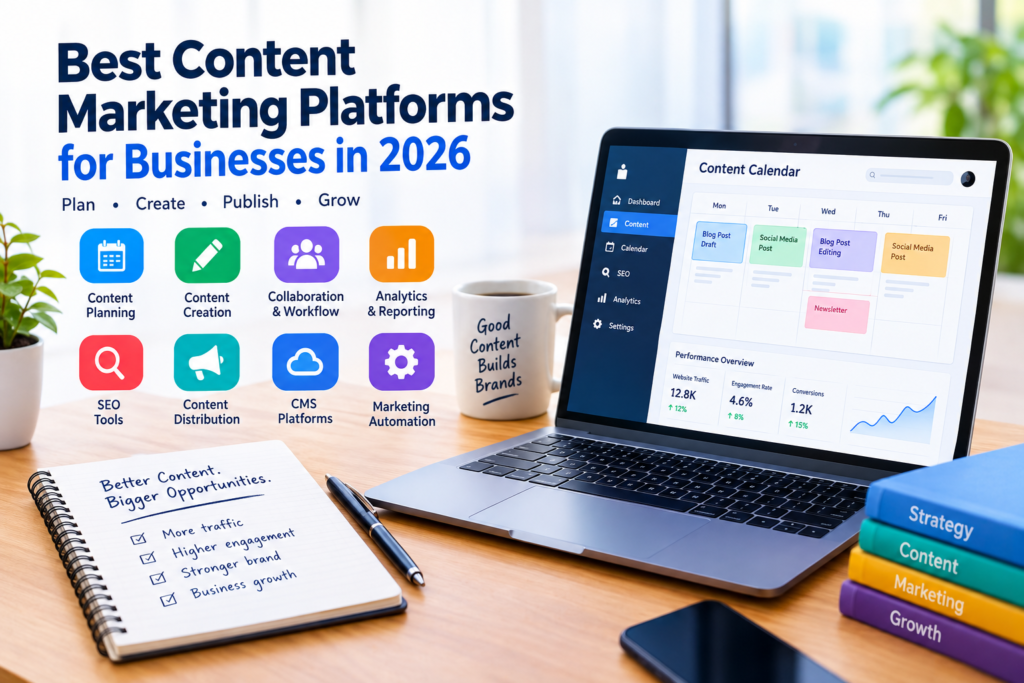

Content marketing involves much more than publishing blog posts. Businesses need to research topics, plan campaigns, create content, optimize it for search, distribute it across channels, and measure how audiences respond. Managing all of these activities with disconnected tools can become difficult as a marketing operation grows.
The best content marketing platforms bring several parts of this workflow together. Depending on the platform, businesses may get tools for content planning, SEO research, editorial calendars, collaboration, publishing, analytics, or content distribution.
However, there is no single platform that is ideal for every business. A small company with one marketer may need a simpler and less expensive solution than a large organization with multiple writers, editors, and marketing teams.
This guide explains what content marketing platforms do, what features to consider, and how to choose an option that fits your goals and workflow.
What Is a Content Marketing Platform?
A content marketing platform is software designed to help businesses organize and manage activities related to content marketing.
Depending on the product, a platform may support tasks such as:
- Content planning and topic research
- Editorial calendars
- Keyword and SEO research
- Content briefs
- Writing and editing
- Team collaboration
- Content approval workflows
- Publishing and distribution
- Performance tracking
- Content audits
- Reporting and analytics
Some platforms focus on one part of the process, while others combine several functions.
For example, an SEO-focused platform may help a marketer discover keywords and analyze competitors but provide limited publishing capabilities. A broader content marketing platform may provide planning, collaboration, workflow management, and analytics in one environment.
Why Use a Content Marketing Platform?
Managing content manually can work for a small project, but the process can become complicated when several people or channels are involved.
A dedicated platform can help create a more organized workflow.
1. Better Content Planning
Marketing teams can organize upcoming articles, videos, social posts, newsletters, and other assets in one place.
An editorial calendar can make it easier to see what is being prepared, who is responsible for it, and when it is expected to be published.
2. Easier Team Collaboration
Content often involves multiple roles. A writer may create the first draft, an editor may review it, an SEO specialist may provide optimization recommendations, and a marketing manager may approve the final version.
Collaboration features can reduce unnecessary back-and-forth between these roles.
3. More Consistent Workflows
A platform can help teams establish repeatable processes.
For example, a company might use the following workflow:
Research → Brief → Draft → Edit → SEO Review → Approval → Publish → Measure
A clearly defined workflow makes responsibilities easier to understand.
4. Improved Content Organization
As a website grows, finding old content can become difficult. A structured platform can help teams organize content by campaign, topic, format, status, or target audience.
This can also make content audits easier.
5. Better Performance Monitoring
Analytics features can help marketers understand how published content performs.
Depending on the platform, reports may include information about traffic, engagement, conversions, rankings, or other marketing metrics.
These measurements should be interpreted in context rather than treated as proof that a single piece of content caused a business result.
Types of Content Marketing Platforms
Before choosing software, it helps to understand that “content marketing platform” can describe several different categories of tools.
SEO and Content Research Platforms
These tools help marketers research search demand, keywords, competitors, and content opportunities.
They can be useful when organic search is an important part of a content strategy.
Best for: SEO teams, content strategists, bloggers, and businesses investing in organic search.
Content Planning and Workflow Platforms
These platforms focus on editorial calendars, task management, approvals, collaboration, and campaign organization.
Best for: Marketing teams that need stronger project and workflow management.
Content Management Systems
A content management system, or CMS, allows businesses to create, organize, and publish website content.
A CMS is particularly important for websites that regularly publish articles, landing pages, resources, or other online content.
Best for: Businesses that need a central system for managing website content.
Social Media Content Platforms
These tools help businesses plan, schedule, publish, and monitor social media content.
Best for: Teams managing multiple social channels.
All-in-One Marketing Platforms
Some marketing platforms combine content, email marketing, CRM, automation, analytics, and other functions.
They can be useful for organizations that want multiple marketing activities connected within one system.
Best for: Businesses that want broader marketing functionality rather than a specialized content tool.
Features to Look for in the Best Content Marketing Platforms
The right features depend on your business and workflow. Consider the following before subscribing.
Content Calendar
A visual calendar can make it easier to manage publishing schedules and campaigns.
Look for flexible views, task assignments, deadlines, and content status options if your team publishes frequently.
Collaboration and Approvals
If several people review content, look for comments, permissions, approval stages, and revision tracking.
These features can be especially useful for organizations with formal editorial processes.
SEO Features
If organic search is important to your strategy, consider platforms that provide useful SEO functionality such as:
- Keyword research
- Topic research
- Search performance monitoring
- Content optimization
- Competitor analysis
- Content audits
SEO recommendations should support good content rather than replace editorial judgment.
Analytics and Reporting
Good reporting helps marketers understand whether their content is meeting its intended purpose.
Useful measurements can include:
- Organic traffic
- Engagement
- Leads
- Conversions
- Content-assisted activity
- Search visibility
- Social performance
The most useful metrics depend on the business objective.
Integrations
Check whether the platform connects with the tools your team already uses.
Common integrations may include:
- Website platforms
- Analytics tools
- CRM systems
- Email marketing software
- Social networks
- Project management tools
- Cloud storage services
An impressive feature list has limited value if the platform does not fit your existing workflow.
User Permissions
Larger teams may need different access levels for writers, editors, managers, clients, and administrators.
Review permission controls before selecting a platform for a multi-user environment.
Popular Content Marketing Platforms to Consider
The following examples represent different approaches to content marketing. They should not be treated as a universal ranking because the appropriate choice depends on budget, team size, marketing goals, and required features.
HubSpot
HubSpot provides a broad collection of marketing and customer-management tools. Businesses can use its ecosystem for content, email marketing, CRM, automation, analytics, and related activities.
Consider it if: You want content marketing connected with broader customer and marketing workflows.
Potential limitation: Businesses that only need basic content planning may find a broader platform more extensive than necessary.
Semrush
Semrush is widely associated with SEO and digital marketing research. Its tools can support keyword research, competitive analysis, content optimization, and search-related workflows.
Consider it if: SEO research and organic search are major parts of your content strategy.
Potential limitation: Teams mainly looking for editorial project management may need additional software.
Ahrefs
Ahrefs provides tools for SEO research, keyword analysis, backlinks, competitors, and content-related research.
Consider it if: Your content strategy relies heavily on search visibility and SEO research.
Potential limitation: It is more focused on SEO and search intelligence than being a complete editorial publishing system.
CoSchedule
CoSchedule focuses on marketing organization, calendars, campaign management, and workflow features.
Consider it if: Your primary challenge is coordinating marketing activities and publishing schedules.
Potential limitation: Businesses looking for advanced SEO research may need another specialized tool.
Contentful
Contentful takes a different approach by providing a content platform designed to manage structured content across digital experiences.
Consider it if: Your organization needs structured content that can be delivered across multiple digital channels.
Potential limitation: A more technical implementation may be unnecessary for a small website with straightforward publishing requirements.
How to Choose the Right Platform
Instead of choosing a platform because it has the longest feature list, start with your actual marketing process.
Step 1: Define Your Main Goal
Ask what you are trying to improve.
Is the main problem:
- Finding content ideas?
- Managing writers?
- Improving SEO?
- Publishing consistently?
- Coordinating campaigns?
- Measuring performance?
- Managing content across multiple channels?
The answer will help narrow the type of platform you need.
Step 2: Identify Your Team Size
A solo marketer may need only a simple combination of planning, writing, publishing, and analytics tools.
A larger team may require approvals, permissions, workflow automation, integrations, and centralized reporting.
Step 3: Create a Feature Shortlist
Separate essential features from optional ones.
For example:
Essential: Editorial calendar, collaboration, publishing integration, analytics.
Optional: Advanced automation, extensive integrations, custom reporting.
This prevents unnecessary spending on features your team will rarely use.
Step 4: Compare Total Cost
Do not look only at the advertised starting price.
Check:
- Number of users included
- Feature restrictions
- Usage limits
- Additional seats
- Premium integrations
- Reporting limitations
- Contract requirements
- Annual versus monthly pricing
Prices and plans can change, so verify current details on the provider’s official website before purchasing.
Step 5: Test the Workflow
If a free trial or demonstration is available, use it with a real content task.
For example, try creating a brief, assigning it to a writer, reviewing a draft, scheduling publication, and checking the resulting report.
This provides more useful information than simply reading a feature list.
Common Mistakes When Choosing Content Marketing Software
Choosing Too Many Features
More functionality does not automatically mean better results.
A complicated platform can create unnecessary training and administration if your team only needs a few core functions.
Ignoring Existing Tools
Before purchasing new software, check whether your existing CMS, analytics system, project management software, or CRM already provides the required functionality.
You may be able to avoid overlapping subscriptions.
Focusing Only on Price
The cheapest option may not provide the workflow or integrations your team needs. At the same time, an expensive platform may contain features you never use.
Compare the overall fit rather than price alone.
Treating Software as a Content Strategy
A platform can organize the process, but it does not automatically create a useful content strategy.
Businesses still need to understand their audience, identify meaningful topics, produce accurate information, and maintain content quality.
Ignoring Data and Content Ownership
Before committing to a platform, review its terms, export options, privacy documentation, and data policies.
Businesses should understand how their information is stored and what happens if they decide to move to another service.
How to Get More Value From a Content Marketing Platform
The software is only one part of the process. Good implementation matters.
Create a Consistent Editorial Process
Define clear stages for every content project.
For example:
- Select the topic
- Define the audience
- Prepare the content brief
- Assign the work
- Draft the content
- Review accuracy and quality
- Optimize where appropriate
- Approve and publish
- Monitor performance
- Update when necessary
Use Content Briefs
A content brief can give writers a clear understanding of the intended audience, purpose, primary topic, supporting points, and desired format.
This can reduce unnecessary revisions.
Review Older Content
Content can become outdated as products, software, regulations, industry practices, and search results change.
Regular reviews can help identify pages that need updates, consolidation, or removal.
Connect Content With Business Goals
Not every article needs to generate an immediate sale.
Different pieces of content can serve different purposes, including education, brand awareness, organic search visibility, customer support, or lead generation.
Define the purpose before measuring performance.
Content Marketing Platform vs. Individual Tools
A business does not always need an all-in-one platform.
A smaller team might use a combination such as:
CMS + spreadsheet or project management tool + analytics + SEO tool
A larger organization might prefer:
Content platform + SEO software + CMS + CRM + analytics
The best setup depends on the complexity of the operation.
An integrated platform can reduce the number of separate systems, while specialized tools may provide deeper functionality in individual areas.
Frequently Asked Questions
What is the best content marketing platform for a small business?
There is no universal best option. A small business should generally prioritize ease of use, essential features, integrations, and predictable costs. A simple platform may be more practical than an enterprise solution with features the business does not need.
Are content marketing platforms worth the cost?
They can be useful when they solve a real workflow problem, such as managing a growing editorial calendar, coordinating multiple contributors, or improving reporting. The value depends on how extensively the business uses the platform and whether it replaces or complements existing tools.
Can a content marketing platform improve SEO?
Some platforms provide SEO research and optimization features that can support an SEO workflow. However, software does not guarantee search rankings. Search visibility also depends on content quality, relevance, technical factors, competition, and other variables.
Do I need an all-in-one content marketing platform?
Not necessarily. Businesses with straightforward requirements may prefer several specialized tools. An all-in-one platform becomes more relevant when a team wants multiple marketing functions connected in one environment.
How often should a business review its content marketing platform?
Review the platform when your team, publishing volume, channels, or marketing requirements change. A periodic review can also identify unused features, unnecessary costs, workflow problems, or integration gaps.
Conclusion
The best content marketing platforms are not necessarily the ones with the largest number of features. The right choice is the platform that fits your team’s workflow, marketing objectives, technical requirements, and budget.
Start by identifying the problem you want the software to solve. Then compare the features that matter most, check integrations and pricing, and test the workflow before making a long-term commitment.
Whether you need SEO research, editorial planning, collaboration, publishing, analytics, or broader marketing functionality, choosing software around your actual needs can make content operations easier to manage and measure.