
A campaign can produce inexpensive clicks and plenty of inquiries while still costing too much to generate paying customers. Customer acquisition cost helps connect marketing activity to the expense of winning new business.
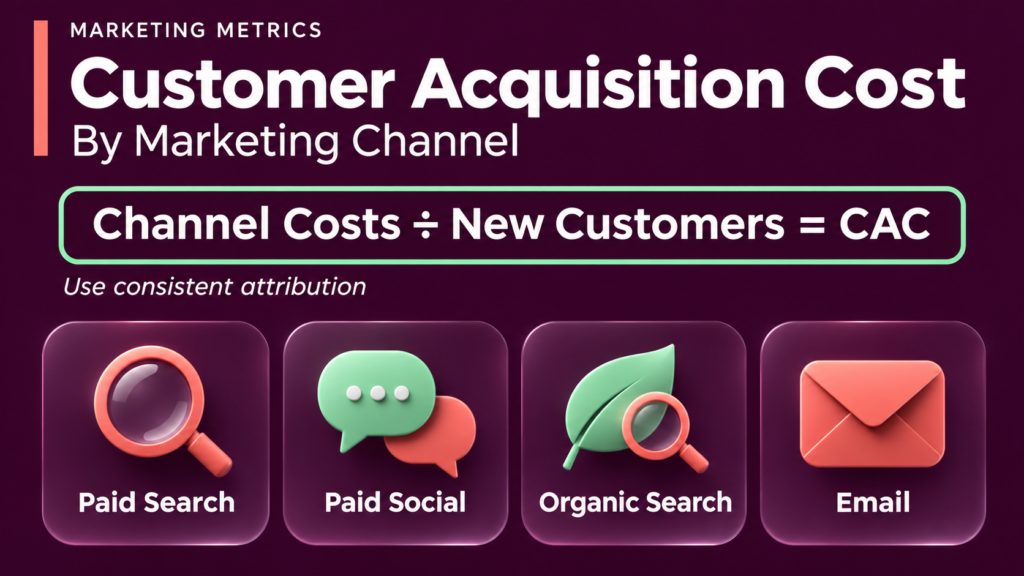
To understand how to calculate customer acquisition cost by marketing channel, divide each channel’s acquisition-related costs by the new customers credited to it. The arithmetic is straightforward. The work is deciding which costs belong in the calculation and how to assign customers consistently.
This guide explains those decisions, shows a fictional small-business example, and provides a spreadsheet structure you can reuse.
What Is Customer Acquisition Cost?
Customer acquisition cost, or CAC, measures the sales and marketing cost of gaining a new customer. Shopify’s CAC guide uses this definition and explains the distinction between channel-specific and blended acquisition costs.
For an individual channel:
Channel CAC = Acquisition-related costs assigned to the channel ÷ New customers attributed to that channel
If paid search costs $2,000 and receives credit for 20 new customers:
$2,000 ÷ 20 = $100 CAC
That means the business spent an average of $100 in assigned acquisition costs for each new customer credited to paid search.
Channel CAC is an internal management metric. Its usefulness depends on a clear cost definition, reliable customer records, and a consistent attribution method.
CAC, Cost per Lead, and Cost per Acquisition
These measurements can refer to different outcomes:
| Metric | Typical calculation | What it measures |
|---|---|---|
| Cost per lead | Lead-generation spending ÷ Leads | Expense of generating an inquiry or prospect |
| Advertising CPA | Ad spending ÷ Recorded acquisition actions | Expense per action defined in the advertising account |
| Channel CAC | Assigned acquisition costs ÷ Attributed new customers | Cost of gaining a new customer through a channel |
| Blended CAC | Total acquisition-related sales and marketing costs ÷ Total new customers | Overall acquisition efficiency |
Always inspect what an advertising platform calls a conversion or acquisition. A form submission, repeat purchase, and first-time paying customer are different outcomes.
How to Calculate Customer Acquisition Cost by Marketing Channel
1. Choose the Period and Define a New Customer
Select a reporting period, such as a month or quarter.
Then define the event that makes someone a customer. For example:
- An online store: a person completing their first qualifying paid order.
- A service business: a client paying their first invoice.
- A subscription business: an account starting its first paid subscription.
Specify how cancellations, full refunds, test orders, and duplicate records are handled. Apply that policy consistently and label recent results provisional when adjustments remain likely.
Use a stable customer or account ID where possible. Counting purchases can overstate acquisition when one customer buys several times.
2. Establish Channel Categories
Choose categories that reflect how you manage marketing:
- Paid search.
- Paid social.
- Organic search.
- Email acquisition.
- Affiliate or partner referrals.
- Events or offline marketing.
- Direct, referral, or unknown sources where applicable.
Keep the categories consistent between periods. Separate paid and organic social if they have different budgets and objectives.
Record unknown attribution openly. Forcing an untraceable customer into a familiar channel creates false precision.
3. Collect Acquisition-Related Costs
Start with expenses directly associated with each channel, then allocate shared acquisition costs.
| Cost | Example | Suggested treatment |
|---|---|---|
| Media spending | Search or social advertisements | Assign to the relevant paid channel |
| Creative production | Ad design, video, or landing-page work | Assign directly where possible; allocate shared work |
| Agency or contractor fees | Campaign management or SEO services | Split by documented scope or work performed |
| Employee acquisition time | Prospecting, campaign setup, sales calls | Allocate using estimated or recorded time |
| Marketing software | CRM, email, or tracking tools | Allocate the acquisition-related share |
| Partner fees | Commissions for new customers | Assign to the relevant partner channel |
| Event expenses | Booth fees or acquisition materials | Assign to the event or offline channel |
Include salary-related employer costs when estimating employee time for a fuller view. If an owner’s unpaid time is excluded, disclose that limitation; an optional time-cost estimate can show the economic effort involved.
Separate acquisition activity from customer retention, fulfillment, and ongoing support. For email, this means distinguishing prospect campaigns from messages aimed at existing buyers.
Decide how to treat one-time setup work. You might report it in the period incurred or spread it across a documented useful period for internal analysis. Explain the approach and apply it consistently. This worksheet is a management tool, rather than guidance on accounting or tax treatment.
Avoid double-counting discounts as marketing costs when their effect is already reflected in your margin calculation.
4. Allocate Shared Costs Once
Suppose a staff member spends 40 hours on acquisition work:
- 20 hours on paid search.
- 12 hours on paid social.
- 8 hours on organic search.
Allocate that person’s acquisition-related employment cost 50%, 30%, and 20% respectively.
For shared software, use a reasonable basis such as acquisition users, campaign activity, or a documented time split.
Check that all allocations add up to the original cost. A $600 shared expense should not become $600 in every channel.
5. Attribute New Customers Consistently
A person might discover your business through a search result, follow you on social media, and later purchase through an email link. Your report needs a rule for assigning that customer.
For a simple CRM-based report, you might use:
| Approach | How it assigns credit | Main limitation |
|---|---|---|
| First recorded touch | Credits the earliest known source | Can overlook later interactions |
| Last eligible touch before purchase | Credits the final qualifying interaction | Can undervalue discovery channels |
| Fractional attribution | Shares credit across interactions | Requires more data and careful reconciliation |
These are measurement approaches you can define in your own reporting. Their availability and behavior vary by analytics product.
Google Analytics documentation explains that attribution models assign credit to interactions and can distribute fractional credit. It also distinguishes event-scoped attribution from first-user and session dimensions.
For CAC, the credited outcome must represent a new customer. A purchase-event report that includes repeat buyers cannot supply the denominator unchanged.
Use consistent campaign tagging, CRM source fields, and order records. Google’s campaign URL guidance explains how UTM parameters identify referred campaign traffic. Tags help capture a source; customer records establish whether the buyer is new.
Do not add customer totals claimed independently by multiple advertising platforms. Several platforms may claim the same customer.
6. Calculate CAC and Reconcile the Totals
Divide each channel’s assigned costs by its attributed new customers.
Then check that:
- Assigned channel costs reconcile to the included acquisition budget.
- Customer credits reconcile to the eligible new-customer total.
- Shared costs appear once.
- Unknown customer sources remain visible.
- Attribution rules and reporting dates are documented.
With fractional attribution, customer credit can contain decimals. Across channels, those credits should still reconcile to the underlying total.
Worked Example: A Small Service Business
The following figures are fictional and illustrate the calculation. They are not industry benchmarks.
Assume a service business reports one quarter of activity. Each new customer is credited to one channel using the business’s documented last-eligible-touch rule. Acquisition delays are short enough for the owner to use a period-based report as an initial operational view.
| Channel | Media spending | Direct labor and production | Allocated shared costs | Total acquisition cost | New customers | Channel CAC |
|---|---|---|---|---|---|---|
| Paid search | $1,500 | $300 | $200 | $2,000 | 20 | $100 |
| Paid social | $1,200 | $400 | $200 | $1,800 | 12 | $150 |
| Organic search | $0 | $900 | $300 | $1,200 | 15 | $80 |
| Email acquisition | $0 | $300 | $200 | $500 | 5 | $100 |
| Total | $2,700 | $1,900 | $900 | $5,500 | 52 | $105.77 blended |
Paid social CAC:
($1,200 + $400 + $200) ÷ 12 = $150
Organic search CAC:
($0 + $900 + $300) ÷ 15 = $80
Blended CAC:
$5,500 ÷ 52 = $105.77
Organic search has the lowest reported CAC in this example, but it still has production and labor costs. Its current customers may also reflect work completed earlier.
The blended figure is calculated from total costs and total customers. Simply averaging the four channel CAC values would give each channel equal weight regardless of customer volume.
How to Handle Delayed Sales and Small Samples
Match the Report to Your Sales Cycle
A business with a long sales process may spend money in January and win the resulting customers in April. Dividing January spending by January customers can misrepresent the performance of that spending.
Keep two views when useful:
- Period view: acquisition costs incurred during a period divided by customers acquired during that period.
- Cohort view: costs assigned to a defined acquisition group divided by the customers that group eventually produces.
For cohort reporting, group prospects by acquisition period and source, follow them through the sales cycle, and include the relevant allocated sales costs as they develop. Label immature cohorts provisional.
A lookback window determines which earlier interactions are eligible for attribution. It does not, by itself, solve the matching of spending to later customers.
Treat Small Samples Carefully
If a channel spends $300 and gains two customers, CAC is $150. One additional customer would reduce it to $100 without any spending change.
Show customer volume beside CAC. Review several periods and allow enough time for delayed conversions before making a large budget decision.
If a channel gains zero new customers, CAC is undefined for that period. Report “N/A—0 new customers” alongside spending, rather than $0 CAC.
A Simple Spreadsheet Layout
Use these columns:
| Column | Heading |
|---|---|
| A | Channel |
| B | Media spending |
| C | Direct acquisition costs |
| D | Allocated shared costs |
| E | Total acquisition cost |
| F | Attributed new customers |
| G | CAC |
For row 2:
E2 = SUM(B2:D2)
G2 = IF(F2>0,E2/F2,"N/A")
If your channels occupy rows 2–7, calculate blended CAC with:
=IF(SUM(F2:F7)>0,SUM(E2:E7)/SUM(F2:F7),"N/A")Add notes above the table for the reporting dates, customer definition, attribution rule, allocation basis, and handling of refunds.
How to Use Channel CAC to Make Better Decisions
A lower CAC is useful only alongside customer value and cash-flow needs.
Compare channels using revenue, contribution after delivery costs, repeat purchases, cancellations, and the time it takes to recover acquisition spending.
For illustration, if a first project generates $240 in revenue and costs $140 to deliver, $100 remains before acquisition cost and other overhead. A $150 CAC would exceed that first-project contribution by $50. Future projects might change the picture, but they should be supported by observed customer behavior.
Before increasing a budget, investigate whether a high CAC comes from poor targeting, weak landing pages, slow sales follow-up, or inaccurate tracking.
Attributed CAC also does not prove that every credited customer was caused by the channel. Some people might have purchased anyway. Controlled experiments can help assess additional impact where practical.
Frequently Asked Questions
1. Should I use ad spending alone to calculate CAC?
Ad spending divided by attributed new customers gives an ad-spend-only measure. Label it clearly. A fuller channel CAC includes relevant labor, production, fees, tools, and allocated sales costs.
2. What is a good customer acquisition cost?
There is no universal target. An affordable CAC depends on contribution margins, customer retention, cash available, and how quickly acquisition costs are recovered. Use your own customer economics rather than an unrelated industry average.
3. Should returning customers count in CAC?
No. CAC measures new-customer acquisition. Repeat orders can inform customer value and retention analysis, but counting them as newly acquired customers makes acquisition appear cheaper.
4. Why do my advertising platform and CRM show different CAC figures?
They may use different attribution windows, conversion definitions, customer identities, or cost coverage. Start with a shared new-customer definition, then reconcile records and settings before comparing results.
5. Is SEO or organic social acquisition free?
It can involve no media charge while still requiring staff time, content production, tools, or outside services. Include the acquisition-related share of those costs and acknowledge that results may reflect earlier work.
Conclusion
Build your report around a clear definition of a new customer, a documented cost policy, and consistent attribution. Reconcile the totals before comparing channels.
Use CAC alongside customer contribution, sales timing, and retention. That makes the report a practical basis for testing budget changes and improving acquisition efficiency.