
A successful marketing campaign does more than attract attention. It encourages potential customers to take the next step. Whether someone is visiting a service page, reading a promotional email, or viewing a digital advertisement, the words you use to guide their actions can influence whether they become a customer.
This is where a call to action (CTA) becomes important.
A well-written call to action helps visitors understand what to do next, whether that means requesting a quote, booking a consultation, downloading a resource, or purchasing a product. However, choosing the right wording can be challenging, particularly when different marketing channels require different approaches.
In this guide, we explore 15 practical call to action examples for service pages, emails, and advertisements. You will also learn how to write effective CTAs, where to place them, and how to improve their performance through testing.
What Is a Call to Action (CTA)?
A call to action (CTA) is a marketing message that encourages an audience to complete a specific action.
It can appear as a clickable button, a text link, or a short sentence within marketing content.
For example, a website offering digital marketing services might include a button saying “Get a Free Consultation.” This message tells visitors exactly what they can do next.
Common CTA actions include:
- Buying a product.
- Booking an appointment.
- Requesting a service quotation.
- Signing up for a newsletter.
- Downloading a free resource.
- Registering for an online event.
- Contacting a sales representative.
The main purpose of a CTA is to reduce uncertainty and guide potential customers toward the next step in the buying process.
Why Are Call to Actions Important in Marketing?
CTAs play an important role in connecting marketing activities with business objectives. Without clear instructions, visitors may consume your content but leave without taking any meaningful action.
Here are several reasons why effective CTAs matter.
1. They Encourage Customer Engagement
A clear CTA gives visitors a reason to interact with your business.
Instead of simply reading about your services, customers can take an immediate action, such as requesting additional information or booking a meeting.
2. They Improve Conversion Opportunities
Conversion occurs when a visitor completes an action that supports your business objectives.
A strategically positioned CTA can help turn website visitors into leads, subscribers, or paying customers.
3. They Improve the Customer Journey
Different customers have different levels of purchasing interest.
Someone discovering your company for the first time may prefer to download a free guide, while someone ready to purchase may respond better to a “Buy Now” button.
Matching CTAs to customer intent makes the buying journey easier.
4. They Make Marketing Messages Clearer
A CTA communicates what the audience should do next.
For example, “Learn More” is useful when introducing a service, while “Request a Quote” is more appropriate when encouraging potential customers to discuss pricing.
15 Call to Action Examples for Different Marketing Channels
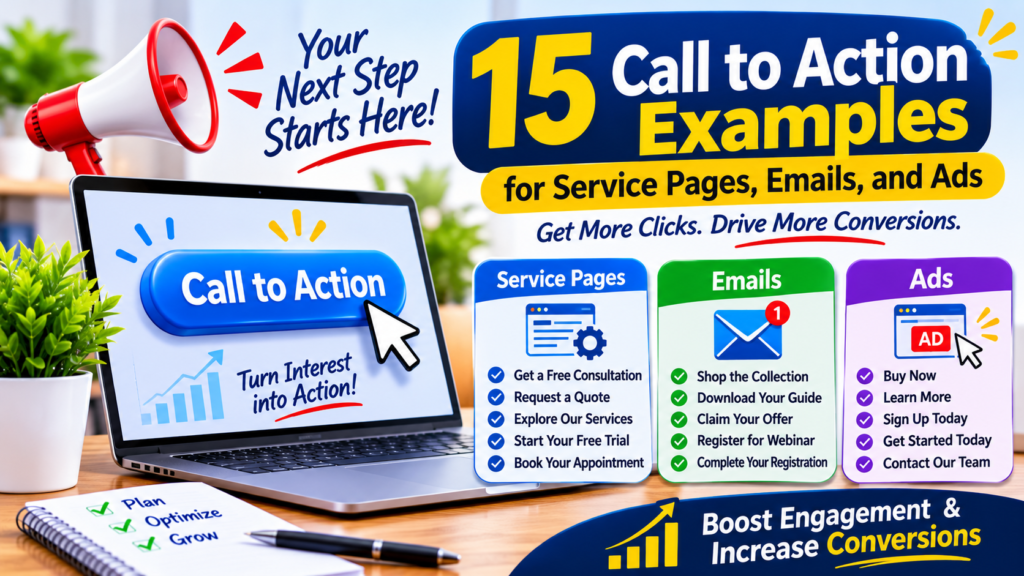
The following call to action examples are organized into three categories: service pages, marketing emails, and digital advertisements.
Each example includes an explanation of when to use it and why it can be effective.
A. Call to Action Examples for Service Pages
Service pages explain what a business offers and why potential customers should choose it.
Their CTAs should encourage visitors to move from researching a service to taking a meaningful step.
1. Get a Free Consultation
Example CTA: “Get a Free Consultation Today”
This CTA works well for professional service providers, including marketing agencies, consultants, financial advisors, and software companies.
It encourages potential customers to discuss their needs without immediately committing to purchasing a service.
Best used for: Consulting businesses, agencies, and professional services.
2. Request a Free Quote
Example CTA: “Request Your Free Quote”
Customers often want to understand the expected cost before making a purchasing decision.
This CTA provides a direct way to collect inquiries from people interested in receiving customized pricing.
Best used for: Construction companies, digital agencies, home services, and B2B service providers.
3. Book Your Appointment
Example CTA: “Book Your Appointment Now”
This message encourages visitors to schedule a meeting or service appointment.
It is particularly useful for businesses where customers need to reserve a specific time.
Best used for: Healthcare providers, salons, consultants, and appointment-based businesses.
4. Explore Our Services
Example CTA: “Explore Our Services”
Not every website visitor is ready to make a purchase.
Some people are still comparing providers and learning about available solutions. This CTA helps them discover additional information before making a decision.
Best used for: Agencies, consulting companies, technology providers, and professional service websites.
5. Start Your Free Trial
Example CTA: “Start Your Free Trial Today”
Software companies frequently use free trials to allow potential customers to experience a product before purchasing a subscription.
This CTA reduces the initial commitment and gives users an opportunity to understand the product’s value.
Best used for: SaaS platforms, productivity software, and online business tools.
B. Call to Action Examples for Marketing Emails
Email marketing allows businesses to communicate directly with subscribers, existing customers, and potential buyers.
An effective email CTA should be easy to understand and closely connected to the message.
6. Shop the Collection
Example CTA: “Shop the Latest Collection”
This CTA encourages subscribers to visit an online store and explore available products.
It works particularly well when promoting new product releases, seasonal collections, or special offers.
Best used for: Ecommerce businesses, fashion retailers, and online stores.
7. Download Your Free Guide
Example CTA: “Download Your Free Business Guide”
Providing valuable resources can encourage subscribers to interact with your brand.
For example, a marketing agency might send an email offering a free SEO checklist in exchange for visiting a resource page.
Best used for: Educational businesses, consultants, marketing agencies, and B2B companies.
8. Claim Your Exclusive Offer
Example CTA: “Claim Your Exclusive Discount”
This CTA highlights a special offer and encourages subscribers to visit the promotional page.
If the offer has a genuine expiration date or limited availability, communicate those conditions clearly.
Best used for: Ecommerce promotions, seasonal campaigns, and customer loyalty emails.
9. Register for the Webinar
Example CTA: “Reserve Your Seat for Our Free Webinar”
Webinars provide opportunities to educate potential customers and demonstrate expertise.
This CTA encourages subscribers to register for an upcoming online session.
Best used for: Training providers, software companies, educational organizations, and consultants.
10. Complete Your Registration
Example CTA: “Complete Your Registration Now”
Some subscribers begin registration but do not finish the process.
A reminder email with a clear CTA can encourage them to return and complete the required steps.
Best used for: Online courses, membership platforms, events, and subscription services.
C. Call to Action Examples for Digital Advertisements
Digital advertisements have limited space to communicate their message. Therefore, their CTAs should be direct, relevant, and easy to understand.
11. Buy Now
Example CTA: “Buy Now and Get Started”
This is one of the most direct purchasing CTAs.
It encourages customers who are already interested in a product to complete their purchase.
Best used for: Ecommerce advertisements, product promotions, and online retail campaigns.
12. Learn More
Example CTA: “Learn More About Our Solution”
Not every advertisement needs to generate an immediate sale.
When promoting a service or introducing a new product, this CTA encourages people to visit a landing page and explore additional details.
Best used for: Brand awareness campaigns, new products, and complex services.
13. Sign Up Today
Example CTA: “Sign Up Today and Join Our Community”
This CTA encourages users to create an account or subscribe to a service.
It works particularly well when the business offers membership benefits, educational resources, or online communities.
Best used for: Membership websites, newsletters, and online platforms.
14. Get Started Today
Example CTA: “Get Started Today With Our Business Solutions”
This CTA communicates that customers can begin using a service or exploring a solution immediately.
It is useful when the next step is straightforward and does not require a complicated purchasing decision.
Best used for: SaaS platforms, digital services, and business software.
15. Contact Our Team
Example CTA: “Contact Our Team to Find the Right Solution”
Some customers need additional information before making a decision.
This CTA gives them an opportunity to communicate directly with a business representative.
Best used for: B2B services, consulting firms, agencies, and high-value products.
Comparison of the 15 Call to Action Examples
The following table provides a quick overview of the examples and their intended purposes.
| CTA example | Marketing channel | Main objective |
|---|---|---|
| Get a Free Consultation | Service page | Generate leads |
| Request a Free Quote | Service page | Collect inquiries |
| Book Your Appointment | Service page | Schedule bookings |
| Explore Our Services | Service page | Encourage exploration |
| Start Your Free Trial | Service page | Generate trial users |
| Shop the Collection | Generate sales | |
| Download Your Free Guide | Generate engagement | |
| Claim Your Exclusive Offer | Encourage purchases | |
| Register for the Webinar | Generate registrations | |
| Complete Your Registration | Increase completion | |
| Buy Now | Advertisement | Generate purchases |
| Learn More | Advertisement | Drive website traffic |
| Sign Up Today | Advertisement | Generate subscribers |
| Get Started Today | Advertisement | Encourage adoption |
| Contact Our Team | Advertisement | Generate inquiries |
How to Write an Effective Call to Action
Having several CTA examples is useful, but understanding how to create your own messages is equally important.
The following practices can help you develop CTAs that match your marketing objectives.
1. Use Clear and Action-Oriented Words
Your CTA should tell people exactly what they can do.
Use direct action words such as:
- Download
- Register
- Discover
- Purchase
- Subscribe
- Contact
- Book
- Explore
Avoid vague messages that leave visitors uncertain about the next step.
2. Focus on Customer Benefits
People are more likely to respond when they understand what they will gain.
For example, instead of simply writing “Submit,” consider “Get Your Free Marketing Plan.”
The second option communicates a clearer benefit.
3. Create a Sense of Urgency When Appropriate
Urgency can encourage customers to take action sooner.
Examples include:
- Register Before Friday.
- Book Your Consultation Today.
- Get the Seasonal Offer While Available.
However, urgency should be genuine. Avoid creating artificial deadlines or misleading availability claims.
4. Make Your CTA Visually Noticeable
A CTA button should be easy to identify and interact with.
Consider these design practices:
- Use contrasting colors.
- Choose readable font sizes.
- Provide enough spacing around buttons.
- Make buttons mobile-friendly.
- Avoid placing too many competing CTAs together.
The objective is to make the next action obvious without overwhelming visitors.
5. Match Your CTA to Customer Intent
A visitor who is researching a product may not be ready to purchase immediately.
For that audience, “Explore Product Features” may be more appropriate than “Buy Now.”
Understanding customer intent helps you select the right message for each stage of the buying journey.
How to Test and Improve CTA Performance
Creating a CTA is only the beginning. You should also evaluate whether it encourages people to complete the intended action.
One effective approach is A/B testing.
A/B testing involves comparing two versions of a marketing element to determine which performs better.
For example:
| Version A | Version B |
|---|---|
| Get Started | Start Your Free Trial |
| Learn More | Explore Our Solutions |
| Contact Us | Request a Consultation |
You can test different elements, including:
- CTA wording.
- Button color.
- Button placement.
- Button size.
- Supporting text.
- Landing page design.
Important CTA Performance Metrics
Monitor these metrics to understand how your CTAs perform.
Click-through rate (CTR): Measures the percentage of people who click a CTA after seeing it.
CTR = (Number of Clicks ÷ Number of Impressions) × 100
For example, if an advertisement receives 1,000 impressions and 50 clicks:
CTR = (50 ÷ 1,000) × 100 = 5%
Conversion rate: Measures the percentage of visitors who complete the desired action.
Conversion Rate = (Number of Conversions ÷ Number of Visitors) × 100
For example, if 100 visitors reach a landing page and 10 complete a registration:
Conversion Rate = (10 ÷ 100) × 100 = 10%
Cost per conversion: Measures how much a business spends to generate each completed action.
Monitoring these indicators helps businesses identify opportunities to improve their marketing performance.
Common Call to Action Mistakes to Avoid
Even a well-designed marketing campaign can underperform when its CTAs are unclear or poorly positioned.
Avoid these common mistakes:
- Using vague wording: Messages such as “Click Here” may not explain what visitors will receive.
- Adding too many CTAs: Multiple competing actions can confuse visitors.
- Ignoring mobile users: Buttons that are difficult to tap can reduce engagement.
- Making unrealistic promises: Never advertise benefits that your business cannot deliver.
- Using the wrong CTA: A purchasing message may be inappropriate for visitors who are still researching.
- Ignoring performance data: Without tracking results, it becomes difficult to identify which CTAs are effective.
A strong CTA should make the next step clear, relevant, and easy to complete.
Frequently Asked Questions (FAQs)
1. What is a good example of a call to action?
A good example is “Get Your Free Consultation Today.” It uses direct language, communicates a clear action, and offers a benefit to potential customers.
2. What are the most effective CTA words?
Common action-oriented words include Get, Start, Download, Discover, Register, Book, Buy, and Subscribe. The most appropriate choice depends on your audience and marketing objective.
3. Where should I place a CTA on my website?
You can place CTAs in the website header, service descriptions, landing pages, product sections, and at the end of relevant content. Important CTAs should also be accessible on mobile devices.
4. How many CTAs should a landing page have?
There is no universal number. A landing page should generally have one primary conversion objective, with supporting CTA placements that encourage the same action.
5. What is the difference between a CTA and a conversion?
A CTA is the message that encourages someone to take action. A conversion occurs when that person successfully completes the desired action.
For example, “Sign Up Today” is a CTA, while a completed registration is a conversion.
6. How can I improve my CTA conversion rate?
Use clear wording, communicate customer benefits, improve button visibility, match messages to customer intent, and conduct A/B testing. Track actual conversions rather than relying only on clicks.
Final Thoughts
Call to actions are essential elements of successful digital marketing because they connect customer interest with meaningful business actions.
Whether you are creating a service page, writing a promotional email, or launching an advertising campaign, your CTA should communicate a clear next step.
The 15 call to action examples in this guide provide practical starting points for different marketing objectives. However, the most effective approach is to understand your audience, communicate relevant benefits, and test different messages to identify what works best.
Start with one clear action, make it easy for customers to complete, and use performance data to improve your results over time.