
Imagine a neighborhood bike shop promoting a same-day tune-up. The ad attracts attention, but customers discover at checkout that same-day service is only available on Tuesdays. The shop could spend more on ads and still disappoint customers. The offer, booking process, and message need to match.
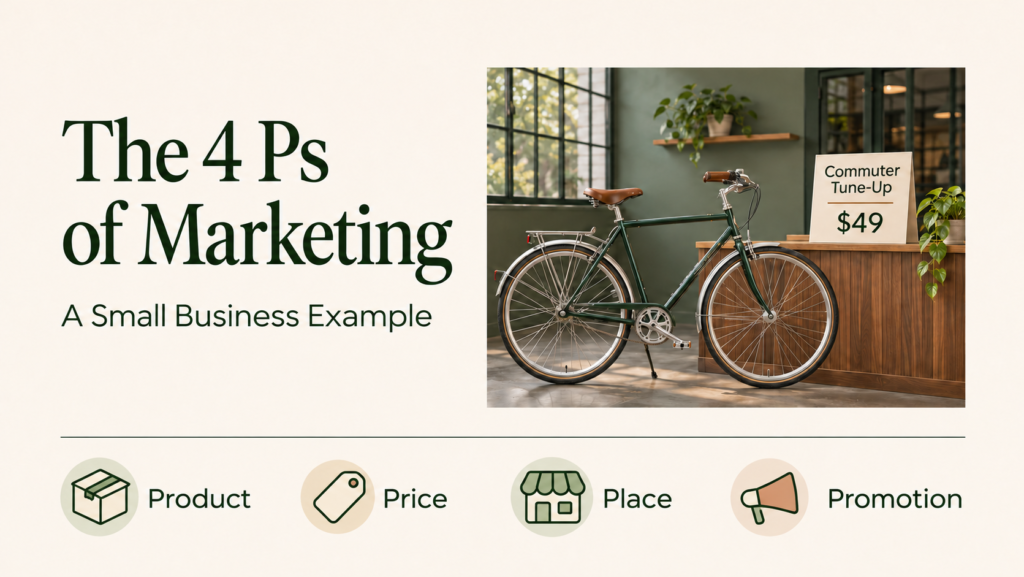
The 4 Ps of marketing are product, price, place, and promotion. Together they form a marketing mix, the set of decisions that shapes what customers buy, what they pay, where they get it, and how they hear about it. This guide explains the four decisions, then works through a fictional bike shop’s service launch, including its pricing and promotion math.
What are the 4 Ps of marketing?
| P | What it covers | Question to ask |
|---|---|---|
| Product | The goods or services you offer and what the customer receives | What problem does this solve, and what is included? |
| Price | What customers pay and how you present charges, discounts, or terms | Is the price clear to customers, and what does it leave after direct costs? |
| Place | Where customers find, buy, and receive the offer | Can they complete the purchase or booking without unnecessary steps? |
| Promotion | The message and channels you use to reach buyers | Where will the right customers see the offer, and what will they do next? |
Product is the offer the customer receives
Spell out what the customer gets. For a product, that might mean the size, materials, bundle, and support. For a service, it might mean the work included, the time required, and how you handle extra requests. A clearly defined offer makes it easier to explain the price and fulfill the service consistently.
Price is what the customer pays
Consider the cost of delivering the offer, what customers value, and what they can buy elsewhere. Decide whether you’ll charge a fixed fee, price by unit, sell a bundle, or quote each job. Make additional charges visible before the customer commits. If you run a discount, calculate what it does to the amount left to cover overhead.
Place is where the customer buys and receives it
Place includes distribution and the purchase process. A physical product might sell through a website and ship from a warehouse. A local service might use online booking and deliver the work in person. Trace the steps from seeing the offer to receiving it. A booking form that omits available appointment times can make a good offer harder to buy.
Promotion is how the customer hears about it
Promotion includes the message and the channel. It could be a window sign, an email to customers who asked for updates, or an ad aimed at people nearby. Give readers enough information to decide whether the offer fits, then ask for one next action, such as viewing available appointments.
Worked example of the 4 Ps at a neighborhood bike shop
Harbor Wheel Cycles is a fictional independent bike shop. It wants to fill six quieter Tuesday and Wednesday afternoon slots with a basic service for local commuters. The shop starts with one offer that fits the work its mechanic can complete in those slots.
1. Product — a commuter bike tune-up
The service includes brake and gear adjustments, a tire-pressure check, and chain lubrication. Replacement parts and major repairs are quoted separately. If the mechanic finds a problem outside the package, the shop contacts the customer for approval before doing extra work.
That scope matters for the other three Ps. The shop can publish a fixed price for routine work, set aside a predictable appointment window, and tell customers exactly what the promotion includes.
2. Price — $49 per tune-up
The shop uses these illustrative figures to check what each completed service contributes before overhead.
| Item | Amount per completed tune-up |
|---|---|
| Selling price before any applicable tax | $49 |
| Direct mechanic labor | $18 |
| Supplies | $4 |
| Payment processing | $2 |
| Total direct cost | $24 |
| Contribution before promotion and overhead | $25 |
The shop estimates that each $49 job leaves $25 after its direct costs. The remaining amount still has to help cover expenses such as rent and utilities. The figures are examples, and a real shop would use its own labor, supply, and payment costs.
3. Place — book online and bring the bike to the shop
Customers choose a Tuesday or Wednesday afternoon slot on a simple booking page. It shows the shop’s address, whether the appointment is a drop-off, and when staff expect the bike to be ready. The shop can also accept bookings by phone, and staff use the same calendar to avoid double-booking.
The booking page repeats the package scope and price, so people see the same offer on the page as they did in the ad.
4. Promotion — tell commuters when the slots are available
The shop posts a sign for walk-in customers and runs a $30 local social ad that links to its booking page. The ad promotes the slots the shop can actually fulfill.
Commuter bike tune-ups for $49 on Tuesday and Wednesday afternoons. Includes brake and gear adjustments, a tire-pressure check, and chain lubrication. Parts and major repairs are quoted separately. See available appointments.
The ad uses a tagged link, and front-desk staff ask phone customers how they heard about the service. The shop records how many bookings each source produced and how many of those customers showed up and paid.
How the shop checks the numbers after the promotion
Suppose the shop spends $30 on the ad and records six completed tune-ups from ad-attributed bookings. Those bookings generate $294 in sales. Here is how the shop can evaluate the results.
| Measure | Calculation | Result |
|---|---|---|
| Direct service costs | 6 × $24 | $144 |
| Ad cost per completed tune-up | $30 ÷ 6 | $5 |
| Contribution after direct costs and ad spend | $294 − $144 − $30 | $120 |
| Contribution per completed tune-up before overhead | $120 ÷ 6 | $20 |
That $120 is the amount left to contribute toward overhead after the costs shown. Attribution tells the shop which bookings it linked to the ad. Some of those customers might have booked anyway, so the shop can compare the slots with a normal week before deciding whether to repeat the campaign.
Look at where the offer broke down before changing it. If customers click but leave the booking page when they see the times, review slot availability. If they call to ask whether parts are included, clarify the scope in the ad and on the page. If completed jobs leave too little after direct costs, revisit the price or what the service includes.
A 4 Ps checklist for your own small business
- Product. Describe one offer in a sentence and list what the customer receives.
- Price. Calculate the direct cost and check what remains at the price you plan to charge.
- Place. Follow the buying process yourself, including the booking, checkout, collection, or delivery step.
- Promotion. Pick one channel and a clear message. Decide how you’ll track the outcome that matters, such as completed bookings or paid orders.
Before publishing, compare the promotion with your booking page or checkout. The price, availability, and scope should agree everywhere the customer sees them.
Frequently asked questions
1. Are the 4 Ps and the marketing mix the same thing?
The 4 Ps are one way to organize a marketing mix. They describe decisions about what you offer, what you charge, how customers get it, and how you promote it. A small business can use the framework to review one offer at a time.
2. Which of the 4 Ps should a small business start with?
Start with a specific customer and product or service. Once you know what the customer receives, you can estimate the cost, check how you’ll deliver it, and write a clearer message. If the price or delivery process proves unworkable, revisit the offer.
3. What does “place” mean for an online business?
Place includes the channels and steps that make the offer available. For an online store, that could mean the website, checkout, shipping regions, and delivery options. For a business selling online consultations, it might mean the booking platform and how customers join the call.
4. Can the 4 Ps work for a service business?
Yes. In a service business, the product is the service package and what the customer receives. Price can be a fixed fee or hourly rate. Place might be a branch, a client site, or a video call. Promotion communicates the offer to people who are likely to need it.
5. What are the 7 Ps, and when would I use them?
The 7 Ps add people, process, and physical evidence. They help when the customer’s experience depends heavily on service staff, handoffs, or visible signs of quality. A repair shop could use them to review how staff explain quotes, how customers receive status updates, and how the shop presents completed work.
Conclusion
Choose one offer and follow it through all four decisions. Check that the price supports the work, the booking or buying process makes the offer easy to get, and the promotion describes what you can deliver. After the first test, use completed sales or bookings to decide which part of the marketing mix to adjust.