
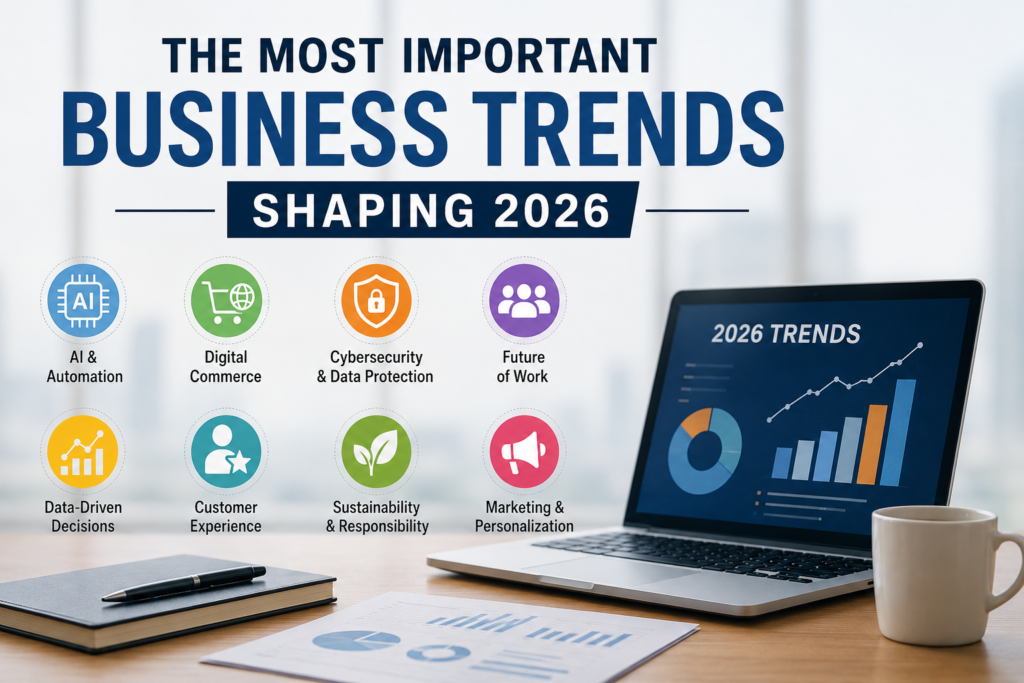

Business is changing quickly in 2026.
Technology is becoming more deeply integrated into everyday operations, customers are becoming more selective about where they spend their money, and businesses are under increasing pressure to become efficient while maintaining quality.
Artificial intelligence is one of the most visible changes, but it is only part of the story. Businesses are also dealing with changes in digital commerce, cybersecurity, workforce expectations, customer experience, data management, and sustainability.
For business owners, managers, marketers, and professionals, understanding these developments is useful because today’s business environment is increasingly shaped by the interaction between technology, people, customers, and operational efficiency.
So, what are the most important business trends shaping 2026, and what do they mean for companies?
Let’s examine the trends that matter most.
1. Artificial Intelligence Is Becoming a Business Tool
Artificial intelligence has moved beyond being a technology discussed mainly by researchers and technology companies.
In 2026, businesses across different industries are exploring AI for practical tasks such as content creation, customer service, data analysis, software development, research, administration, and workflow automation.
The important shift is that companies are increasingly asking:
How can AI solve a specific business problem?
rather than simply asking whether they should use AI.
AI Is Supporting Everyday Work
Businesses can use AI tools to assist employees with tasks such as:
- Summarizing documents
- Drafting emails
- Analyzing information
- Organizing data
- Creating content drafts
- Answering routine customer questions
- Researching topics
- Supporting software development
- Automating repetitive workflows
However, businesses should not assume that AI-generated output is automatically accurate.
Human review remains important, particularly when information is sensitive, complex, or business-critical.
AI Agents Are Getting More Attention
Another development is the growth of AI systems designed to perform multiple steps toward completing a task.
Instead of simply answering a question, an AI-enabled system may be able to help organize information, interact with software, and complete parts of a workflow.
This could change how employees interact with business software.
The opportunity is significant, but companies also need to consider security, permissions, accuracy, data privacy, and accountability before allowing AI systems to perform important actions.
2. Businesses Are Prioritizing Efficiency
Economic uncertainty, competition, and changing customer expectations are encouraging businesses to look closely at how efficiently they operate.
Efficiency does not necessarily mean reducing staff or cutting costs everywhere.
Instead, it can mean finding better ways to use existing resources.
Businesses are examining:
- Manual processes
- Unnecessary administrative work
- Technology costs
- Supply chains
- Inventory management
- Customer-service processes
- Marketing spending
- Internal communication
- Employee productivity
Automation Can Remove Repetitive Work
Automation is particularly useful when employees repeatedly perform the same predictable task.
For example, a business might automate:
- Data entry
- Appointment reminders
- Invoice notifications
- Customer-service routing
- Report generation
- Inventory alerts
The objective should be to allow employees to spend more time on activities that require judgment, communication, creativity, and problem-solving.
3. Customer Experience Is Becoming a Competitive Advantage
Customers have more choices than ever in many markets.
They can compare products, prices, reviews, delivery options, and services before making a purchase.
As a result, businesses cannot rely only on having a good product.
The overall customer experience matters.
This includes:
- How easy it is to find information
- How quickly questions are answered
- How simple the purchasing process is
- How transparent pricing is
- How businesses handle complaints
- How quickly orders are delivered
- How easy it is to return a product
- Whether customers receive useful support after purchase
Convenience Matters
A customer may choose one business over another simply because the first company makes the process easier.
For example, a mobile-friendly website, clear product information, multiple payment options, and responsive customer service can significantly improve the purchasing experience.
Technology can help businesses provide this convenience, but technology itself is not the goal.
The goal is a better experience for the customer.
4. Digital Commerce Continues to Evolve
E-commerce is no longer simply about having an online store.
Businesses are selling through multiple digital channels, including websites, mobile platforms, social media, online marketplaces, and messaging services.
This creates both opportunities and challenges.
Businesses Need an Integrated Digital Presence
A customer might discover a product on social media, research it through a search engine, visit a website, ask a question through messaging, and eventually purchase through an online store.
Businesses therefore need to think about the entire customer journey rather than treating each platform separately.
Important areas include:
- Website usability
- Mobile optimization
- Search visibility
- Social media
- Online payments
- Customer reviews
- Delivery
- Customer support
- Retention
For smaller businesses, the lesson is not that they need to be everywhere.
Instead, they should identify the digital channels their customers actually use and concentrate their resources there.
5. Data Is Becoming More Important for Business Decisions
Modern businesses generate large amounts of information.
Sales transactions, website visits, customer interactions, inventory records, advertising performance, and operational data can all provide useful insights.
But collecting data is not enough.
Businesses need to understand what the data actually means.
From Guesswork to Evidence
Instead of making decisions entirely based on assumptions, businesses can use data to investigate questions such as:
- Which products are selling?
- Which marketing channels are producing results?
- Where are customers abandoning the purchasing process?
- Which services generate the most complaints?
- When does demand increase?
- Which operational processes take the most time?
Data does not eliminate uncertainty.
It simply gives businesses another source of evidence for making decisions.
Data Quality Matters
Poor-quality data can lead to poor decisions.
Businesses should therefore pay attention to:
- Accuracy
- Completeness
- Consistency
- Security
- Data governance
- Appropriate access
6. Cybersecurity Is Becoming a Business Priority
Cybersecurity is no longer just an IT department issue.
Businesses of all sizes increasingly depend on digital systems for payments, communication, customer information, documents, and daily operations.
A security incident can therefore affect the entire organization.
Common Areas Businesses Need to Protect
Companies should consider security across:
- Employee accounts
- Customer information
- Payment systems
- Cloud services
- Business websites
- Internal networks
- Mobile devices
- Third-party software
- Backups
Employees Are Part of the Security Strategy
Technology alone cannot eliminate cybersecurity risks.
Employees need appropriate training on issues such as:
- Suspicious emails
- Password security
- Multi-factor authentication
- Safe handling of sensitive information
- Unauthorized software
- Social engineering
For businesses adopting AI, security becomes even more important because AI systems may interact with sensitive business information or other software.
7. The Workplace Is Becoming More Flexible
The traditional workplace continues to evolve.
Depending on the industry and job, employees may work from offices, remotely, or through hybrid arrangements.
Technology has made collaboration possible across different locations.
But flexible work requires more than video-conferencing software.
Businesses need effective systems for:
- Communication
- Project management
- Performance measurement
- Team collaboration
- Documentation
- Employee development
- Information security
Skills Matter More Than Ever
As technology changes jobs, employees need opportunities to develop new skills.
Important capabilities include:
- Digital literacy
- Critical thinking
- Communication
- Problem-solving
- Adaptability
- Data literacy
- AI literacy
- Industry-specific expertise
The future workplace is unlikely to be defined by technology alone.
It will increasingly involve people working alongside technology.
8. Businesses Are Paying More Attention to Sustainability
Sustainability continues to influence business decisions.
For some companies, environmental considerations are connected to regulatory requirements. For others, they relate to operating costs, supply-chain resilience, customer expectations, or long-term strategy.
Businesses may examine areas such as:
- Energy consumption
- Packaging
- Waste
- Transportation
- Supply chains
- Resource efficiency
- Product design
Sustainability Can Also Mean Efficiency
Some sustainability initiatives can overlap with good operational management.
For example, reducing unnecessary material use can potentially reduce waste and operating costs.
However, businesses should avoid making environmental claims they cannot substantiate.
Transparent communication is more valuable than exaggerated sustainability marketing.
9. Personalization Is Changing Marketing
Customers increasingly expect businesses to understand their needs.
Digital platforms make it possible for companies to tailor certain communications and recommendations based on customer interactions and preferences.
For example, an online store may recommend products related to previous browsing or purchasing activity.
A business may also personalize:
- Email campaigns
- Product recommendations
- Website experiences
- Customer-service interactions
- Promotional messages
- Content
However, personalization needs to be balanced with privacy.
Businesses should be clear about how customer information is collected and used and should follow applicable privacy requirements.
10. Social Commerce Is Connecting Marketing and Sales
Social media is increasingly being used not only to build awareness but also to support product discovery and purchasing.
A potential customer can encounter a product through a short video, creator recommendation, company post, or advertisement and then move directly toward a purchase.
This reduces the distance between marketing and commerce.
Authenticity Matters
Social media users are exposed to enormous amounts of promotional content.
Businesses therefore need to create content that is genuinely useful or interesting.
Instead of constantly saying:
“Buy our product.”
A stronger approach can be to provide:
- Demonstrations
- Educational content
- Product comparisons
- Practical tips
- Customer questions and answers
- Behind-the-scenes information
- Helpful explanations
Marketing becomes more valuable when it helps customers make informed decisions.
11. Small Businesses Have Access to More Digital Tools
Technology is not only benefiting large corporations.
Small businesses can now access software for:
- Accounting
- Customer relationship management
- Marketing
- Website management
- E-commerce
- Communication
- Scheduling
- Analytics
- AI-assisted productivity
This can reduce the amount of technical infrastructure a small company needs to build itself.
However, having access to more tools can also create a new problem: too many tools.
A small business does not need every new application.
The better approach is to choose technology based on actual business needs.
12. Trust and Transparency Are Becoming More Valuable
As AI-generated content, automated communication, and digital advertising become more common, trust becomes increasingly important.
Customers want to know:
- Who is behind a business?
- Is the information accurate?
- Are prices transparent?
- Can they contact a real person?
- How is their information handled?
- Are product claims supported?
Businesses that communicate clearly can build stronger relationships with customers.
This is particularly important online, where customers may have limited information about the company they are dealing with.
Human Connection Still Matters
Automation can improve efficiency, but customers do not always want an automated experience.
For complicated complaints, sensitive situations, or unusual requests, human support can be much more appropriate.
The strongest customer experience may therefore combine automation for speed with humans for judgment and empathy.
What These Business Trends Mean for Small Businesses
Small businesses do not need to respond to every trend at the same time.
A practical approach is to focus on areas that directly affect customers and operations.
Start With Your Biggest Problem
Ask:
What currently wastes the most time or creates the biggest customer problem?
That might be:
- Slow customer responses
- Manual bookkeeping
- Poor inventory management
- Difficult online ordering
- Ineffective marketing
- Repetitive administrative tasks
Technology should be considered after identifying the problem.
Choose Tools Carefully
Before adopting a new technology, ask:
- What problem does it solve?
- How much does it cost?
- How much time could it save?
- What information does it require?
- Is the information secure?
- Can employees use it effectively?
- What happens if the technology fails?
- Can the results be measured?
This prevents businesses from adopting technology simply because it is popular.
How Businesses Can Prepare for 2026 and Beyond
Companies that want to remain competitive can take several practical steps.
1. Build Digital Skills
Employees should understand the digital tools relevant to their jobs.
2. Experiment Carefully With AI
Start with low-risk tasks and evaluate the results before expanding usage.
3. Strengthen Cybersecurity
Use strong authentication, appropriate access controls, backups, security training, and regular reviews.
4. Understand Your Customers
Use customer feedback and reliable business data to understand what people actually need.
5. Improve Your Online Presence
Make sure customers can easily find accurate information about your products, services, prices, and contact options.
6. Avoid Technology for Technology’s Sake
A new tool is valuable only when it solves a genuine problem.
7. Keep Learning
Business conditions and technology will continue to change. Continuous learning is therefore more useful than relying on one strategy indefinitely.
The Biggest Business Lesson for 2026
Perhaps the most important lesson is that business transformation is not simply about adopting the newest technology.
A company can purchase sophisticated AI software and still provide poor customer service.
It can have an impressive website and still have inefficient internal operations.
It can collect enormous amounts of data and still make poor decisions.
Technology works best when it is connected to a clear business objective.
The companies most likely to benefit from today’s technology are not necessarily those using the most tools. They are the companies that understand why they are using them.
Frequently Asked Questions
1. What are the most important business trends shaping 2026?
Major trends include AI adoption, automation, digital commerce, cybersecurity, data-driven decision-making, changing customer expectations, workplace transformation, personalization, sustainability, and the growing importance of digital skills.
2. Is AI the biggest business trend in 2026?
AI is one of the most significant technology trends affecting businesses, but its importance varies by industry. Other issues such as cybersecurity, customer experience, workforce skills, and operational efficiency remain equally important for many organizations.
3. How can small businesses benefit from business trends in 2026?
Small businesses can benefit by adopting practical digital tools for areas such as customer service, marketing, accounting, e-commerce, analytics, and routine administration. The focus should be on solving real problems rather than adopting technology simply because it is new.
4. Will AI replace business employees?
AI can automate some tasks and change how certain jobs are performed, but the effect differs between industries and occupations. Businesses will still need people for judgment, communication, creativity, relationship-building, and specialized expertise.
5. What should businesses prioritize in 2026?
There is no universal priority for every company. Businesses should generally begin by understanding their customers, identifying operational problems, protecting important information, developing employee skills, and adopting technology where it provides a clear and measurable benefit.
Conclusion
The most important business trends shaping 2026 are not limited to artificial intelligence.
AI and automation are changing workflows, digital commerce is changing how customers buy, cybersecurity is becoming increasingly important, data is influencing decisions, and workplace expectations continue to evolve.
At the same time, customers still care about fundamentals: good products, fair value, reliable service, clear communication, and trust.
For business owners and professionals, the best response is not to chase every new trend.
Instead, identify the changes that are most relevant to your customers and industry, understand their potential benefits and risks, and adopt technology with a clear purpose.
The businesses that approach 2026 thoughtfully will be better positioned to adapt as the business environment continues to change.