
Getting customers online is no longer simply about having a website or posting regularly on social media. In 2026, customers can discover a business through search engines, social platforms, online communities, videos, maps, recommendations, email, and increasingly AI-powered discovery tools.
That creates more opportunities, but it also makes digital marketing more complicated.
The solution is not to be everywhere at once. A better approach is to understand where your potential customers spend their time, create useful content that answers their questions, build trust, and make it easy for interested people to take the next step.
This guide explains how to get customers online in 2026 using practical strategies that businesses can adapt to their audience, budget, and goals.
What Has Changed About Getting Customers Online?
The basic principle of customer acquisition has not changed: businesses need to reach the right people, demonstrate value, build trust, and provide a clear way to buy or contact them.
What has changed is the number of places where these interactions can happen.
A potential customer might:
- Search Google for a solution.
- Watch a product demonstration on YouTube.
- Discover a business through social media.
- Ask an AI tool for recommendations or information.
- Read customer reviews.
- Visit the company’s website.
- Compare alternatives.
- Subscribe to an email list.
- Contact the business.
- Make a purchase later.
Because the customer journey can involve several channels, businesses should think beyond individual posts or advertisements.
The goal is to build a connected customer journey.
1. Define Your Ideal Customer
Before spending money on advertising or creating dozens of social media posts, understand who you are trying to reach.
A clear customer profile can help you make better decisions about your content, channels, messaging, and offers.
Consider questions such as:
- Who is most likely to need your product or service?
- What problem are they trying to solve?
- What questions do they ask before purchasing?
- What factors influence their decision?
- What alternatives are they considering?
- Where do they search for information?
- What might prevent them from buying?
- What information would make them more confident?
For example, a company selling accounting software to small businesses should not communicate in exactly the same way as a company selling accounting software to large corporations.
The needs, budget, decision-making process, and level of technical knowledge can be very different.
Create a Simple Customer Profile
You do not need an elaborate marketing document.
Start with:
Audience: Small business owners
Problem: Managing invoices and expenses manually
Goal: Save time and organize finances
Concern: Cost and complexity
Useful content: Tutorials, comparisons, checklists, and product explanations
This information can guide your entire marketing strategy.
2. Build a Website That Converts Visitors Into Customers
Your website is often the central point of your online presence.
However, simply having a website does not guarantee customers.
A useful business website should quickly answer three questions:
What do you offer?
Who is it for?
What should the visitor do next?
Your homepage should communicate the core value of the business without forcing visitors to search through several pages.
Important Website Elements
Consider including:
- A clear headline
- A concise explanation of your product or service
- Relevant images or demonstrations
- Benefits explained in straightforward language
- Pricing or information about how pricing works
- Customer reviews where appropriate and genuine
- Frequently asked questions
- Contact information
- Clear calls to action
- Privacy and other relevant legal information
Avoid filling every section with promotional language.
A customer who is still researching needs useful information, not pressure.
3. Use SEO to Reach People Who Are Already Searching
Search engine optimization can help businesses become visible when potential customers are actively looking for information, products, or services.
Instead of trying to rank for every possible keyword, focus on topics that genuinely relate to your business and customer needs.
For example, a company selling website design services could create content around:
- How much does a business website cost?
- What should a small business website include?
- Website vs social media: What does a business need?
- How to prepare content for a new website
- How to choose a website designer
These topics address real questions.
Create Content Around Different Search Intent
Not everyone searching online is ready to buy.
Some people are learning.
Others are comparing options.
Some are looking for a specific company.
Others are ready to purchase.
Your content can address different stages.
| Search intent | Example | Useful content |
|---|---|---|
| Informational | How does email marketing work? | Guide |
| Commercial | Best email marketing tools | Comparison |
| Transactional | Buy email marketing software | Product/service page |
| Navigational | Company name login | Branded page |
A strong SEO strategy recognizes these differences rather than treating every visitor as an immediate buyer.
4. Create Helpful Content That Demonstrates Expertise
Content marketing remains useful because customers often need information before making a decision.
But publishing large amounts of low-value content is not a good strategy.
Focus on answering questions your customers actually have.
Useful formats include:
Educational Blog Posts
Explain problems, processes, trends, and solutions.
How-To Guides
Show readers how to complete a relevant task.
Comparisons
Explain meaningful differences between products, services, approaches, or tools.
Case Studies
Where genuine examples are available, explain the problem, approach, and outcome without exaggerating results.
Videos
Demonstrate products, explain processes, answer questions, or provide educational information.
Checklists
Turn complicated processes into practical steps.
The best content should leave the reader with something useful even if they do not immediately purchase.
5. Make Your Business Discoverable on Social Media
Social media can help businesses reach potential customers, build recognition, communicate with existing audiences, and distribute content.
However, businesses do not necessarily need to maintain an active presence on every platform.
Choose platforms based on your audience and the type of content you can consistently produce.
For example:
- Instagram: Visual products, lifestyle businesses, creators, and short-form content
- LinkedIn: B2B services, professional expertise, and business audiences
- YouTube: Tutorials, demonstrations, reviews, and educational content
- TikTok: Short-form educational and entertainment-oriented content
- Facebook: Communities, local businesses, groups, and broad consumer audiences
These are broad tendencies rather than rules. Your actual customer data should determine where you invest your time.
Focus on Useful Posts
Instead of constantly saying “Buy now,” consider publishing:
- Tips
- Tutorials
- Frequently asked questions
- Product demonstrations
- Behind-the-scenes information
- Industry explanations
- Customer education
- Responses to common problems
Social media works better when people have a reason to follow or engage with your business.
6. Optimize Your Local Online Presence
If your business serves customers in a specific geographic area, local search can be particularly important.
Make sure your business information is accurate and consistent across relevant online platforms.
Pay attention to:
- Business name
- Address
- Phone number
- Opening hours
- Website
- Services
- Photos
- Customer reviews
A customer searching for a nearby restaurant, repair service, clinic, retailer, or professional service may be making a decision quickly.
Accurate information can make the difference between contacting your business and choosing another option.
Ask for Genuine Reviews
Reviews can help potential customers understand other people’s experiences.
If you request reviews, ask genuine customers to share honest feedback.
Do not manufacture reviews or misrepresent customer experiences.
7. Use Short-Form Video Strategically
Video has become an important format for online communication because it can demonstrate ideas quickly.
Businesses can use short videos to answer simple customer questions.
For example:
A clothing business:
“Three ways to style this jacket.”
A software company:
“How to create your first invoice in two minutes.”
A restaurant:
“How today’s special is prepared.”
A marketing agency:
“Three common mistakes on business websites.”
The key is to make the video useful rather than simply promotional.
A strong opening should immediately tell viewers what they will learn.
8. Build an Email List
Social platforms and search engines can help businesses reach audiences, but those platforms are controlled by third parties.
An email list gives a business a direct communication channel with people who have chosen to receive messages.
You might offer a useful resource in exchange for an email address, such as:
- A checklist
- A guide
- A template
- A newsletter
- Educational updates
- Relevant product information
Don’t Overload Subscribers
Email marketing can become ineffective if every message is a sales pitch.
A balanced strategy might include:
- Educational information
- New content
- Helpful resources
- Product updates
- Relevant offers
Always follow applicable privacy and email marketing requirements in the markets where you operate.
9. Use Paid Advertising Carefully
Organic marketing can take time.
Paid advertising can help businesses reach specific audiences more quickly, but it requires careful budgeting and measurement.
Common advertising channels include:
- Search advertising
- Social media advertising
- Display advertising
- Video advertising
- Shopping campaigns
The right option depends on the business.
For example, search advertising may be useful when people are actively looking for a product or service. Social advertising may be useful for reaching audiences based on interests or other available targeting options.
Start With a Small Test
Rather than committing a large budget immediately, test:
- One audience
- One offer
- A small number of creatives
- A clear landing page
- A defined conversion goal
Then evaluate the results.
Important metrics can include:
- Click-through rate
- Cost per click
- Conversion rate
- Cost per lead
- Cost per acquisition
- Revenue generated
Do not judge an advertising campaign solely by how many people clicked an advertisement.
The more important question is whether the traffic produced a valuable business outcome.
10. Improve Your Landing Pages
A person who clicks an advertisement or marketing link should arrive somewhere relevant.
For example, if an advertisement promotes a specific service, sending the visitor to a generic homepage may create unnecessary friction.
A dedicated landing page can focus on:
- The specific problem
- The proposed solution
- Key benefits
- Important details
- Common questions
- Evidence or reviews where genuine
- A clear next step
Keep the page easy to understand.
Remove unnecessary distractions that prevent visitors from finding the information they need.
11. Use AI as a Marketing Assistant, Not a Replacement for Judgment
AI tools can help businesses with many marketing tasks in 2026.
For example, they can assist with:
- Brainstorming content ideas
- Organizing research
- Creating content outlines
- Summarizing information
- Analyzing customer feedback
- Generating variations of marketing copy
- Repurposing existing content
- Automating certain routine workflows
However, businesses should review AI-generated material before publishing it.
AI can produce inaccurate information, outdated details, unsuitable wording, or content that does not reflect the company’s actual experience.
Human review remains important, particularly for claims about products, prices, policies, regulations, and business performance.
A Better AI Workflow
A practical process is:
Research → Draft → Human review → Fact-check → Edit → Publish → Measure
The goal should be better customer communication, not simply producing more content.
12. Build Trust Before Asking for the Sale
Online customers cannot physically walk into every business they consider.
They often look for signals that a business is legitimate and reliable.
Useful trust signals include:
- Clear contact information
- Transparent policies
- Accurate product descriptions
- Genuine customer reviews
- Professional website design
- Secure payment options where applicable
- Helpful educational content
- Clear pricing information
- Consistent business information
Do not make claims that cannot be supported.
If you say a product is “the best,” explain what makes it suitable for a particular customer instead.
Specific information is generally more useful than exaggerated marketing language.
13. Make the Buying Process Simple
You can attract thousands of visitors and still struggle to generate customers if the purchasing process is confusing.
Look at your customer journey from the visitor’s perspective.
Ask:
- Can visitors quickly understand the offer?
- Is the next step obvious?
- Can they easily contact the business?
- Is the checkout process straightforward?
- Are prices clear?
- Are shipping or delivery details easy to find?
- Can customers find answers to common questions?
- Does the website work well on mobile devices?
Every unnecessary step can create friction.
The simpler the experience, the easier it is for an interested visitor to move forward.
14. Measure What Actually Matters
Marketing decisions should be based on evidence rather than assumptions.
Set a few meaningful goals.
For example:
Goal: Generate more qualified leads.
Possible measurements:
- Website visits
- Contact form submissions
- Phone calls
- Email inquiries
- Booked consultations
- Qualified leads
- Customers acquired
For an online store, you might also monitor:
- Product views
- Add-to-cart activity
- Checkout completion
- Purchases
- Average order value
Avoid Vanity Metrics
A large follower count can look impressive, but it does not automatically mean a business is acquiring customers.
Likewise, a high number of website visits is not necessarily valuable if the visitors are not part of the target audience.
Focus on metrics connected to your actual business objectives.
15. Create a Simple Customer Acquisition Funnel
A practical online marketing funnel can look like this:
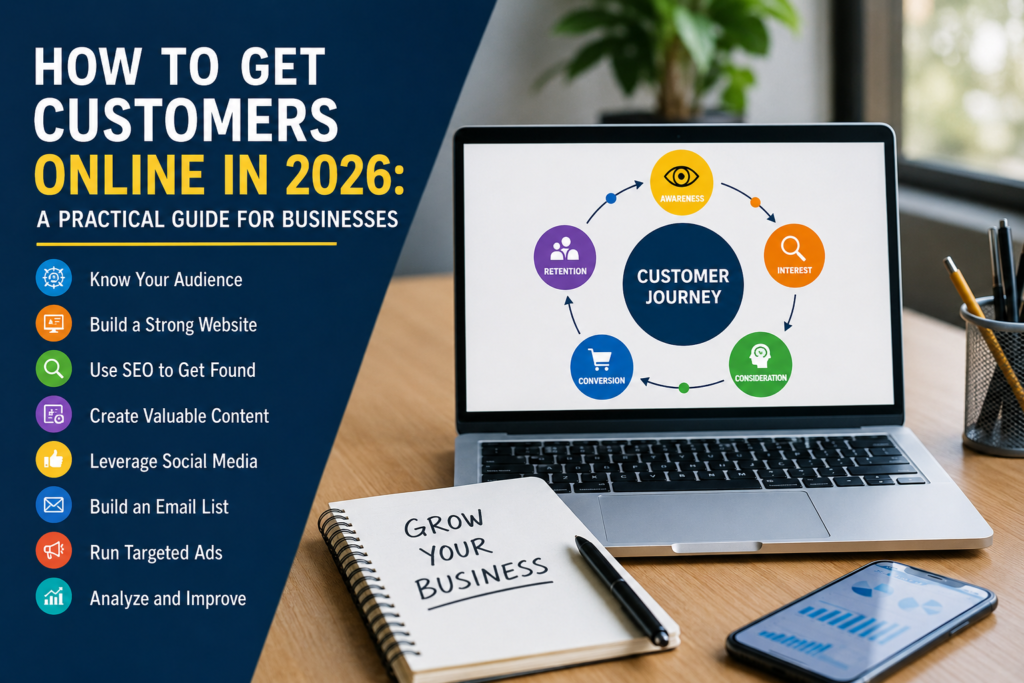
Awareness → Interest → Consideration → Conversion → Retention
Awareness
People discover your business through search, social media, video, advertising, referrals, or other channels.
Interest
They visit your website, watch your content, read an article, or follow your business.
Consideration
They compare your solution with alternatives and look for additional information.
Conversion
They purchase, submit an inquiry, book an appointment, or take another meaningful action.
Retention
You continue providing value after the first transaction.
This final stage is important because customer acquisition is not only about finding new people. Existing customers can also become repeat buyers when the product, service, and overall experience meet their expectations.
16. A Practical 30-Day Online Customer Acquisition Plan
If your business is starting from scratch, do not attempt everything simultaneously.
Week 1: Foundation
- Define your target customer.
- Clarify your main offer.
- Review your website.
- Create or update important business information.
- Set measurable marketing goals.
Week 2: Content
Create several useful pieces of content based on genuine customer questions.
For example:
- Two educational articles
- Three short videos
- Several social media posts
- One useful downloadable resource
Adapt the numbers to your available time and resources.
Week 3: Distribution
Share your content through the channels where your customers are most likely to be present.
Consider:
- Search optimization
- Social media
- Local listings
- Relevant communities
- Paid advertising if appropriate
Week 4: Measurement
Review what happened.
Ask:
- Which channel generated useful visitors?
- Which content received meaningful engagement?
- How many inquiries were generated?
- Which pages performed well?
- Where did potential customers leave?
- What should be improved next month?
Then repeat what works and adjust what does not.
Common Mistakes Businesses Should Avoid
Getting customers online is rarely about finding one magical marketing tactic.
Several common mistakes can make the process more difficult.
Trying Every Platform
Being active on ten platforms is not necessarily better than doing a great job on two or three.
Publishing Without a Customer
Content should solve real problems rather than exist simply to fill a publishing calendar.
Buying Traffic Without a Conversion Strategy
Sending visitors to an unclear website can waste advertising money.
Ignoring Mobile Users
Many customers browse and communicate through mobile devices. Your website should provide a usable experience on smaller screens.
Making Unsupported Claims
Overpromising can damage trust and create compliance or reputation problems.
Failing to Follow Up
Someone who does not purchase today may still become a customer later. Appropriate follow-up through channels where the person has given permission can help maintain the relationship.
How Much Does It Cost to Get Customers Online?
There is no single price for online customer acquisition.
Costs vary significantly according to:
- Industry
- Location
- Competition
- Product price
- Customer lifetime value
- Advertising platform
- Target audience
- Marketing skills
- Content production costs
- Website and software costs
Some activities, such as creating educational content or maintaining an organic social presence, can be performed with relatively limited direct spending, although they still require time and resources.
Paid advertising requires a financial budget.
The important question is not simply “How much does marketing cost?”
Instead, ask:
“How much can we reasonably invest to acquire a customer while maintaining a sustainable business?”
That calculation should consider your margins, average customer value, operating costs, and conversion rates.
Frequently Asked Questions
1. What is the best way to get customers online in 2026?
There is no universal best channel. The right approach depends on your customers and business model. A strong starting point is to combine a useful website, search visibility, relevant content, social media or another appropriate distribution channel, and a clear conversion process.
2. Can a small business get customers online without a large advertising budget?
Yes. A business can use organic approaches such as useful content, search optimization, social media, local visibility, referrals, and email marketing. These approaches still require time and consistent effort, and results can vary.
3. How long does online marketing take to produce customers?
There is no reliable universal timeframe. Paid advertising can generate traffic quickly, while organic search and content marketing often require sustained effort. Results depend on the industry, audience, competition, offer, website, and execution.
4. Should businesses use AI for marketing?
AI can be useful for research assistance, brainstorming, content workflows, analysis, and repetitive tasks. However, businesses should review AI-generated material for accuracy, originality, relevance, and brand suitability before publishing.
5. Should I focus on SEO or social media?
You do not necessarily have to choose one. SEO can help capture search demand, while social media can help distribute content and build relationships. Your customer behavior and available resources should determine where you place the most emphasis.
Conclusion
Learning how to get customers online in 2026 is less about chasing every new platform and more about building a reliable customer journey.
Start by understanding your audience. Build a trustworthy website, create genuinely useful content, improve your search visibility, choose social platforms carefully, consider email and paid advertising where appropriate, and make the buying process straightforward.
Most importantly, measure the outcomes that matter to your business.
Digital marketing changes quickly, but the fundamentals remain valuable: understand your customers, provide genuine value, communicate clearly, earn trust, and make it easy for people to take the next step.