
Search is changing.
For many years, digital marketing revolved around one central question: How can my website rank higher in search results? That question is still important, but the way people discover information online is becoming more diverse.
People now search through traditional search engines, ask questions in conversational interfaces, look for direct answers, and increasingly interact with AI-powered systems that can summarize information or recommend sources.
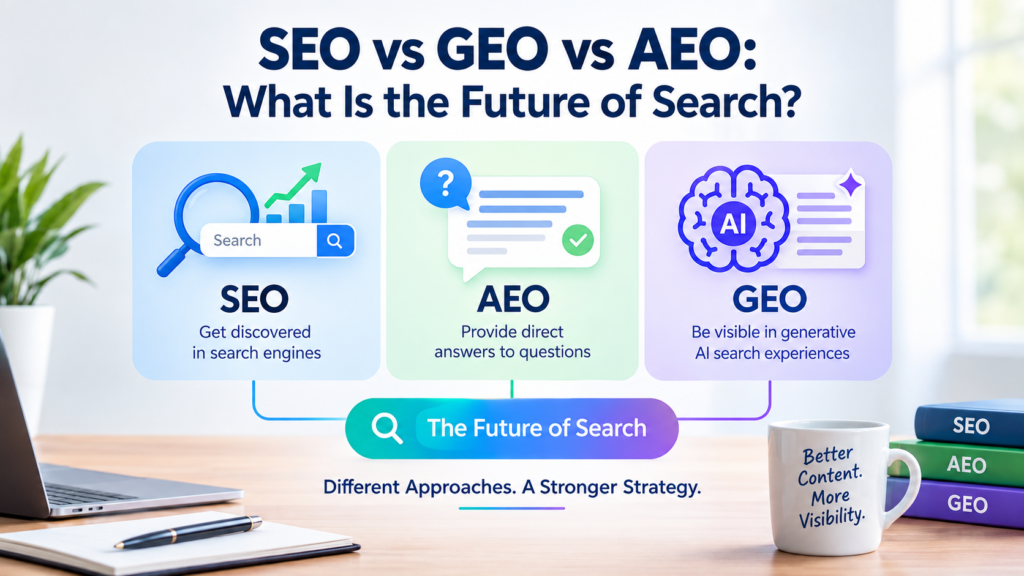
This shift has introduced terms such as AEO (Answer Engine Optimization) and GEO (Generative Engine Optimization) alongside traditional SEO (Search Engine Optimization).
So, what is the difference between them? Are they competing strategies, or do businesses need all three?
The short answer is that SEO, AEO, and GEO address different parts of the modern search experience. Rather than replacing one another completely, they can work together as part of a broader content strategy.
This guide explains SEO vs GEO vs AEO, how each approach works, where each one is useful, and what businesses can do to prepare for the future of search.
What Is SEO?
SEO, or Search Engine Optimization, is the practice of improving webpages so they can be discovered and understood by search engines and potentially appear prominently in organic search results.
Traditional SEO covers several areas, including:
- Search intent and keyword research
- Helpful, original content
- Website structure
- Internal linking
- Page experience and technical performance
- Mobile usability
- Metadata and page titles
- Crawlability and indexability
- Relevant external references and links
- Clear organization of information
The goal is not simply to insert keywords into an article. Good SEO starts with understanding what people are trying to accomplish and creating a useful resource that addresses that need.
Example of SEO
Imagine someone searches:
“Best CRM software for a small business”
An SEO-focused article might compare several CRM solutions, explain important features, discuss pricing considerations, and help readers decide which type of CRM fits their needs.
The page can be structured around the user’s search intent while making the information easy for search engines to understand.
Why SEO Still Matters
Traditional search engines remain an important way for people to discover websites, products, services, businesses, and information.
SEO can also provide benefits beyond rankings. A well-structured website can make content easier for visitors to navigate, understand, and share.
However, modern search is no longer limited to a list of blue links.
That is where AEO and GEO become increasingly relevant.
What Is AEO?
AEO stands for Answer Engine Optimization.
AEO focuses on creating content that clearly answers questions users are asking through search and answer-oriented systems.
Instead of focusing primarily on ranking for a broad keyword, AEO emphasizes providing a clear, direct, useful answer.
For example, a user might ask:
“What is customer relationship management?”
An AEO-friendly page would answer the question directly near the beginning, followed by additional explanation, examples, and useful context.
How AEO Differs From Traditional SEO
SEO and AEO overlap significantly, but their emphasis can differ.
Traditional SEO often considers how a page can perform in search results for a particular query.
AEO places greater emphasis on answering specific questions clearly and efficiently.
This can involve:
- Question-based headings
- Concise definitions
- Step-by-step explanations
- FAQ sections
- Structured content
- Clear factual statements
- Tables or lists where appropriate
- Content organized around user questions
AEO does not mean writing extremely short answers. A detailed article can still be optimized for answers if important questions are addressed clearly.
What Is GEO?
GEO stands for Generative Engine Optimization.
The term generally refers to optimizing content so that it has a better chance of being understood, selected, or represented by generative AI-powered search and answer systems.
These systems can respond to questions with synthesized answers rather than simply displaying a conventional list of webpages.
For businesses, this creates a new consideration:
How can our information remain useful and discoverable when users receive answers generated from multiple sources?
GEO is still an evolving area. There is no universal formula that guarantees that an AI system will mention a particular website or source.
Instead, the practical foundation is creating content that is:
- Accurate
- Relevant
- Clearly structured
- Original
- Easy to understand
- Supported by reliable information
- Focused on the user’s actual question
- Transparent about limitations and uncertainty
Example of GEO
Suppose someone asks an AI-powered search system:
“What should a small business consider when choosing email marketing software?”
A generative system may synthesize information from multiple sources.
A business publishing a comprehensive guide could potentially become one of those sources if its content is relevant, trustworthy, accessible, and useful to the system.
The important point is that GEO is not simply another name for keyword optimization.
It is better understood as part of adapting content to a search environment where AI systems may synthesize information from multiple sources.
SEO vs GEO vs AEO: What’s the Difference?
The easiest way to understand the three approaches is to look at what each one emphasizes.
| Strategy | Main Focus | Typical User Experience |
|---|---|---|
| SEO | Discoverability in search engines | User finds and visits a webpage |
| AEO | Providing direct answers | User receives a clear answer to a question |
| GEO | Visibility within generative search experiences | AI system synthesizes information from sources |
| All Three | Useful, accessible, trustworthy information | User gets an answer and can explore deeper information |
These approaches are not necessarily competitors.
A strong content strategy can incorporate principles from all three.
SEO vs GEO vs AEO: A Practical Example
Consider a company that sells project management software.
It could create an article titled:
“How to Choose Project Management Software for a Small Business”
SEO approach
The company might optimize the page around relevant search intent, create a logical URL, improve technical accessibility, and organize the article clearly.
AEO approach
The article could directly answer questions such as:
- What is project management software?
- What features should small businesses look for?
- How much does project management software cost?
- Is project management software necessary for a small team?
GEO approach
The company could make the content comprehensive, factual, transparent, and easy for systems to interpret.
It could include:
- Clear definitions
- Original explanations
- Feature comparisons
- Practical examples
- Specific limitations
- Updated information
- Links to relevant supporting pages
- Clear information about the company and its product
The result is not three separate articles.
It is one genuinely useful resource designed for different ways people discover and consume information.
Does GEO Replace SEO?
No.
At least, there is no good reason for businesses to abandon SEO simply because generative search is growing.
Search engines still need to discover, crawl, interpret, and organize information across the web. Websites also need to attract visitors who want to go beyond a short answer.
Generative search may change how some users interact with information, but that does not automatically make traditional SEO irrelevant.
A better approach is to think of SEO as a foundation.
Then add answer-focused and generative-search considerations on top of that foundation.
Does AEO Replace SEO?
AEO does not eliminate the need for SEO either.
A page that provides a great answer still needs to be accessible and discoverable.
Technical problems, poor website structure, unclear content, and weak user experience can make useful information harder to find.
The strongest strategy is therefore not:
SEO vs AEO
but rather:
SEO + AEO
How SEO, AEO, and GEO Work Together
Businesses can build a modern search strategy by combining the strongest principles of each approach.
1. Start With Search Intent
Before writing an article, identify what the reader actually wants.
For example, someone searching:
“CRM software”
may want a general definition.
Someone searching:
“best CRM for a small business”
may be comparing products.
Someone searching:
“how to choose a CRM”
may want guidance.
The content should match the underlying purpose of the search.
2. Answer the Main Question Early
Do not force readers to navigate through several paragraphs before reaching the basic answer.
If your article is answering a specific question, provide a concise explanation early.
Then expand with examples, context, practical steps, and limitations.
This approach can benefit both human readers and systems that need to identify the central topic of a page.
3. Build Comprehensive Content
Comprehensive does not mean unnecessarily long.
It means covering the important aspects of a topic that a reader genuinely needs.
For example, a guide about choosing accounting software could discuss:
- Important features
- Business size
- Ease of use
- Integrations
- Security considerations
- Pricing models
- Customer support
- Scalability
- Limitations
The objective should be completeness without filler.
4. Use Clear Headings
Good headings make long content easier to navigate.
Instead of large blocks of text, organize information into logical sections.
For example:
What Is SEO?
What Is AEO?
What Is GEO?
How Are SEO, AEO, and GEO Different?
How Can Businesses Prepare for the Future of Search?
This structure helps readers find what they need quickly.
5. Use Natural Language
People do not always search using perfect keyword phrases.
They may ask complete questions or describe problems conversationally.
For example:
“How can I get more customers from Google?”
could lead to content covering local SEO, content marketing, conversion optimization, and other relevant topics.
Writing naturally allows you to address the topic rather than repeatedly inserting an exact keyword.
6. Support Important Claims
Trust matters in every search environment.
When making factual claims, use reliable sources where appropriate.
Depending on the topic, useful sources may include:
- Government websites
- Academic institutions
- Industry organizations
- Official company documentation
- Original research
- Recognized professional organizations
Avoid citing sources simply to make an article look authoritative. Sources should genuinely support the information being presented.
7. Keep Information Updated
Some information changes quickly.
Software features, pricing, regulations, search interfaces, and technology capabilities can change over time.
If your article discusses information that can become outdated, review it periodically.
An old article containing incorrect pricing or discontinued features can be less useful regardless of how well it was originally optimized.
The Benefits of a Combined Search Strategy
Using SEO, AEO, and GEO principles together can improve the overall quality of a content strategy.
Better content organization
Clear structure makes information easier for people to scan and understand.
Better answers
Answer-focused content can address specific questions rather than forcing readers to search through an article.
Broader search visibility
A business can create content that works across different discovery experiences rather than relying entirely on one format.
Stronger user experience
Content created around genuine user needs tends to be more useful than pages created primarily to target keywords.
More resilient content
Search behavior will continue to change. Building a strong information resource is generally more sustainable than relying on a single optimization tactic.
Challenges and Limitations of GEO
GEO deserves attention, but businesses should approach it realistically.
There Is No Guaranteed AI Visibility
There is no legitimate method that guarantees an AI system will cite, recommend, or mention a particular website.
Generative systems can use different sources and produce different responses depending on the query, system, available information, and other factors.
Therefore, businesses should avoid agencies or tools that promise guaranteed AI citations or guaranteed placement.
Generative Search Is Still Evolving
AI-powered search experiences are developing quickly.
Features, interfaces, ranking systems, citation behavior, and how information is presented can change.
This means businesses should focus on durable fundamentals rather than chasing every new optimization trick.
Visibility Is Not the Same as Conversion
Even if a company becomes visible in an AI-generated answer or search result, that does not automatically mean a visitor will become a customer.
Content still needs to build trust and provide a logical next step.
How Businesses Can Prepare for the Future of Search
Businesses do not need to completely rebuild their marketing strategy overnight.
Instead, they can gradually improve their existing content.
Step 1: Audit Existing Content
Look at your most important pages.
Ask:
- Does this page answer the visitor’s main question?
- Is the information accurate?
- Is anything important missing?
- Are the headings clear?
- Can users quickly find the answer?
- Are claims supported where necessary?
- Is the content still current?
Step 2: Identify Customer Questions
Review questions from:
- Sales conversations
- Customer support
- Product research
- Website searches
- Online communities
- Frequently asked questions
- Search queries relevant to your market
These questions can become useful content topics.
Step 3: Improve Existing Pages
You do not always need to publish a new article.
Sometimes the best opportunity is improving an existing resource.
Add missing explanations, improve organization, remove outdated information, and make important answers easier to find.
Step 4: Create Topic Clusters
Instead of publishing unrelated articles, build groups of content around important subjects.
For example, a marketing website might create a cluster around email marketing:
- What is email marketing?
- How to build an email list
- Email marketing strategies
- Email marketing automation
- Email marketing software comparison
- Email marketing mistakes to avoid
Related pages can then link naturally to one another.
Step 5: Strengthen Your Website’s Trust Signals
Make it easy for visitors to understand:
- Who operates the website
- Who creates the content
- How to contact the business
- What the website’s purpose is
- When content was published or updated where relevant
- Which sources support important claims
Transparency helps create a better experience for readers.
What Should Marketers Focus on in 2026?
The future of search is unlikely to be about choosing one acronym and abandoning the others.
Instead, marketers should think about search visibility as a broader ecosystem.
A modern content strategy should aim to:
Create useful information → make it accessible → answer questions clearly → demonstrate credibility → maintain accurate content → help users take the next useful step.
SEO remains important for discoverability.
AEO encourages businesses to answer questions directly.
GEO reflects the growing importance of generative search experiences.
Together, they encourage a shift away from thinking only about rankings and toward thinking about how people actually discover, understand, and use information.
Common SEO, AEO, and GEO Mistakes
Keyword Stuffing
Repeating a keyword excessively can make content uncomfortable to read and does not automatically make it more useful.
Write for the topic and the reader.
Writing Only for AI
Content should not be created solely to influence an AI system.
If the article is confusing or unhelpful to humans, optimization has missed the point.
Publishing Thin Content
Creating many short pages that provide little original value is unlikely to build a strong information resource.
One genuinely useful article can be more valuable than numerous low-value pages.
Making Unsupported Claims
Avoid statements such as “this strategy guarantees first-page rankings” or “GEO will make your business appear in every AI answer.”
Search visibility does not work that way.
Ignoring Existing Content
Businesses sometimes focus heavily on publishing new articles while leaving older pages inaccurate or poorly organized.
Regular content maintenance is an important part of a sustainable strategy.
Frequently Asked Questions
1. What is the difference between SEO, AEO, and GEO?
SEO focuses primarily on improving discoverability in search engines. AEO focuses on providing clear answers to user questions, while GEO focuses on content visibility and usefulness within generative AI-powered search experiences.
2. Is GEO replacing SEO?
No. GEO is better viewed as an emerging complement to traditional SEO rather than a complete replacement. Businesses can continue using strong SEO fundamentals while adapting their content to new search experiences.
3. Is AEO the same as SEO?
They overlap, but they emphasize different things. SEO is a broader discipline covering search discoverability and website optimization, while AEO places particular emphasis on answering questions clearly and directly.
4. How can a small business prepare for AI search?
Start with the fundamentals: create accurate and original content, answer customer questions clearly, organize information logically, maintain your website, support important claims with trustworthy sources, and keep useful content updated.
5. Can a business guarantee that AI search engines will mention its website?
No. There is no reliable method that guarantees a website will be cited or recommended by every generative search system. Businesses should focus on producing useful, trustworthy, accessible information rather than relying on guaranteed-placement claims.
Conclusion: The Future of Search Is Bigger Than SEO
The debate around SEO vs GEO vs AEO can make it seem as though marketers must choose one strategy.
In reality, the three concepts can complement one another.
SEO helps people discover your content.
AEO encourages you to answer their questions clearly.
GEO reflects the changing environment in which AI-powered systems may summarize and connect information from different sources.
The most sustainable approach is to start with what has always mattered most: helping people find accurate, useful information.
Businesses that understand their audiences, answer genuine questions, maintain trustworthy websites, and create well-structured content will be better positioned to adapt as search continues to evolve.
The future of search may look very different from today’s search results, but the fundamental goal remains the same: connect people with information that genuinely helps them.