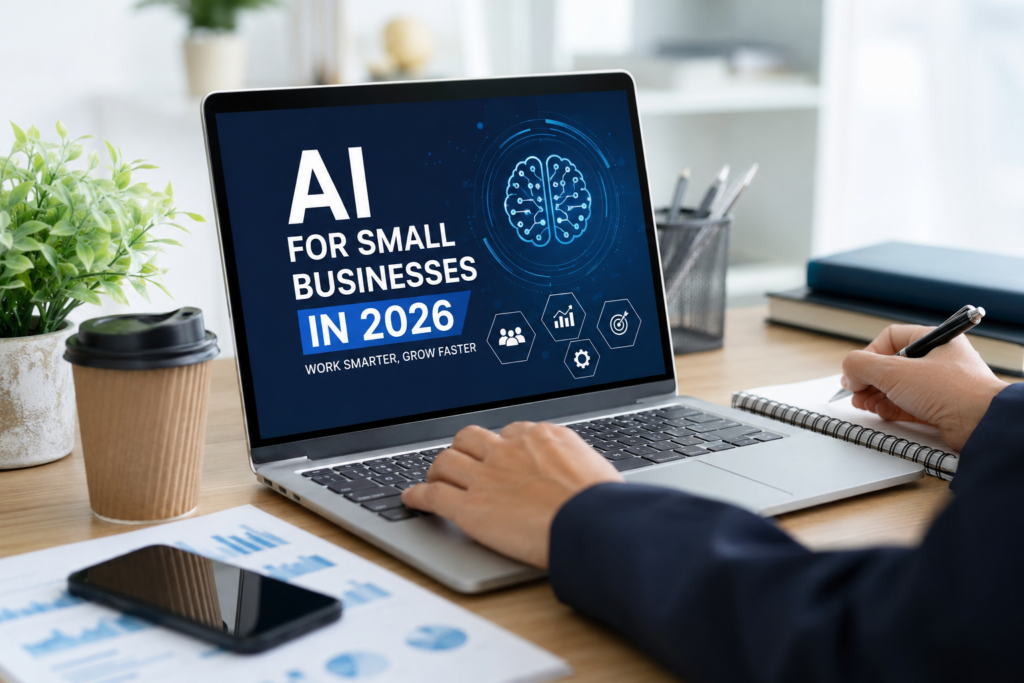

Running a small business has always required entrepreneurs to wear many hats. One person may need to handle marketing in the morning, answer customers in the afternoon, prepare reports in the evening, and still find time to plan the next stage of the business.
In 2026, artificial intelligence is changing how many of these tasks can be handled.
AI tools can help entrepreneurs draft content, analyze information, organize repetitive work, generate ideas, summarize documents, support customer service, and assist with everyday decision-making. But AI is not a replacement for good business judgment. The businesses that use it effectively are usually the ones that understand where automation helps and where human involvement remains essential.
This guide explores how small businesses can use AI practically, what tasks are worth automating, what risks to consider, and how entrepreneurs can introduce AI without making their operations unnecessarily complicated.
What Is an AI-Powered Small Business?
An AI-powered small business is not necessarily a company that develops artificial intelligence.
It can simply be a traditional business that uses AI tools to improve some of its daily operations.
For example, a small marketing agency might use AI to help organize research and create first drafts. An online retailer might use AI to categorize products and answer common customer questions. A consulting business might use AI to summarize meeting notes and organize information.
The important distinction is that AI supports the business rather than becoming the business itself.
Human expertise remains important for decisions involving customers, finances, strategy, quality control, privacy, and reputation.
Why AI Matters to Small Businesses in 2026
Large organizations have traditionally had more resources to invest in technology, specialized employees, and sophisticated systems.
AI is making some advanced capabilities easier for smaller organizations to access.
A small business owner can potentially use AI to:
- Research a market
- Brainstorm business ideas
- Draft marketing materials
- Analyze spreadsheets
- Summarize long documents
- Create customer-service responses
- Organize internal information
- Generate content ideas
- Automate repetitive administrative tasks
- Improve productivity
However, using AI does not automatically make a business more productive.
Poorly designed processes can simply become automated poor processes.
The objective should therefore be to identify genuine bottlenecks before choosing an AI solution.
1. AI for Market Research
Understanding customers is one of the foundations of good business planning.
AI can help entrepreneurs organize and analyze information from sources they are already permitted to use.
For example, a business owner researching a new product could ask an AI tool to help organize:
- Customer questions
- Product features
- Competitor offerings
- Common complaints
- Pricing information
- Potential customer segments
- Frequently discussed problems
The entrepreneur should still verify important information against reliable sources.
AI-generated analysis can contain errors, outdated information, or unsupported assumptions. It should therefore be treated as an assistant for research rather than an unquestionable source of truth.
A Practical Example
Imagine a small business wants to sell office accessories.
Instead of immediately purchasing a large amount of stock, the owner could use AI to organize research questions such as:
Who are the potential customers?
What problems do they experience?
What products already exist?
What features do customers value?
What questions should the business answer before making a purchase?
The AI can help structure the research, while the entrepreneur validates the answers through actual market research.
2. AI for Content Marketing
Content creation can consume significant amounts of time for a small business.
AI can help generate initial drafts for:
- Blog articles
- Social media ideas
- Email newsletters
- Product descriptions
- Video scripts
- Frequently asked questions
- Advertising concepts
But publishing AI-generated content without reviewing it can create problems.
Content should be checked for:
- Accuracy
- Originality
- Tone
- Relevance
- Grammar
- Unsupported claims
- Outdated information
The strongest approach is often AI-assisted content creation, where the business owner provides expertise, direction, examples, and review while AI helps with repetitive drafting work.
3. AI for Customer Service
Customer service is another area where AI can be useful.
Businesses can use AI-powered systems to help answer common questions about:
- Opening hours
- Product availability
- Delivery procedures
- Basic product information
- Return policies
- Appointment procedures
For simple questions, automated assistance can save time.
However, customers should have a clear path to human support when an issue is complicated, sensitive, or requires judgment.
For example, an automated system may explain a general return policy, while a staff member handles a disputed order or unusual customer complaint.
The Human Touch Still Matters
Customers do not always want a perfectly automated experience.
Sometimes they want someone to understand their specific situation.
AI can improve customer service, but empathy, judgment, accountability, and relationship-building remain important human responsibilities.
4. AI for Business Administration
Small business owners often spend considerable time on administrative work.
AI can assist with tasks such as:
- Summarizing meetings
- Organizing notes
- Drafting routine emails
- Creating document outlines
- Extracting information from documents
- Creating task lists
- Categorizing information
- Preparing first drafts of reports
These applications may not sound revolutionary, but saving time on repetitive tasks can allow business owners to focus more attention on customers and strategic decisions.
Before automating administrative processes, businesses should also consider whether the information involved contains confidential or sensitive data.
5. AI for Data Analysis
Business data can become difficult to understand when it is stored across spreadsheets, sales reports, customer records, and other systems.
AI can help users identify patterns, summarize information, and explain calculations in simpler language.
For example, an entrepreneur might use AI to help answer:
- Which products generated the most sales?
- Which months performed better?
- Which expenses increased?
- What percentage of customers returned?
- Which categories require further investigation?
AI can make data easier to explore, but business owners should verify important calculations and understand how conclusions were reached.
An incorrect analysis can lead to incorrect decisions.
6. AI for Social Media Management
Maintaining a consistent social media presence can be challenging for small businesses.
AI can help create a content calendar and generate ideas around themes such as:
- Educational posts
- Product demonstrations
- Customer questions
- Industry developments
- Behind-the-scenes content
- Seasonal campaigns
For example, a local clothing business could create a weekly content plan containing product education, styling suggestions, customer FAQs, and business updates.
The business should still review every post before publishing, particularly when AI is involved in factual claims or current events.
7. AI for Sales and Lead Management
AI can also assist with organizing potential customers.
Depending on the tools being used, businesses may use AI to:
- Categorize leads
- Summarize customer interactions
- Identify follow-up tasks
- Draft personalized outreach
- Organize sales information
- Prioritize routine follow-up activities
This can help sales teams spend less time organizing information and more time having meaningful conversations with potential customers.
However, personalization should not become invasive. Businesses should respect privacy requirements and avoid using customer information in ways customers would not reasonably expect.
8. AI for E-Commerce
Online stores can use AI in several parts of the customer journey.
Possible applications include:
- Product recommendations
- Search assistance
- Customer support
- Product categorization
- Inventory analysis
- Product-description drafting
- Review summarization
For example, an online store selling electronics could use AI to organize products by category and help customers find products based on their requirements.
The business remains responsible for making sure product information is accurate.
AI should never be allowed to invent specifications, warranties, compatibility information, or other important product details.
9. AI for Financial Organization
AI can assist with certain financial administration tasks, such as organizing information, categorizing expenses, or explaining basic financial concepts.
However, business owners should be particularly careful with financial information.
AI should not replace qualified accounting, tax, legal, or financial advice when professional advice is required.
A useful principle is:
Use AI to help organize financial information, but verify important financial decisions with appropriate records and qualified professionals.
10. What Small Businesses Should Not Automate Completely
Not every task should be handed over to AI.
Businesses should be cautious about fully automating decisions involving:
Hiring
AI may help organize applications or create interview questions, but employment decisions can involve legal and ethical considerations and should receive appropriate human oversight.
Customer Complaints
A difficult complaint often requires understanding context and emotion. A rigid automated response can make the situation worse.
Important Financial Decisions
AI can assist with analysis, but significant financial decisions require careful verification.
Legal Decisions
AI can help organize information or explain general concepts, but it should not be treated as a substitute for qualified legal advice.
Brand Reputation
Public-facing communications should have human oversight because a poorly generated response can damage customer trust.
AI Risks Small Businesses Need to Understand
AI creates opportunities, but it also introduces risks.
Inaccurate Information
AI systems can generate information that sounds convincing but is incorrect.
Always verify important facts.
Privacy
Do not automatically upload confidential customer records, passwords, financial information, private business documents, or other sensitive information into an AI service.
Understand how the tool handles data before using it for business purposes.
Intellectual Property
Businesses should understand the terms and licensing conditions associated with the AI tools and content they use.
Where copyright or ownership is important, obtain appropriate professional advice.
Over-Automation
If every customer interaction becomes automated, a business can lose the personal service that made it attractive in the first place.
Automation should remove unnecessary friction, not remove meaningful human relationships.
Dependence on One Tool
AI services can change their pricing, capabilities, availability, and policies.
Businesses should avoid designing their entire operation around a single tool without considering alternatives and maintaining access to important business information.
How to Introduce AI Into a Small Business
You do not need to transform your entire business overnight.
A gradual approach is usually more practical.
Step 1: Identify Repetitive Tasks
Write down activities that happen repeatedly.
Examples include:
- Writing routine emails
- Creating reports
- Organizing data
- Answering common questions
- Preparing content ideas
- Summarizing meetings
Step 2: Choose One Problem
Do not begin by purchasing several AI tools.
Choose one process where AI could realistically save time or improve quality.
Step 3: Test the Process
Run a small experiment.
Compare the AI-assisted process with your existing method.
Ask:
- Did it save time?
- Was the output accurate?
- Did quality improve?
- Did it create additional work?
- Did customers respond positively?
- Were there privacy concerns?
Step 4: Create Human Review
Decide which outputs require human approval.
For example:
AI drafts → Employee reviews → Business approves → Customer receives
This simple workflow can reduce the risk of automatically publishing inaccurate information.
Step 5: Measure the Result
Do not assume an AI tool is valuable simply because it is impressive.
Measure practical outcomes such as:
- Time saved
- Error reduction
- Customer response
- Operating cost
- Employee workload
- Quality of output
If the tool does not solve a meaningful problem, there may be little reason to keep using it.
A Simple AI Strategy for a Small Business
A practical AI strategy could look like this:
| Business Area | Possible AI Use | Human Responsibility |
|---|---|---|
| Marketing | Content ideas and drafts | Accuracy and final approval |
| Customer service | Common questions | Complex issues |
| Administration | Summaries and organization | Review and decisions |
| Data | Analysis assistance | Verify conclusions |
| E-commerce | Product organization | Product accuracy |
| Sales | Lead summaries | Customer relationships |
| Planning | Brainstorming | Business decisions |
The objective is not to maximize the amount of AI in a business.
The objective is to use technology where it provides genuine value.
How Entrepreneurs Can Stay Competitive in the AI Era
AI is changing the tools available to businesses, but technology alone is unlikely to create a durable competitive advantage.
Entrepreneurs should continue developing capabilities that technology cannot simply replace.
These include:
- Understanding customers
- Building trust
- Solving problems
- Communicating clearly
- Developing strong products
- Making sound decisions
- Building relationships
- Understanding the local market
- Adapting to changing customer needs
A business that combines these strengths with appropriate technology may be better positioned to adapt than one that simply follows every new AI trend.
The Future of AI and Small Business
AI technology will continue to evolve, and the capabilities available to small businesses are likely to change.
Some tasks that currently require manual work may become increasingly automated. At the same time, new challenges will emerge around privacy, security, accuracy, regulation, employment, and responsible technology use.
Entrepreneurs should therefore avoid thinking about AI as a one-time investment.
Instead, treat it as a technology category that requires continuous learning and evaluation.
The most useful question is not:
“How can I use AI everywhere?”
A better question is:
“Which business problem can AI help me solve better?”
That shift in thinking can prevent unnecessary technology spending and keep the focus on customers and business outcomes.
Frequently Asked Questions
1. Can a small business use AI without hiring an AI expert?
Yes. Many AI tools are designed for general business users. However, businesses should learn the tool’s capabilities, limitations, privacy practices, and costs before relying on it for important work.
2. What is the easiest way for a small business to start using AI?
Start with a repetitive, low-risk task such as brainstorming, document summarization, content outlining, or organizing non-sensitive information. Test the results before expanding its use.
3. Will AI replace small business employees?
AI can automate some tasks, but its impact will vary by industry and job. In many businesses, AI is more useful as a tool that helps employees work differently rather than as a complete replacement for human workers.
4. Is AI-generated content safe to publish?
It can be used as a starting point, but it should be reviewed before publication. Businesses should check factual accuracy, originality, relevance, tone, and compliance with applicable policies and laws.
5. How much does AI cost for a small business?
Costs vary widely. Some tools offer free versions, while others charge subscriptions, usage-based fees, or business licensing costs. Compare the total cost with the actual business problem the tool is expected to solve.
Conclusion
AI is becoming an increasingly practical technology for small businesses, but using it effectively requires more than simply adopting the newest tool.
Entrepreneurs can use AI to assist with research, content creation, customer service, administration, data analysis, sales, and e-commerce. The key is to start with a real business problem, test a manageable solution, verify the results, and maintain appropriate human oversight.
Businesses should also take privacy, accuracy, security, intellectual property, and regulatory considerations seriously.
The future of small business is unlikely to be about AI versus people. A more practical approach is people using AI thoughtfully.
For entrepreneurs in 2026, the competitive advantage may come not from using the most AI tools, but from knowing where AI genuinely helps, where human judgment matters, and how to combine both effectively.