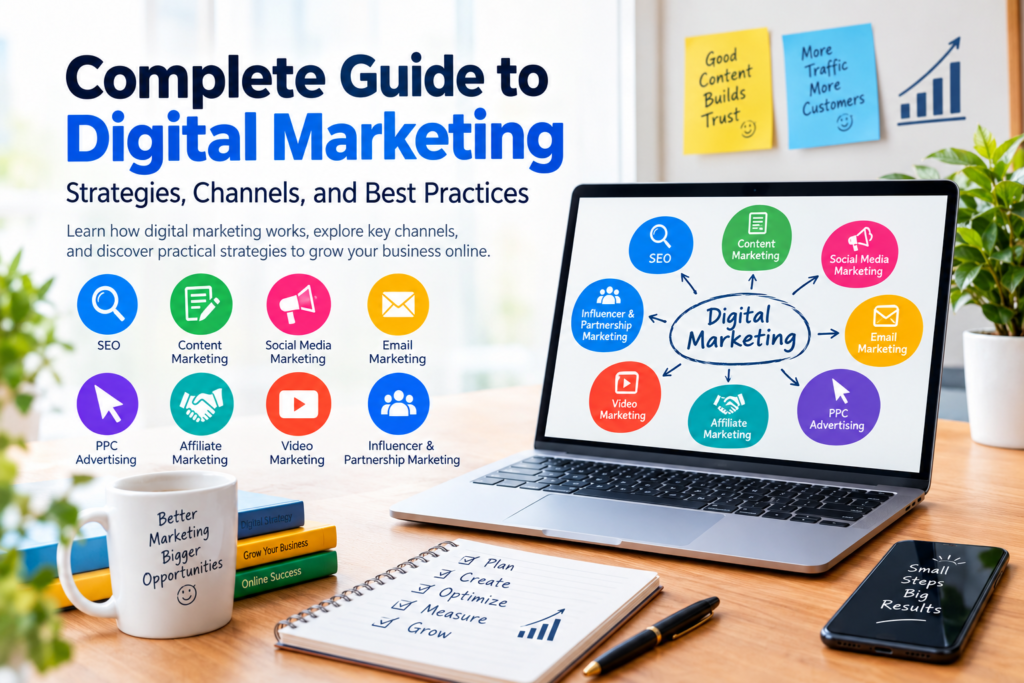

Digital marketing has become an important part of how businesses introduce their products, connect with customers, and build lasting relationships online. Whether you run a small business, manage a website, sell products, or provide professional services, understanding digital marketing can help you reach relevant audiences and make better decisions about your marketing activities.
However, digital marketing involves more than publishing social media posts or paying for online advertisements. It includes several connected activities, such as search engine optimization (SEO), content marketing, email marketing, social media management, paid advertising, and performance measurement.
Each channel serves a different purpose, and the right combination depends on your business goals, audience, budget, and available resources.
This complete guide to digital marketing explains the essential channels, how they work, how to develop a practical strategy, and how to measure results. It also covers common mistakes, useful tools, and steps beginners can take to establish a sustainable online marketing process.
What Is Digital Marketing?
Digital marketing is the promotion of products, services, brands, or ideas through digital channels. These channels include search engines, websites, email, social media platforms, mobile applications, and online advertising networks.
For example, a local clothing store might use a website to display its products, social media to introduce new collections, search optimization to attract people looking for clothing online, and email to communicate with customers who have chosen to receive updates.
A business-to-business software company might use educational articles, webinars, email campaigns, and targeted advertising to reach decision-makers.
Although the methods differ, the purpose is similar: to connect the right audience with relevant information, products, or services and encourage appropriate actions.
Why Digital Marketing Matters
Digital marketing offers several practical advantages.
- Audience targeting: Businesses can tailor messages to particular audiences, interests, locations, or stages of the buying process, depending on the channel.
- Measurable activity: Many digital platforms provide data about website visits, clicks, engagement, leads, and conversions.
- Flexible budgets: Businesses can begin with organic activities or small advertising tests and adjust their approach as they learn.
- Direct communication: Websites, email, and social platforms allow businesses to answer questions and share useful information.
- Adaptability: Campaigns and content can be refined based on customer feedback and observed performance.
These advantages do not guarantee success. Results depend on the quality of the offer, audience demand, competition, execution, and other factors. Digital marketing requires planning, consistent work, and ongoing evaluation.
The Main Types of Digital Marketing
Understanding the different marketing channels helps you decide where to invest your time and budget.
1. Search Engine Optimization (SEO)
Search engine optimization is the process of improving a website so that its pages can be discovered and understood by search engines and provide value to visitors.
SEO can help businesses attract people who are actively searching for information, solutions, or products related to their offerings.
Key Areas of SEO
On-page SEO: Improve page titles, headings, descriptions, content organization, internal links, and the overall usefulness of individual pages.
Technical SEO: Help search engines access and understand your website by addressing issues such as broken links, crawlability, indexing, mobile usability, and page performance.
Content quality: Publish accurate, original, helpful content that answers real questions and demonstrates relevant knowledge.
Off-page SEO: Build awareness and reputation through legitimate references, relevant mentions, and naturally earned links from other websites.
Local SEO: Help eligible businesses appear in relevant local searches by maintaining accurate business information and an appropriate online presence.
Practical SEO Example
Imagine that you operate a website offering accounting services to small businesses. Instead of publishing only general promotional pages, you could create useful resources explaining invoice management, expense tracking, bookkeeping basics, and how to choose accounting software.
Each article should address a specific reader need and connect naturally to the relevant service pages.
SEO is a long-term activity. Search rankings can change, competition varies, and no ethical SEO method can guarantee a particular position.
Official resource: Google Search Central — https://developers.google.com/search/docs
2. Content Marketing
Content marketing involves creating and distributing useful, relevant content to attract and retain an audience.
Rather than focusing exclusively on immediate sales, content marketing helps people understand problems, compare options, and make informed decisions.
Common Content Formats
- Blog posts and educational articles.
- Guides, tutorials, and checklists.
- Videos and demonstrations.
- Infographics and original research.
- Case studies based on real, verifiable results.
- Email newsletters and downloadable resources.
- Webinars and educational presentations.
How to Create Useful Content
Start by identifying the questions your audience regularly asks. Then choose a format that answers those questions clearly.
For example, a website serving small business owners could publish an article explaining how to compare project management software. The article might cover essential features, pricing considerations, usability, security, and limitations.
A helpful article should provide enough information for readers to make progress, even if they do not purchase anything.
Content marketing takes time to develop. Articles may need updating, video production can require equipment and editing, and not every piece of content will attract substantial attention.
3. Social Media Marketing
Social media marketing uses platforms such as Facebook, Instagram, LinkedIn, TikTok, and other relevant networks to distribute content, communicate with audiences, and support business objectives.
The best platform depends on the audience and the type of product or service being promoted.
For example, a visual design business may benefit from image and video platforms, while a professional consultancy may find industry discussions and business-focused networks more relevant.
How to Build a Social Media Strategy
- Choose platforms that your target audience actually uses.
- Define the purpose of each platform, such as awareness, customer support, or website visits.
- Develop a realistic publishing schedule.
- Create content that fits the platform and audience.
- Respond professionally to relevant comments and messages.
- Review engagement and business outcomes regularly.
Organic vs. Paid Social Media
Organic social media refers to unpaid posts and interactions. It can help build relationships over time, but reach and engagement are not guaranteed.
Paid social media uses advertising budgets to distribute content to selected audiences. It may provide more control over campaign objectives and targeting, but costs can increase without producing useful business results.
Both approaches require clear goals and relevant content.
4. Email Marketing
Email marketing allows businesses to communicate directly with people who have subscribed or otherwise provided appropriate permission to receive messages.
It can support customer education, product updates, newsletters, onboarding, event announcements, and repeat purchases.
Steps for Effective Email Marketing
Build a permission-based list. Use clear subscription forms and explain what subscribers can expect.
Segment your audience. When appropriate, organize subscribers by interests, customer status, or the type of information they requested.
Write useful subject lines. Describe the message accurately without misleading readers.
Provide relevant content. Share information that matches subscribers’ interests and your stated purpose.
Include a clear next step. This might be reading an article, reviewing a product, registering for an event, or contacting your business.
Monitor performance. Review delivery problems, clicks, unsubscribes, conversions, and other relevant measures.
Email marketing is not simply about sending more messages. Excessive or irrelevant emails can damage trust and increase unsubscribes. Businesses should follow applicable privacy, consent, and anti-spam requirements.
5. Pay-Per-Click Advertising (PPC)
Pay-per-click advertising is a model in which advertisers generally pay when someone clicks an advertisement. Search advertising is a common example, although digital advertising platforms offer other pricing models as well.
PPC can help businesses reach people searching for specific products or services and test whether a message or offer attracts interest.
How PPC Works
- Select a campaign objective.
- Identify relevant search terms or audience characteristics.
- Develop advertisements that accurately describe the offer.
- Direct visitors to a relevant landing page.
- Set an appropriate budget and bidding approach.
- Monitor conversions and costs.
- Improve or stop campaigns based on evidence.
Example of a PPC Campaign
A web design agency might advertise a service to businesses searching for professional website development.
The advertisement should clearly describe the service, and the landing page should explain the agency’s process, relevant experience, service scope, and how to request a consultation.
If the advertisement attracts clicks but few qualified inquiries, the agency should investigate factors such as search intent, landing-page clarity, pricing expectations, and the relevance of its targeting.
Advertising spend does not guarantee sales. Campaign performance depends on competition, targeting, the offer, conversion experience, and many other variables.
6. Affiliate Marketing
Affiliate marketing is a model in which a publisher or partner promotes another company’s products or services and may earn a commission when qualifying actions occur under the program’s terms.
It is used by bloggers, content publishers, creators, and businesses that recommend relevant products.
How Affiliate Marketing Fits Into Digital Marketing
A technology publisher could write a detailed comparison of business software, explain which users each product suits, and link to the providers’ websites.
A useful comparison should discuss both benefits and limitations. It should not recommend a product solely because it offers a higher commission.
Publishers should clearly disclose affiliate relationships where required and follow applicable advertising and consumer-protection rules. Program terms, eligibility, commission structures, and payment conditions can change.
Affiliate marketing is not a guaranteed source of income. Results depend on audience relevance, content quality, trust, product suitability, and other factors.
7. Video Marketing
Video marketing uses video content to explain products, demonstrate processes, educate customers, and communicate a brand’s message.
Videos can be published on websites, social media platforms, video-sharing services, and landing pages.
Useful formats include:
- Product demonstrations.
- Step-by-step tutorials.
- Frequently asked questions.
- Software walkthroughs.
- Interviews with relevant experts.
- Customer stories supported by permission and verifiable information.
For example, a software company could publish a tutorial showing how to organize a project, create a report, or complete a common task in its application.
Video production does not always require expensive equipment. However, clear audio, understandable explanations, appropriate editing, and accurate captions can improve accessibility and usability.
8. Influencer and Partnership Marketing
Influencer marketing involves working with creators or public figures who have an audience relevant to a brand. Partnership marketing can also include collaborations with complementary businesses, professional organizations, or publishers.
A successful partnership depends on audience relevance and credibility rather than follower counts alone.
Before entering an agreement, evaluate the creator’s content, audience fit, engagement quality, costs, usage rights, and disclosure practices. Define deliverables and expectations in writing.
Paid relationships and material connections should be disclosed as required by the applicable rules. A large audience does not automatically translate into sales.
How to Build a Digital Marketing Strategy Step by Step
A digital marketing strategy connects business goals with audience needs, suitable channels, a budget, and a way to measure results.
The following process can help businesses develop a practical plan.
Step 1: Define Your Business Goals
Begin with the outcome you want to achieve.
Possible goals include:
- Increasing qualified website traffic.
- Generating relevant inquiries.
- Increasing online purchases.
- Improving customer retention.
- Growing awareness among a specific audience.
- Encouraging registrations for a service or event.
Make the goal specific enough to evaluate. For example, “improve the number of qualified consultation requests from the website” is more actionable than “become more popular online.”
Set a realistic measurement period and use existing performance data where available.
Step 2: Understand Your Target Audience
Identify the people most likely to benefit from your product or service.
Consider their needs, questions, location, preferred communication channels, purchasing concerns, and reasons for choosing or rejecting a solution.
Useful information may come from customer interviews, support questions, website analytics, sales conversations, and legitimate market research.
Avoid assuming that every person in a broad demographic group has the same preferences. Use actual feedback and relevant evidence to refine your understanding.
Step 3: Research Competitors and Alternatives
Review businesses offering similar products or services.
Examine how they explain their offerings, organize their websites, address customer concerns, and distribute content. Look for unanswered questions or areas where you can provide clearer information.
The purpose is to identify opportunities, not copy another business’s wording, design, or proprietary material.
Your differentiation might involve better support, a more specialized service, clearer documentation, local expertise, or a simpler customer experience.
Step 4: Choose the Right Marketing Channels
You do not need to use every digital marketing channel.
Choose channels based on your audience, resources, and objectives.
| Business objective | Potentially useful channels |
|---|---|
| Improve search visibility | SEO and helpful content |
| Educate prospective customers | Blog articles, videos, and webinars |
| Build ongoing customer relationships | Email and customer support |
| Reach people actively searching for a service | Search advertising |
| Promote visual products | Image and video platforms |
| Generate and nurture business leads | Content, email, CRM, and relevant advertising |
| Encourage repeat purchases | Email, customer service, and relevant remarketing |
These are starting points, not universal rules. Test the channels that make sense for your business and adjust according to results.
Step 5: Create a Content Plan
A content plan identifies what you will publish, who it is for, where it will appear, and when it will be reviewed.
A simple plan might include:
- One educational article addressing a common customer question.
- One practical tutorial demonstrating a useful process.
- A few social posts summarizing the main lessons.
- An email newsletter sharing the resource with subscribers who have opted in.
- A relevant service page that explains how your business can help.
Repurposing content can make production more efficient, but each format should be adapted to its audience and purpose.
For websites, prioritize accuracy, originality, clear structure, and meaningful value. Review older pages when products, processes, or recommendations change.
Step 6: Establish Your Budget
Your digital marketing budget may include advertising, software, content production, web hosting, design, analytics, and professional services.
Separate ongoing operating costs from experimental campaign spending. This makes it easier to understand the total cost of your marketing activities.
For paid campaigns, begin with a budget the business can afford to test without jeopardizing essential operations. Define the objective and evaluation criteria before spending money.
Do not increase a campaign budget simply because it receives many clicks. Assess whether those clicks lead to meaningful actions.
Step 7: Create a Useful Conversion Experience
A conversion is an action that supports a defined goal, such as submitting an inquiry, purchasing a product, registering for an event, or subscribing to a newsletter.
A landing page should clearly explain what is offered, who it is for, what the visitor needs to know, and how to take the next step.
Make important information easy to find. Ensure that forms work correctly, pages are usable on mobile devices, and contact details are accurate.
Avoid misleading buttons, hidden conditions, fabricated urgency, and confusing navigation. These practices can undermine trust.
Step 8: Measure Results and Improve
Collect relevant performance data and compare it with your original goals.
Identify which channels attract suitable visitors, which content helps users, and where potential customers leave the process.
Use these findings to refine your strategy. If a campaign underperforms, investigate possible explanations before concluding that the entire channel is ineffective.
Essential Digital Marketing Metrics to Understand
Digital marketing platforms can produce large amounts of data. The challenge is choosing measures that reflect business objectives rather than focusing on numbers that look impressive.
Website Traffic
Website traffic measures visits or users, depending on the analytics platform and reporting method.
Traffic can help you understand whether people are reaching your website, but more visitors do not necessarily mean more qualified customers.
Click-Through Rate (CTR)
Click-through rate measures the proportion of eligible impressions that result in clicks.
A commonly used formula is:
CTR = (Clicks ÷ Impressions) × 100
For example, if an advertisement receives 40 clicks from 2,000 impressions, its CTR is 2%.
CTR provides information about how often people click, but it does not show whether those visitors purchase a product or become qualified leads.
Conversion Rate
Conversion rate measures the proportion of a defined group of visitors or interactions that complete a specified action.
A simplified formula is:
Conversion rate = (Conversions ÷ Relevant visits) × 100
If 200 relevant website visits result in 10 completed inquiries, the conversion rate under this definition is 5%.
The result depends on how conversions and visits are defined. Use consistent measurement rules when comparing performance.
Cost per Lead
Cost per lead measures how much a campaign spends to generate a lead under the chosen definition.
Cost per lead = Marketing spend ÷ Leads generated
A lower cost is not always better. A campaign that produces inexpensive but irrelevant inquiries may be less useful than one that produces fewer, more qualified leads.
Return on Advertising Spend (ROAS)
ROAS compares attributed revenue with advertising expenditure.
ROAS = Attributed revenue ÷ Advertising spend
For example, if a campaign generates $1,000 in attributed revenue from $250 in advertising spend, its ROAS is 4:1.
ROAS is not the same as profit. It does not automatically account for product costs, operating expenses, refunds, or other business costs. Attribution methods can also affect the result.
Customer Acquisition Cost (CAC)
Customer acquisition cost estimates the cost of acquiring customers over a defined period.
Depending on the business, the calculation may include advertising, sales expenses, marketing staff, software, and other relevant costs.
Define the costs and customer count consistently before comparing periods or channels.
Engagement and Retention
Engagement measures vary by channel and may include comments, shares, video completion, email clicks, or meaningful interactions.
Retention measures help businesses understand whether customers continue using or purchasing from them.
These metrics are most useful when interpreted alongside customer needs and business outcomes. A large engagement number alone does not prove that a marketing strategy is effective.
Useful Digital Marketing Tools
Digital marketing tools help with research, content production, publishing, analytics, communication, and campaign management. Start with the tools required for your workflow rather than purchasing every available platform.
Google Analytics
Google Analytics can help website owners understand traffic sources and user interactions when it is configured appropriately.
It is useful for evaluating how visitors arrive at a website and how they interact with key pages. Correct setup, consent requirements, and interpretation matter.
Official website: https://analytics.google.com/
Google Search Console
Google Search Console provides information about a website’s presence in Google Search, including search performance and certain indexing issues.
It can help website owners identify opportunities to improve their search visibility and investigate technical problems.
Official website: https://search.google.com/search-console/
Google Trends
Google Trends allows users to explore changes in search interest for selected topics and terms.
It can support topic research and help identify patterns in interest. Its figures represent relative search interest rather than a direct count of all searches or a guarantee of future demand.
Official website: https://trends.google.com/
Canva
Canva supports the creation of visual content, presentations, and marketing materials. It can be useful for businesses that need to produce routine graphics without a complex design workflow.
Check licensing conditions and available features before using assets in commercial materials.
Official website: https://www.canva.com/
Mailchimp
Mailchimp provides email marketing and related audience-management tools. Businesses can use services of this type to organize subscriber lists, create campaigns, and review performance.
Available features, pricing, and sending limits depend on the current plan. Review consent and unsubscribe requirements before sending marketing emails.
Official website: https://mailchimp.com/
HubSpot
HubSpot provides CRM and marketing-related tools that can help businesses manage contacts, track leads, and coordinate customer communication.
The appropriate plan depends on the number of contacts, desired features, and complexity of the workflow.
Official website: https://www.hubspot.com/
Tool selection should be based on suitability, cost, security, compatibility, and ease of use. A free tool may be sufficient for a small business, while a growing organization may require more advanced reporting or collaboration features.
Common Digital Marketing Mistakes to Avoid
Even a well-planned strategy can struggle when its foundations are weak.
Trying to Reach Everyone
Broad messaging often makes it difficult for potential customers to understand why an offer is relevant to them. Define the audience and communicate the benefits that matter to that group.
Publishing Content Without a Clear Purpose
Content should address a real question, explain a product, support a customer decision, or serve another defined purpose. Publishing frequently without useful information can waste resources.
Expecting Immediate SEO Results
Organic search performance can take time to develop and may fluctuate. Avoid relying on guaranteed ranking promises or tactics designed to manipulate search engines.
Spending on Advertising Without Tracking Outcomes
Clicks and impressions can help diagnose campaign performance, but they do not automatically demonstrate business value. Set up appropriate conversion measurement before evaluating paid campaigns.
Ignoring Mobile Users
A page that is difficult to read or use on a mobile device can frustrate visitors. Review page layout, text size, navigation, forms, and loading performance on different screen sizes.
Neglecting Existing Customers
Marketing should not focus only on acquiring new customers. Useful onboarding, responsive support, relevant updates, and reliable service can contribute to longer-term customer relationships.
Using Misleading Claims
Avoid fabricated reviews, unsupported product claims, fake scarcity, hidden sponsorships, and unclear advertising disclosures. Communicate limitations honestly and provide evidence for claims where appropriate.
Digital Marketing Best Practices for Sustainable Growth
A sustainable approach emphasizes customer value, accurate measurement, and continuous improvement.
Prioritize usefulness. Create resources that genuinely help your audience understand a problem or make a decision.
Keep your message consistent. Your website, advertisements, social profiles, and email campaigns should communicate compatible information about your business.
Protect customer information. Collect only the data you need, apply appropriate safeguards, and follow relevant privacy and marketing regulations.
Make your website accessible and usable. Use clear navigation, readable content, descriptive links, and suitable alternatives for meaningful images.
Review performance regularly. Evaluate results against the goal of each activity and investigate meaningful changes.
Update information when it changes. Product features, prices, platform policies, and regulations can change. Verify important details using official sources.
Be transparent. Disclose paid partnerships where required, explain relevant conditions, and avoid overstating what your products or services can deliver.
Frequently Asked Questions
1. What is digital marketing in simple terms?
Digital marketing is the promotion of products, services, or brands through online and other digital channels. Examples include search engines, websites, email, social media, video, and online advertisements.
2. What are the main types of digital marketing?
The main types include SEO, content marketing, social media marketing, email marketing, PPC advertising, affiliate marketing, video marketing, and influencer or partnership marketing. Businesses can combine these channels based on their goals and audiences.
3. How can beginners start digital marketing?
Start by identifying an audience and a clear business goal. Build a useful website or online presence, select one or two suitable channels, publish relevant content, and establish a way to measure results. Expand your activities as you gain experience and evidence about what works.
4. Is digital marketing expensive?
Digital marketing costs vary widely. Some activities, such as creating educational content or maintaining an organic social presence, may require more time than direct spending. Paid advertising, professional services, software, and content production can add costs. Set a realistic budget and evaluate the value of each activity.
5. How long does digital marketing take to produce results?
There is no universal timeline. Paid campaigns may generate early activity, while SEO, content marketing, and audience development often require sustained effort. Meaningful results depend on the competition, offer, audience, channel, budget, and quality of execution. Monitor progress rather than relying on guaranteed timelines.
Conclusion
Digital marketing gives businesses several ways to reach relevant audiences, explain their offerings, build relationships, and evaluate marketing activity. SEO can support organic discovery, content marketing can answer customer questions, email can maintain communication, social media can build awareness, and paid advertising can help test specific opportunities.
The most effective strategy is not necessarily the one that uses the most channels or spends the largest budget. It is the one that connects clear business objectives with audience needs, useful content, suitable distribution channels, and reliable measurement.
Start with a focused plan, learn from real customer behavior, and improve your approach over time. By prioritizing usefulness, transparency, and consistent evaluation, you can build a digital marketing process that supports your business without relying on unrealistic promises.