
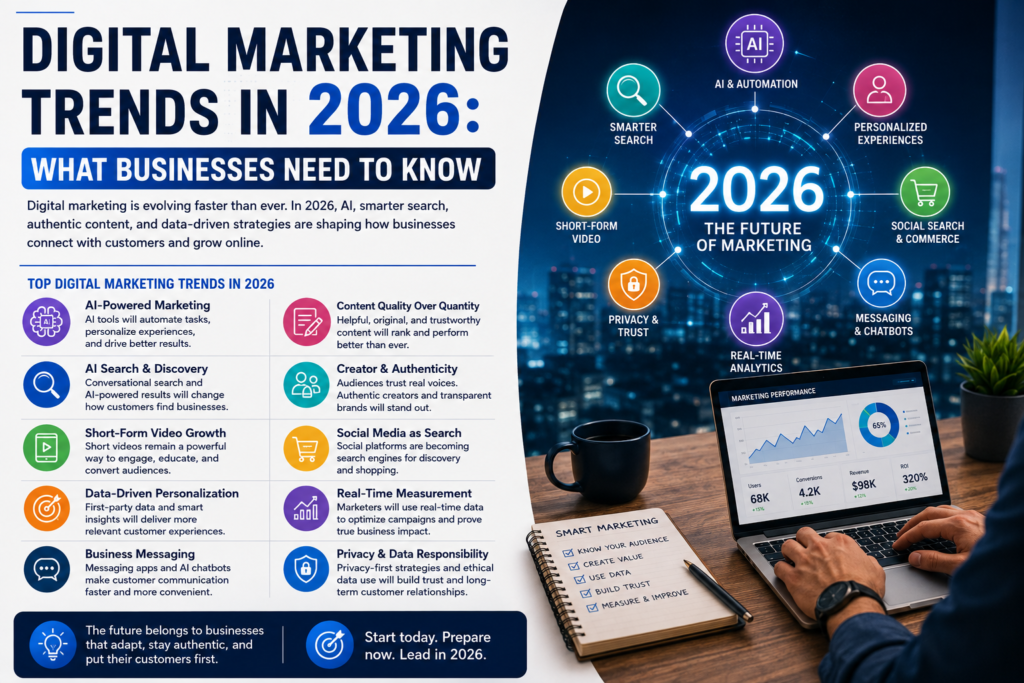

Digital marketing is changing quickly. Artificial intelligence is becoming part of everyday marketing workflows, consumers are discovering products through social platforms and AI-powered search experiences, and businesses are placing greater emphasis on first-party data, personalization, authentic content, and measurable results.
For businesses, the challenge is not simply adopting every new technology. The more important question is which changes actually matter to your customers and your business model.
The digital marketing trends in 2026 point toward a more connected approach to marketing. AI is increasingly helping with content, advertising, customer interactions, and analysis, while marketers still need human judgment to protect accuracy, brand identity, privacy, and trust. Gartner’s 2026 marketing predictions highlight AI agents, authenticity, AI-ready data and content governance, and changing customer experiences as important developments for marketing organizations.
This guide explains the major trends businesses should understand and, more importantly, how to respond to them without chasing every new marketing trend.
Why Digital Marketing Is Changing in 2026
Marketing has traditionally been organized around separate channels: search, social media, email, advertising, websites, and other platforms.
That model is becoming less straightforward.
Customers may discover a company through a search engine, ask an AI assistant about it, watch a video on social media, visit the company’s website, read reviews, and then contact the business through a messaging platform.
At the same time, AI is increasingly involved in both the creation and distribution of marketing content.
Google’s current Search guidance specifically addresses generative AI features such as AI Overviews and AI Mode, while emphasizing that established SEO fundamentals remain relevant. Google also advises publishers to provide original, useful, non-commodity content rather than focusing on techniques designed simply to influence AI-generated search results.
For businesses, this means marketing should become more connected, useful, and customer-focused.
10 Digital Marketing Trends in 2026 Businesses Should Know
1. AI Is Moving From Experiment to Everyday Marketing
One of the most important digital marketing trends in 2026 is the growing integration of artificial intelligence into routine marketing work.
AI can assist marketers with:
- Content brainstorming
- Drafting and editing
- Audience research
- Campaign planning
- Data analysis
- Customer-service support
- Advertising optimization
- Image and video creation
- Workflow automation
Major advertising platforms are also integrating AI directly into marketing tools. Meta, for example, has expanded AI capabilities for advertising, creative production, business assistance, and customer interactions during 2026.
What Businesses Should Do
Do not begin by purchasing numerous AI tools.
Instead, identify repetitive tasks that consume significant time and test whether AI can assist with them.
A sensible workflow is:
Identify a task → test AI assistance → review the result → measure the outcome → improve the process.
Human review remains important because AI can generate inaccurate information or inappropriate recommendations.
2. AI-Powered Search Is Changing How People Discover Businesses
Search is becoming more conversational.
Instead of typing a few keywords into a search engine, users can increasingly ask detailed questions and receive synthesized answers through AI-powered search experiences.
Google has added guidance specifically addressing AI Overviews, AI Mode, and other generative AI features in Search. Its documentation emphasizes that traditional SEO practices continue to matter while businesses should also provide useful original content, including relevant local, shopping, image, and video information where appropriate.
How Businesses Can Adapt
Create content that clearly answers real customer questions.
For example, a travel business could publish:
- What to consider before booking
- How to choose the right type of accommodation
- What customers should prepare before traveling
- Frequently asked questions about its services
The objective should not be to write content merely because an AI system might mention it.
The objective should be to become a genuinely useful source of information.
3. Original and Helpful Content Matters More Than Content Volume
AI makes it easier to produce large amounts of content.
That creates an important challenge: publishing more does not automatically make a business more useful.
Businesses should focus on content that includes genuine value, such as:
- Original explanations
- Practical examples
- Expert knowledge
- Demonstrations
- Product information
- Customer questions
- First-hand business insights
- Clear comparisons
- Helpful visual content
Google’s 2026 guidance for generative search specifically highlights the importance of non-commodity content and continues to emphasize established SEO principles.
A Better Content Question
Instead of asking:
“How many articles can we publish?”
ask:
“What useful information can we provide that our customers cannot easily get from a generic answer?”
That shift can improve the quality of a content strategy.
4. Social Media Is Becoming a Discovery and Search Channel
Social media is no longer only about following friends or interacting with existing audiences.
People increasingly use social platforms to discover products, businesses, creators, recommendations, and information.
Recent 2026 research published by HubSpot identifies interest-based discovery, social search, social commerce, short-form video, creator influence, and community building among important developments in social media marketing.
This means businesses should think beyond follower counts.
What to Focus On
Create content that can stand on its own.
A useful social post should make sense even if the viewer has never heard of your business before.
Examples include:
- How-to videos
- Product demonstrations
- Educational posts
- Short explanations
- Customer questions and answers
- Industry tips
- Behind-the-scenes content
5. Short-Form Video Remains Important
Short-form video continues to be a major part of social media marketing.
Businesses can use short videos to:
- Demonstrate products
- Explain services
- Answer questions
- Introduce employees
- Share useful tips
- Show processes
- Present customer-focused information
However, businesses should not create videos simply because video is popular.
The content still needs a purpose.
A 30-second video that answers a real customer question may be more useful than a professionally produced video with no clear message.
6. Creator and Influencer Marketing Is Shifting Toward Authenticity
Influencer marketing continues to evolve.
As AI-generated images, videos, and other synthetic content become easier to produce, authenticity can become more important to audiences and brands.
Gartner’s 2026 marketing predictions identify a shift toward creator and content authenticity, including greater attention to creator identity and trustworthy content as AI-generated media expands.
What Businesses Should Look For
When working with creators, consider:
- Audience relevance
- Content quality
- Credibility
- Transparency
- Brand fit
- Engagement quality
- Consistency
- Appropriate disclosure of sponsored relationships
A creator with a highly relevant audience may be more useful for a particular campaign than someone with a much larger but less relevant following.
7. First-Party Data Is Becoming More Important
First-party data is information a business collects directly from its customers or users through appropriate interactions.
Examples can include:
- Customer account information
- Purchase history
- Email subscriptions
- Website interactions
- Customer feedback
- Loyalty-program information
- Direct enquiries
As privacy expectations and data practices continue to evolve, businesses need to understand what information they collect, why they collect it, and how they are permitted to use it.
Experian’s 2026 digital marketing research highlights first-party data activation as a foundational capability and emphasizes the importance of connecting data with marketing activity in privacy-conscious ways.
Practical Advice
Do not collect information simply because you can.
Collect information that serves a legitimate business purpose, communicate appropriately with customers, and follow the privacy requirements applicable to your market.
8. Personalization Needs Better Data and Better Judgment
Customers increasingly expect relevant experiences.
Personalization can include:
- Relevant product recommendations
- Useful email content
- Location-aware information
- Personalized website experiences
- Appropriate customer-service communication
- Targeted offers
But personalization can become uncomfortable when businesses use information in ways customers do not expect.
The goal should be relevance without unnecessary intrusion.
Businesses should also make sure that automated personalization does not create incorrect assumptions about customers.
9. Business Messaging and AI Customer Service Are Expanding
Messaging is becoming an increasingly important way for customers to communicate with businesses.
Businesses can use messaging for:
- Customer questions
- Appointment requests
- Product information
- Order updates
- Service support
- Follow-up communication
Meta introduced its Business Agent in 2026 as an AI system designed to help businesses provide personalized customer interactions through platforms including WhatsApp and Messenger.
Use Automation Carefully
AI customer service is most useful when the customer receives a fast and accurate answer.
Businesses should provide clear escalation paths for situations that require a human employee.
Customers should not be trapped in an automated conversation when they need human assistance.
10. Measurement Is Moving Closer to Real-Time Decision-Making
Marketing teams increasingly want to understand not just what happened after a campaign, but what is happening while the campaign is running.
This can help marketers make better decisions about:
- Budget allocation
- Content performance
- Audience targeting
- Customer acquisition
- Conversion rates
- Campaign efficiency
Experian’s 2026 report describes a shift toward connecting activation and measurement so marketers can use data more actively during campaigns rather than relying only on retrospective reporting.
Avoid Vanity Metrics
Likes, impressions, and followers can provide useful context, but they do not always demonstrate business value.
Depending on your objective, more meaningful measures may include:
- Qualified leads
- Sales
- Enquiries
- Appointments
- Customer retention
- Repeat purchases
- Cost per acquisition
- Conversion rate
Choose metrics that connect with your actual business objective.
What These Trends Mean for Small Businesses
Small businesses do not need to copy the marketing strategies of large corporations.
Instead, they can focus on a few practical priorities.
Build a Strong Digital Foundation
Before experimenting with advanced technology, make sure your basic digital presence is reliable.
Check that your:
- Website works properly
- Contact information is accurate
- Business profiles are updated
- Products and services are clearly explained
- Mobile experience is usable
- Customer enquiries receive appropriate responses
Technology cannot compensate for a weak foundation.
Use AI Where It Adds Real Value
Start with simple applications.
For example:
Content: Brainstorm article ideas.
Administration: Summarize routine notes.
Marketing: Develop campaign variations.
Analysis: Organize and interpret business data.
Customer service: Draft responses to common questions.
Then evaluate whether the tool actually saves time or improves quality.
How to Build a 2026 Digital Marketing Strategy
Step 1: Understand Your Customer
Identify:
- Who your customers are
- What problems they have
- How they search for solutions
- What influences their decisions
- Which digital channels they use
Customer research should come before technology selection.
Step 2: Choose Your Priority Channels
You do not need to use every platform.
A local business may prioritize:
Website + local search + reviews + messaging
A professional service business may focus on:
Website + SEO + educational content + LinkedIn
An online retailer may focus on:
Website + social commerce + email + paid advertising
These are examples rather than universal formulas.
Step 3: Create Useful Content
Build content around genuine customer needs.
Use a mixture of:
- Articles
- Videos
- Images
- FAQs
- Product information
- Guides
- Social media posts
Focus on usefulness and accuracy rather than publishing volume.
Step 4: Establish an AI Policy
If employees use AI tools, establish basic rules.
Your policy can address:
- Which tools are approved
- What information employees can enter
- How AI-generated content should be reviewed
- Who is responsible for final approval
- How sensitive information should be handled
- How the company will evaluate AI tools
This becomes increasingly important as AI moves deeper into everyday marketing workflows.
Step 5: Measure and Improve
Review performance regularly.
Ask:
- Which channels are producing useful results?
- Which content helps customers?
- Which campaigns are wasting resources?
- Which customer questions remain unanswered?
- Where can automation safely save time?
Then adjust your strategy.
Digital Marketing Trends in 2026: What Businesses Should Not Do
Do Not Chase Every New Tool
New marketing tools appear constantly.
A tool should solve a business problem rather than become another expense simply because it is fashionable.
Do Not Publish Large Amounts of Generic AI Content
AI can increase production speed, but quantity does not replace originality or usefulness.
Review, edit, fact-check, and improve AI-assisted content before publishing.
Do Not Ignore Privacy
Customer data should be handled responsibly.
Review the privacy requirements applicable to your business and location before introducing new data collection or personalization systems.
Do Not Abandon Human Creativity
AI can assist with production, but brand identity, empathy, strategy, judgment, and customer understanding remain important.
Do Not Measure Success Only by Visibility
A campaign can generate attention without producing meaningful business outcomes.
Connect marketing metrics to actual objectives.
A Simple Comparison of 2026 Marketing Priorities
| Trend | What Is Changing | What Businesses Can Do |
|---|---|---|
| AI marketing | More automation and AI-assisted execution | Automate appropriate low-risk tasks |
| AI search | Customers can discover information through conversational search | Publish useful, original content |
| Social search | Social platforms increasingly support discovery | Create searchable, useful social content |
| Short-form video | Video remains important for discovery and engagement | Demonstrate products and answer questions |
| Creator marketing | Authenticity is becoming more important | Choose relevant, credible creators |
| First-party data | Direct customer relationships matter more | Collect and use data responsibly |
| Personalization | Experiences are becoming more relevant | Use appropriate customer information |
| Messaging | Customers increasingly communicate directly with businesses | Offer convenient support channels |
| Measurement | Marketing data is being used more actively | Connect metrics to business goals |
| AI governance | Businesses need clearer rules for AI use | Create practical internal guidelines |
Frequently Asked Questions
1. What are the biggest digital marketing trends in 2026?
Major developments include the growing use of AI in marketing, AI-powered search, social search, short-form video, creator authenticity, first-party data, personalized customer experiences, business messaging, and more connected measurement. The importance of each trend varies by industry and audience.
2. Will AI replace digital marketers?
AI is increasingly capable of assisting with many marketing tasks, but that does not mean it eliminates the need for marketers. Businesses still need people to understand customers, establish strategy, review information, protect brand reputation, make decisions, and manage responsible use of technology.
3. Should every business use AI in marketing?
No. Businesses should use AI when it provides a clear benefit. A simple manual process may be better than an unnecessarily complicated AI workflow. Start with a specific problem and test whether AI improves the result.
4. Is SEO still important in 2026?
Yes. Google continues to state that established SEO best practices remain relevant to its generative AI search experiences. Businesses should focus on technically sound websites and useful, original content rather than trying to manipulate AI-generated search results.
5. What should a small business prioritize first in 2026?
Start with the basics: a reliable website, accurate business information, a clear value proposition, useful content, appropriate social or search visibility, good customer communication, and measurable objectives. After that foundation is working, introduce AI and automation where they provide a clear benefit.
Conclusion
The most important digital marketing trends in 2026 are not simply about adding more platforms or producing more content. They reflect a broader change in how customers discover information, interact with businesses, and make decisions.
AI is becoming an important part of marketing operations. Search is becoming more conversational. Social platforms are increasingly functioning as discovery and commerce environments. First-party data, personalization, authentic creator content, messaging, and better measurement are also becoming increasingly important.
For businesses, the best response is not to chase every trend.
Build a strong digital foundation, understand your customers, create genuinely useful content, use AI thoughtfully, protect customer information, measure meaningful outcomes, and keep improving.
The businesses most likely to benefit from these changes will not necessarily be those using the most technology. They will be the ones that use technology purposefully while maintaining accuracy, trust, creativity, and a clear understanding of the people they serve.