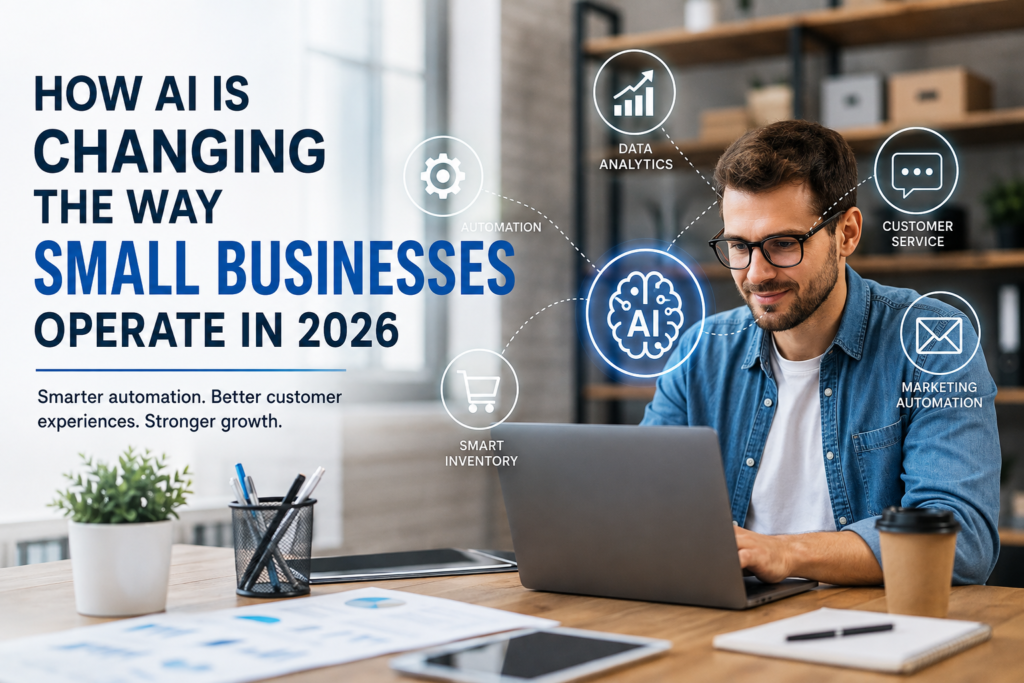

Artificial intelligence has moved from being a technology discussed mainly by large corporations to becoming a practical tool for businesses of many sizes. In 2026, small businesses can use AI to handle repetitive tasks, organize information, communicate with customers, create content, analyze business data, and support everyday decision-making.
This does not mean AI is replacing every employee or eliminating the need for human judgment. For many small businesses, its greatest value is more straightforward: helping people spend less time on repetitive work and more time on activities that require experience, creativity, communication, and judgment.
Understanding how AI is changing the way small businesses operate in 2026 can help business owners decide where automation makes sense, where human involvement remains essential, and how to introduce AI responsibly.
What Is Changing for Small Businesses?
Traditionally, many small businesses have relied heavily on manual processes.
An owner might personally respond to customer emails, enter information into spreadsheets, prepare invoices, write social media posts, organize appointments, analyze sales records, and create reports.
AI can assist with many of these activities.
For example, an AI-powered system might summarize a long customer conversation, help draft an email, identify patterns in sales data, or create a first draft of a marketing article.
The important distinction is that AI should generally be viewed as a business tool rather than an automatic replacement for human decision-making.
The quality of the result depends on the technology being used, the information provided to it, and the level of human review.
1. AI Is Automating Repetitive Administrative Work
Administrative tasks can consume considerable time in a small business.
AI and automation tools can assist with activities such as:
- Sorting and summarizing information
- Drafting routine emails
- Organizing documents
- Scheduling appointments
- Preparing meeting summaries
- Categorizing customer inquiries
- Creating basic reports
- Extracting information from documents
- Generating routine business communications
A simple example
Imagine a small consulting company receiving dozens of customer inquiries each week.
Instead of manually reviewing every message and determining its category, an AI-assisted workflow could identify whether a message relates to:
- A new sales inquiry
- An existing customer
- Technical support
- Billing
- General information
The appropriate employee can then handle the request.
AI has not necessarily replaced the employee. Instead, it has reduced the amount of repetitive sorting required before the employee can do the important work.
2. Customer Service Is Becoming More Responsive
Customer expectations have changed as digital communication has become a normal part of business.
Customers may contact businesses through websites, email, messaging platforms, or social media.
AI-powered customer service systems can help businesses respond to common questions, organize conversations, and provide basic information.
For example, a business could use an AI assistant to answer questions about:
- Business hours
- Product availability
- Basic service information
- Appointment procedures
- Delivery policies
- Frequently asked questions
However, businesses should provide an easy way for customers to reach a human when a question is complicated, sensitive, or outside the system’s capabilities.
Human support still matters
AI can generate a response quickly, but speed does not automatically mean quality.
A customer with a complicated problem may need someone who understands the specific situation rather than a generic automated response.
A practical approach is to use AI for first-line assistance while allowing employees to take over when necessary.
3. Marketing Is Becoming Easier to Scale
Marketing has traditionally been challenging for small businesses because owners often have limited time and resources.
AI can assist with parts of the marketing process, including:
- Brainstorming content ideas
- Creating initial drafts
- Developing social media calendars
- Summarizing customer feedback
- Generating variations of advertising copy
- Analyzing marketing data
- Personalizing certain communications
- Researching potential customer questions
For example, a local clothing business could use AI to brainstorm social media topics based on seasonal products.
An employee could then review the ideas, add authentic information about the business, and create the final posts.
This approach can make content production more efficient without removing the human voice from the brand.
4. AI Is Changing How Businesses Analyze Data
Small businesses generate data every day.
This might include:
- Sales transactions
- Website visits
- Customer inquiries
- Inventory records
- Marketing performance
- Expenses
- Product demand
- Customer feedback
Historically, interpreting this information often required spreadsheets and considerable manual effort.
AI-assisted analytics can help identify patterns and summarize information in a way that is easier for non-technical business owners to understand.
For instance, a business owner could ask an analytics system to identify which products experienced declining sales over a particular period.
The system might help organize the information, but the owner still needs to investigate why sales changed before making a business decision.
This distinction is important: AI can support analysis, but business decisions require context.
5. Inventory Management Can Become More Efficient
Inventory can be difficult for small businesses to manage.
Ordering too much can tie up money and storage space. Ordering too little can lead to shortages and disappointed customers.
AI-assisted systems can analyze historical sales information and other available business data to help identify demand patterns.
A retailer, for example, might use technology to identify products that regularly experience increased demand during particular periods.
However, predictions are not guarantees.
Unexpected events, changes in customer preferences, supply problems, and economic conditions can all affect demand.
Business owners should therefore treat AI-generated forecasts as decision-support information, not absolute predictions.
6. AI Can Help Small Businesses Compete More Efficiently
One of the most significant changes is accessibility.
Advanced digital tools that once required specialized teams can increasingly be accessed through software designed for smaller organizations.
A small company can potentially use AI to support areas such as:
Operations → automate repetitive workflows
Marketing → accelerate content and campaign preparation
Customer service → organize and respond to routine inquiries
Finance → categorize and summarize financial information
Sales → organize leads and customer interactions
Management → summarize reports and business information
This can allow a small team to accomplish more without necessarily expanding its workforce for every administrative requirement.
7. Employees Are Working Alongside AI
The impact of AI is not only about automation.
It is also changing how employees perform their jobs.
An employee who previously spent an hour preparing a basic report might use AI to create an initial summary and then spend more time checking the information and interpreting what it means.
A marketing employee might use AI to brainstorm ideas but remain responsible for the brand strategy and final content.
A salesperson might use AI to summarize customer information before a meeting.
This creates a model where humans provide judgment and accountability while AI assists with speed, organization, and repetitive processing.
8. AI Can Improve Business Productivity—but Only When Used Properly
It is tempting to introduce AI into every part of a business.
That is usually unnecessary.
A better approach is to identify tasks that are:
- Repetitive
- Time-consuming
- Clearly defined
- Relatively low-risk
- Based on information that can be safely processed
- Easy for an employee to review
These are often better starting points than highly sensitive or complex business decisions.
A practical example
Suppose a small company spends several hours each week creating internal meeting summaries.
Rather than trying to automate its entire business, the company could start by using an AI tool to produce draft summaries.
An employee checks the draft, corrects mistakes, and distributes the final version.
If the process works reliably, the business can gradually explore other suitable applications.
9. Small Businesses Also Need to Consider AI Risks
AI provides useful opportunities, but it also introduces risks.
Business owners should understand these before introducing AI into important workflows.
Accuracy
AI systems can produce incorrect or misleading information.
Generated content should therefore be reviewed, particularly when it involves customers, finances, legal matters, technical information, or important business decisions.
Privacy
Businesses should be careful about entering confidential customer, employee, financial, or proprietary information into AI services.
Before using an AI product, businesses should review its privacy policy, data-handling practices, security features, and applicable terms.
Security
AI tools can become part of a company’s technology environment.
Businesses should maintain appropriate access controls, strong passwords, software updates, and employee awareness.
Cost
Not every AI tool provides enough value to justify its subscription price.
Businesses should compare the cost of a tool with the time or resources it actually saves.
Over-automation
Automating a process simply because it is technically possible can create a poor customer experience.
Some interactions benefit from personal attention.
10. AI Is Changing the Skills Small Businesses Need
As AI becomes more common, employees do not necessarily need to become AI engineers.
However, they may need stronger digital skills.
Useful skills include:
- Understanding what AI can and cannot do
- Checking AI-generated information
- Writing clear instructions for AI systems
- Protecting confidential information
- Understanding basic data quality
- Reviewing automated outputs
- Communicating effectively with customers
- Applying human judgment to AI-assisted decisions
In other words, AI literacy is becoming part of broader digital literacy.
How Small Businesses Can Start Using AI in 2026
Businesses do not need to transform everything at once.
A gradual approach is often more practical.
Step 1: Identify repetitive tasks
Write down tasks employees perform repeatedly each week.
Look for activities involving copying information, summarizing documents, organizing data, scheduling, or creating routine drafts.
Step 2: Choose one problem
Start with a specific problem rather than a broad goal such as “use AI.”
For example:
“We spend too much time preparing weekly reports.”
That is easier to evaluate than a vague objective.
Step 3: Select an appropriate tool
Compare tools based on:
- Features
- Pricing
- Ease of use
- Integration options
- Security
- Privacy
- Reliability
- Support
Avoid selecting software simply because it is popular.
Step 4: Test the workflow
Run a small pilot before making AI part of an important business process.
Check whether it actually saves time and produces acceptable results.
Step 5: Keep human review
Determine which outputs require employee approval.
The higher the potential impact of an error, the more important human oversight becomes.
Step 6: Measure the results
After implementation, compare the new process with the old one.
Ask:
- Did the task become faster?
- Did quality improve?
- Did employees find it easier?
- Did customers benefit?
- Did the tool create new problems?
- Is the cost justified?
If the answer is no, change or discontinue the workflow.
AI vs. Traditional Business Processes
| Area | Traditional Approach | AI-Assisted Approach |
|---|---|---|
| Customer inquiries | Manual sorting | Automated categorization and draft responses |
| Reports | Manually prepared | AI-assisted summaries |
| Marketing | Manual brainstorming and drafting | AI-assisted ideation and drafting |
| Data analysis | Spreadsheet-heavy | AI-assisted analysis and summaries |
| Scheduling | Manual coordination | Automated scheduling assistance |
| Document processing | Manual extraction | Automated information extraction |
| Decision-making | Human judgment | Human judgment supported by AI-generated insights |
The AI-assisted approach is not automatically better in every situation. The right choice depends on the business, task, cost, data, and level of risk.
Common Mistakes Businesses Should Avoid
Using AI without a clear objective
Buying an AI subscription does not automatically solve a business problem.
Start with a specific operational challenge.
Publishing AI-generated content without review
AI-generated material can contain errors, awkward wording, outdated information, or unsupported claims.
Human review remains important.
Giving AI access to sensitive information unnecessarily
Businesses should understand what information a system processes and how that information is handled.
Automating customer communication too aggressively
Customers may become frustrated if they cannot reach a human when they need one.
Expecting immediate transformation
AI implementation often requires testing, employee training, workflow changes, and continuous evaluation.
Frequently Asked Questions
1. How is AI changing the way small businesses operate in 2026?
AI is helping small businesses automate repetitive tasks, support customer service, analyze information, assist marketing activities, organize workflows, and improve employee productivity. The exact benefits depend on how the technology is implemented.
2. Can AI replace employees in small businesses?
AI can automate certain tasks, but that does not mean it can replace every role. Many jobs involve judgment, communication, creativity, relationship-building, physical activities, and responsibility that require human involvement.
3. What is the best way for a small business to start using AI?
Start with one repetitive, clearly defined task where mistakes can be identified and corrected. Test the process, measure the results, and expand gradually if the technology provides meaningful value.
4. Is AI expensive for small businesses?
Costs vary considerably depending on the software, number of users, features, and usage level. Some services have free or low-cost options, while advanced business solutions can cost substantially more. Businesses should evaluate the total cost against the value they receive.
5. What are the biggest risks of using AI in business?
Common concerns include inaccurate outputs, privacy issues, security risks, inappropriate automation, dependence on technology, and unexpected costs. Businesses should establish clear rules for when AI can be used and when human review is required.
Conclusion
How AI is changing the way small businesses operate in 2026 is ultimately a story about how work is being reorganized.
AI can take on parts of repetitive administrative work, support customer service, assist marketing, help analyze data, and make certain workflows more efficient. But successful adoption is not simply about adding the newest technology to a business.
The most practical approach is to start with real problems, choose appropriate tools, protect business and customer information, train employees, review AI-generated outputs, and measure whether the technology actually improves the workflow.
For small businesses, the goal should not be to automate everything. The goal should be to use technology where it provides genuine value while keeping human judgment at the center of important decisions.