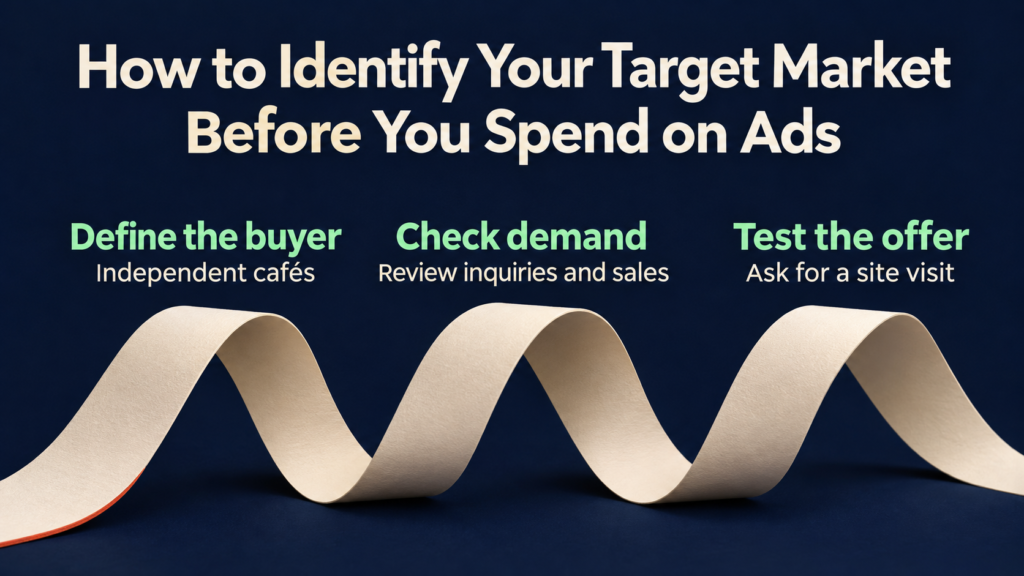

Before you open an ad platform, try finishing this sentence: “We help these people solve this problem when this happens.” If you can describe the people but struggle to name the problem or when it becomes urgent, you have a useful research question. Paying for clicks at that point may tell you who noticed the ad while leaving you unsure who needs the offer.
Here’s how to identify your target market before you spend on ads. Start with one offer, use sales and conversations to compare buyer groups, and test whether people will take a concrete next step. A worked example and a copy-ready worksheet will help you decide when you have enough evidence for a small paid test.
What is a target market?
Your target market is the group of buyers your offer is designed to serve. A useful definition includes who buys, what prompts the purchase, and where you can deliver. For example, “independent cafés in our service area that need someone to maintain their plants during busy trading weeks” is specific enough to guide your research and messaging.
An ad audience is the group your campaign can reach using the options available on a platform. You may be able to choose a geographic area while having no reliable way to target café owners with that particular problem. In that case, the headline and landing page can help the right buyers recognize the offer. Check your chosen platform’s current documentation before planning around a targeting option.
How to identify your target market in five steps
1. Start with one offer and a buying situation
Pick the product or service you intend to advertise. Write down what it solves, when someone might look for it, and any limits on where or how you can deliver. If you sell several services, start with the one you can describe and price most clearly.
A plant-care business could compare cafés that want recurring maintenance with retailers that want a one-time display refresh before opening. Both groups buy plant services, but the buyer’s deadline, budget, and next step may differ.
2. Look at what customers have already done
Review recent sales, quote requests, customer questions, and reasons people declined. For each, note the buyer type, what prompted the inquiry, the price or scope discussed, and the outcome. Keep the date range consistent and mark missing details as unknown.
If you have no sales yet, look at comparable businesses’ public offers and reviews to see what buyers ask about, then speak with potential customers directly. The U.S. Small Business Administration recommends examining demand, location, competing options, and what customers pay for alternatives. SBA market research and competitive analysis guide
3. Talk to potential buyers about a recent decision
Ask people who match each possible buyer group about what they actually did the last time the problem came up. These questions can help you get beyond general interest.
- When did the problem last come up?
- What did you do about it, and what did it cost in time or money?
- Who decided whether to buy or hire someone?
- What nearly stopped you from going ahead?
- Where did you look for help?
Ask what they tried before showing your offer. Then explain the scope and an indicative price, if you have one, and ask whether they’d take the next step, such as requesting a quote or booking a short call. Track those actions separately from compliments or replies.
4. Compare demand, reach, and ability to deliver
Compare two or three possible buyer groups using the same questions. Record a short explanation beside each answer.
| Question | Evidence to look for |
|---|---|
| Does the group have a clear reason to buy? | A recent problem, upcoming deadline, repeat need, or existing spend on an alternative |
| Can the buyer take the next step? | A quote request, a booked call, or a clear approval process |
| Can you reach similar buyers again? | A recurring search, a local business network, or another channel they actually use |
| Can you deliver at a workable price? | Time, materials, travel, fees, and capacity consistent with the proposed offer |
| What is still unknown? | Price objections, weak evidence outside referrals, seasonal demand, or a limited service area |
A group can show strong interest and still be a poor first choice if it takes too long to serve or you have no reliable way to reach it. Select the group that gives you the clearest next test, and keep your notes on the other groups for later.
5. Test the message before buying traffic
Write a short offer using the words buyers used to describe their problem. Include what they get, who it’s for, any service-area limits, and one next action. Share it with relevant prospects through an existing channel, such as a business network you already participate in or a service page you can update.
Define a qualified inquiry before you count results. For example, a qualified inquiry could be from a business inside your service area, seeking the advertised service, and considering a start within the next month. Log how many relevant people saw the offer where you can measure that, how many took the next step, and what prevented others from doing so.
Worked example for a local plant-care business
A fictional plant-care company compares recurring café maintenance with one-time shop displays. It reviews 12 recent inquiries. The sample is illustrative and comes from the business’s existing contacts.
| Buyer group | Inquiries | Paid jobs | What the owner learns |
|---|---|---|---|
| Independent cafés seeking recurring care | 7 | 4 | Café managers asked about visit schedules and who would handle missed visits. |
| Shops seeking a one-time display | 5 | 1 | Several projects required evening installation that the team struggled to schedule. |
| Total | 12 | 5 |
The owner chooses cafés for the next test because the team can deliver recurring visits during regular hours and several inquiries already turned into paid jobs. The proposed offer is scheduled plant maintenance for independent cafés in two adjacent neighborhoods, with a short site visit as the next step.
The owner shares the offer with café managers who did not come through the original referral source and tracks site-visit requests. Four sales from seven past café inquiries are useful evidence for that group. The new test checks whether the same offer attracts café owners outside the existing network.
Copy-ready target market worksheet
| Field | Fill in |
|---|---|
| Offer | [What you sell, what’s included, and starting price or quote process] |
| Buyer group | [Who decides to buy and where you can serve them] |
| Buying trigger | [What happened recently or is about to happen] |
| Current alternative | [What they use today and what problem remains] |
| Evidence | [Recent inquiries, sales, interviews, or other observed behavior] |
| Message to test | [One clear sentence in the buyer’s language] |
| Qualified action | [What counts as a useful inquiry, booking, or order] |
| What to check next | [One uncertainty you can resolve before spending] |
When are you ready to test ads?
You’re ready to consider a small paid test when you can explain who the offer is for, point to recent buyer behavior, and send people to a page or form with a clear next step. Check that you can record that action and tell a qualified inquiry from a general one. Set a spending limit and decide when you’ll review results before you launch.
If your first ads get clicks but few qualified inquiries, check whether the ad promises the same thing the page delivers, whether the page states where you operate, and whether people can contact you easily. The gap may come from the audience, the offer, or the buying process. Knowing which action you expected helps you investigate.
Frequently asked questions
1. How narrow should a small business target market be?
It should be specific enough that you can write a relevant offer and identify where to reach similar buyers. If the group is too small to find enough prospects, expand one dimension at a time, such as the service area or type of business, and check whether the same need still applies.
2. Can I identify a target market without existing customers?
Yes. Start with public information about competing offers and talk to people who experience the problem. Show a clear offer and ask for a practical next step. Treat early responses as evidence for a trial, then update your definition as real buyers respond.
3. Should I start with age, location, or interests?
Start with the factors that affect the buying decision. Location matters when you deliver locally. For other offers, a deadline, a job role, or an existing workflow may explain more about demand than a broad age or interest category.
4. What if I have two promising target markets?
Compare both against the same offer and the same definition of success, where practical. If they need different offers, give each its own message and track results separately so you can see which group responded to what.
5. Do competitor reviews prove people will buy from me?
Reviews can show what customers value, where they struggle, and which alternatives they use. Check whether your buyers face the same problem and will act on your specific offer. A quote request or booking can tell you more about your offer than a competitor’s review can.
Conclusion
Choose one offer and write down who needs it, when they look for it, and how they can take the next step. Check that definition against recent buyer behavior and test your message through a channel you already use. Once you know what a qualified response looks like and how to measure it, a small ad test can help you see whether you can reach more buyers like them.