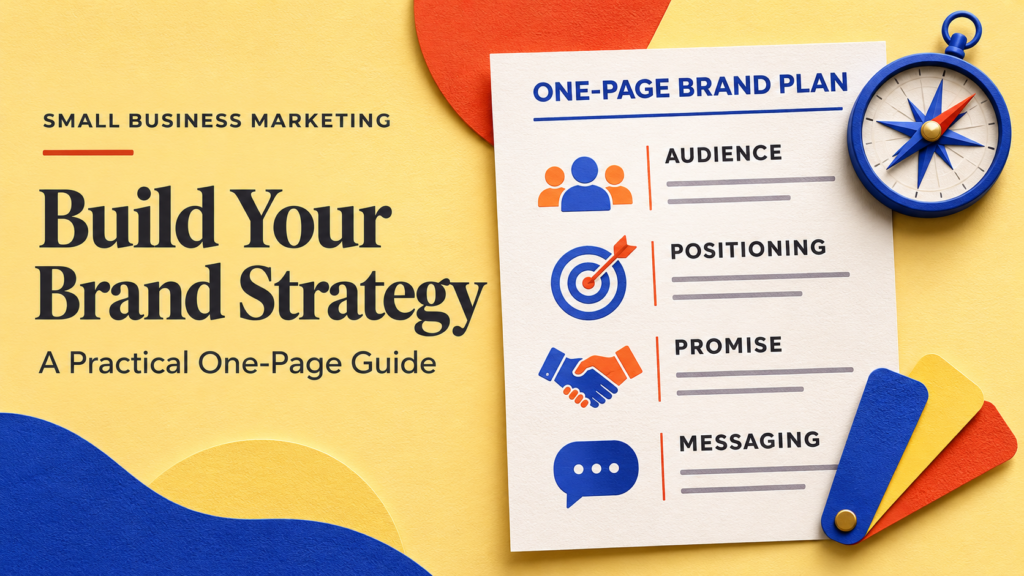

A business can have an attractive logo and still struggle to explain why someone should choose it. The problem may be an unclear audience, a vague promise, or marketing messages that change from one channel to another.
Learning how to build a brand strategy for a small business with a one-page example gives you a practical way to connect those decisions. You define who you serve, what you want to be known for, and how the customer experience will support that position.
The goal is a useful decision-making document. You should be able to hand it to an employee, designer, or marketing contractor and help them understand how your business should communicate and behave.
What Is a Brand Strategy?
A brand strategy is a plan for how your business wants to be understood and why its intended customers should choose it.
For a small business, a working strategy can cover:
- The customer group you prioritize.
- The problem or buying situation you address.
- Your position relative to other options.
- The value you promise and evidence supporting it.
- The messages, voice, and service standards you use.
- The actions and measures that will guide improvement.
A strategy sets your intended direction. Customer perceptions will also depend on their experiences, reviews, and interactions with your business.
Brand Strategy, Visual Identity, and Marketing Plans
| Element | Main question | Example |
|---|---|---|
| Brand strategy | Who should choose us, and why? | A cleaning service focused on clearly scoped appointments for busy households |
| Visual identity | How should the business look? | Logo, colors, typography, and photography |
| Messaging | How should we explain our value? | “Know what your clean includes before you book” |
| Marketing plan | How will we reach people and encourage action? | Local search, referral outreach, and a booking page |
Develop these elements together, while making audience and positioning decisions before committing heavily to design.
How to Build a Brand Strategy for a Small Business
1. Choose a Specific Priority Customer
Start with a group you can serve effectively and reach with your available resources.
“Everyone who needs our service” gives little direction. A more useful description combines the customer’s situation, need, and buying priorities.
For a local cleaning business, that could be:
Busy households within our service area that want recurring cleaning and clear information about what is included.
For a B2B service, it might be:
Small professional firms that need bookkeeping organized before their monthly management review.
Consider who makes the buying decision, what triggers the search, and what might prevent a purchase. Avoid inventing detailed personal characteristics that have no relevance to the decision.
2. Research Customers and Alternatives
Build your first draft from evidence you can gather.
Review inquiries, sales conversations, support messages, and reasons customers decline or leave. Speak with existing customers and suitable prospects.
Useful questions include:
- What was happening when you started looking for help?
- What alternatives did you consider?
- What information was difficult to find?
- What worried you before buying?
- What would make you choose the same provider again?
Ask about specific experiences. A general question such as “Do you like this idea?” may produce encouragement without explaining how someone buys.
Also review competing services and alternatives such as doing the work internally, delaying the purchase, or using a different type of solution.
The SBA’s business-planning resources cover market research and competitive analysis. Use outside data to add context, then investigate the needs of your own likely customers.
Keep a simple evidence log:
| Observation | Source | Status |
|---|---|---|
| Customers ask about extra charges | Actual inquiry records | Observed in this sample |
| Clear inclusions may improve confidence | Interpretation of those inquiries | Hypothesis to test |
| A proposed checklist reduces booking questions | Requires a pilot | Unverified |
Small samples can reveal useful issues, but they cannot establish what an entire market thinks.
3. Define Your Positioning
Positioning describes the place you want to occupy in a customer’s mind relative to their other options.
Use this internal writing prompt:
For [priority customer], our business is a [category] that helps them [valuable outcome] through [specific approach or credible difference].
For example:
For busy local households, our business is a recurring cleaning service that makes booking easier to understand through clear room-by-room inclusions and advance appointment confirmation.
This is a positioning draft, not a verified market claim. Check whether customers value the difference and whether competitors already offer it.
“Quality,” “great service,” and “affordable prices” need explanation. State what the customer can see, receive, or verify.
4. Write a Promise You Can Deliver
A brand promise is the expectation you want customers to associate with your business.
A useful promise has an operational basis. If you emphasize clear communication, decide what that means at each stage:
- Before purchase: explain scope and exclusions.
- At booking: confirm the agreed service and price.
- During delivery: communicate changes before proceeding.
- After delivery: provide a clear way to raise concerns.
Avoid claims such as “always the cheapest” or “perfect results every time” unless you can substantiate them. A narrower promise supported by a repeatable process is more useful.
5. Establish Reasons to Believe
List evidence that supports your positioning.
Depending on the business, this could include a sample deliverable, a published checklist, documented qualifications, a demonstration, or a clearly explained process.
Separate evidence already available from evidence you need to create.
If your strategy promises transparent quotes, prepare an actual quote format with inclusions and exclusions. If you emphasize specialist knowledge, identify the relevant credentials or work examples you can truthfully show.
Use testimonials only when they are authentic and you have appropriate permission to publish them.
6. Define Messages, Voice, and Visual Direction
Choose a small set of messages to repeat consistently. Each should connect a customer need with something your business does.
| Message area | Customer concern | Example communication |
|---|---|---|
| Scope | “What am I paying for?” | “Review the cleaning checklist before booking.” |
| Scheduling | “What happens after I enquire?” | “We confirm available appointment details before you commit.” |
| Changes | “Will extras appear unexpectedly?” | “Additional work requires an agreed price first.” |
Then choose a few voice principles, such as clear, calm, and respectful.
Make them usable. “Clear” could mean short explanations, specific service descriptions, and visible exclusions. “Respectful” could mean acknowledging a customer’s concern before explaining the next step.
Set basic visual rules for typography, color, image style, and readability. Keep the system manageable enough for your team to use across your website, proposals, email, and printed materials.
7. Connect the Strategy to Actions and Measures
Select a few touchpoints where the strategy should change something immediately.
Examples include rewriting your homepage introduction, improving a quote template, adding service inclusions, or standardizing appointment confirmations.
Choose measures connected to the issue you are addressing:
- Can suitable prospects explain what your business offers?
- Are inquiries coming from the customer group you prioritize?
- Which questions repeatedly delay a purchase?
- Are staff following the promised communication process?
- What reasons do customers give for choosing or leaving?
Sales and conversion data can help, but pricing, seasonality, and channel changes also influence them. Avoid attributing every movement to branding.
Completed One-Page Brand Strategy Example
Fictional business: ClearNest Cleaning
The name and details below are illustrative. No name availability, customer research findings, business performance, or existing credentials are claimed. This compact strategy is designed to fit a single page with concise formatting.
| Strategy field | Completed example |
|---|---|
| Business purpose | Make recurring household cleaning simpler to understand and arrange. |
| Priority customer | Busy households in the defined local service area seeking recurring cleaning. |
| Buying situation | The household wants regular help but is unsure about service scope and extra charges. |
| Customer hypothesis | Clear inclusions and an explained booking process may matter more than broad “premium service” language. Validate through interviews and inquiries. |
| Positioning | A recurring home-cleaning service built around clearly explained scope and appointment communication. |
| Brand promise | Know what is included before agreeing to the service. |
| Reasons to believe | Before launch, prepare a room-by-room checklist, written quote, appointment confirmation, and change-approval process. |
| Core messages | Clear service inclusions; confirmed appointment details; agreed pricing for additional work. |
| Voice | Plain, reassuring, and respectful. Use specific explanations and avoid exaggerated claims. |
| Visual direction | Readable type, restrained colors, and original photographs that accurately represent the service. |
| Priority touchpoints | Service page, quote template, booking confirmation, and follow-up message. |
| First 30 days | Owner interviews suitable prospects, tests the checklist, updates touchpoints, and trains staff on the agreed process. |
| Measures | Record scope-related questions, quote outcomes, customer explanations of the offer, and adherence to confirmations. |
| Owner and review | Owner maintains the document; review after the initial 30-day pilot and when evidence changes. |
The strategy becomes usable when the supporting processes exist. Advertising clear inclusions before the checklist is ready would create a gap between the message and delivery.
A Blank One-Page Brand Strategy Template
Copy these prompts into one document. Keep each answer to one or two short sentences.
| Field | Your answer |
|---|---|
| Business purpose | What useful change do we help customers make? |
| Priority customer | Who are we choosing to serve first? |
| Buying situation | What triggers their search or purchase? |
| Evidence and assumptions | What have we observed, and what still needs testing? |
| Positioning | What category do we compete in, and why choose us? |
| Promise | What expectation can we reliably support? |
| Proof | What can customers inspect or verify? |
| Messages | Which three ideas should appear consistently? |
| Voice and visual direction | How should communication sound and look? |
| Priority actions | Which customer touchpoints need work first? |
| Measures | How will we check understanding and delivery? |
| Owner and review | Who maintains the strategy, and when will we revisit it? |
If the page becomes crowded, move background research into a supporting file. Preserve the decisions people need for everyday work.
Costs, Limits, and Common Mistakes
You can create the initial document with ordinary writing tools. The work still requires research time, team discussion, content changes, and possibly design or implementation support.
If you hire outside help, ask whether the scope includes research, positioning, messaging, visual identity, implementation, and revisions. These are different deliverables.
Common mistakes include choosing a logo before defining the audience, claiming differences customers cannot verify, and making promises the delivery process cannot support.
Another mistake is rewriting the strategy after every unsuccessful campaign. Review the evidence first. The offer, targeting, checkout, or follow-up process may need attention.
A one-page strategy simplifies decisions, but it cannot replace product quality, operational capacity, or deeper research for a complex market.
Frequently Asked Questions
1. Does a very small business need a brand strategy?
A short working strategy can help even a solo business explain its offer consistently and make focused decisions. Scale the document to the business rather than creating sections with no practical use.
2. Should I create a logo before writing the strategy?
Clarify your audience, positioning, and promise first. These decisions give the designer a more useful brief and help you evaluate whether a visual direction fits the business.
3. What is the difference between a mission statement and brand positioning?
A mission describes the business’s purpose. Positioning explains how you want a particular customer group to understand your offer relative to alternatives. Both should be reflected in what the business actually does.
4. How often should I update a brand strategy?
Review it when customer evidence, your offer, or your market changes. An early pilot deserves a scheduled review, while an established strategy may need smaller periodic checks. Keep a record of what changed and why.
5. Can a brand strategy guarantee more sales?
No. It can improve clarity and consistency, but sales also depend on demand, pricing, product fit, delivery, and distribution. Test specific changes and assess results without promising a guaranteed outcome.
Conclusion
Begin with a specific customer and evidence about their buying decisions. Use that understanding to define a credible position, a deliverable promise, and messages your team can apply.
Put the decisions on one page, assign responsibility, and test them through real customer touchpoints. Revise the document as you learn what customers understand, value, and experience.