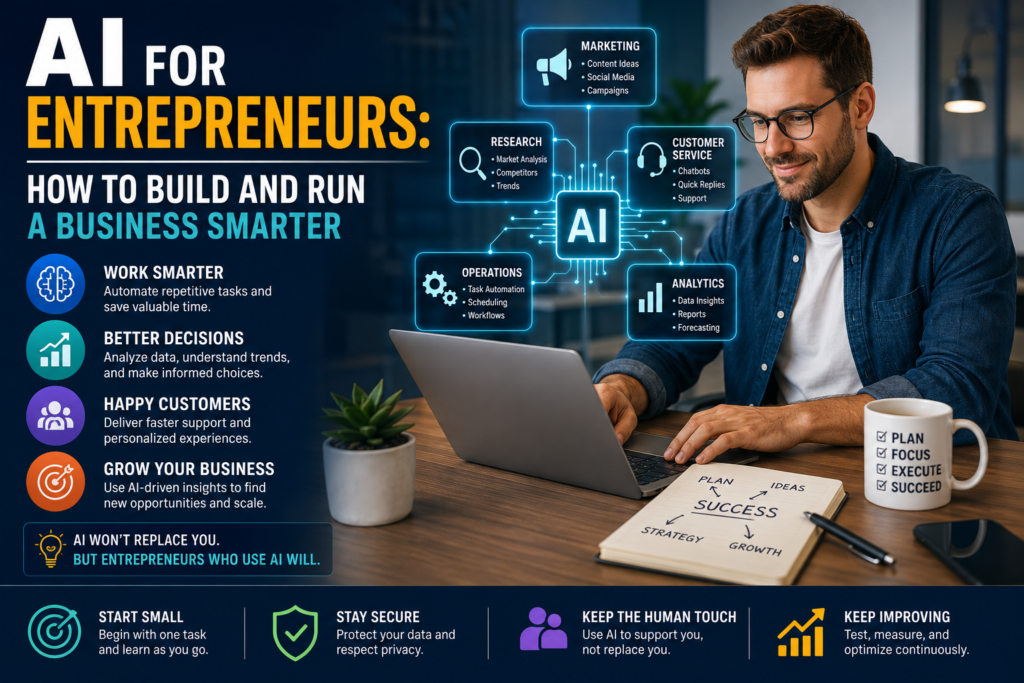

Artificial intelligence is becoming a practical business tool rather than something limited to large technology companies. Entrepreneurs can now use AI to assist with tasks such as content planning, customer communication, research, data organization, brainstorming, and workflow automation.
But using AI effectively is not about handing an entire business over to a machine. The most useful approach is to combine AI capabilities with human judgment, business knowledge, creativity, and responsibility.
For entrepreneurs working with limited time or small teams, this can be particularly valuable. AI may help reduce repetitive work and provide a starting point for tasks that would otherwise take considerable effort. However, AI systems can also produce inaccurate information, expose sensitive data if used carelessly, or generate content that requires substantial human review. NIST identifies issues including inaccurate generated content, privacy, bias, information integrity, and over-reliance as important risks associated with generative AI.
This guide explains how entrepreneurs can use AI thoughtfully to build and operate a smarter business.
What Does AI for Entrepreneurs Actually Mean?
AI for entrepreneurs means using artificial intelligence to support business activities such as planning, communication, analysis, marketing, customer service, and routine operations.
It does not necessarily mean developing your own AI system.
A small business owner might use an AI tool to:
- Brainstorm business ideas
- Draft a marketing campaign
- Summarize customer feedback
- Organize information
- Create a first draft of a document
- Analyze a spreadsheet
- Generate content ideas
- Prepare meeting notes
- Develop a customer-service response
- Identify repetitive administrative tasks
The entrepreneur remains responsible for deciding what should be done, checking the results, and making the final business decision.
Why AI Can Be Useful for Entrepreneurs
1. It Can Reduce Repetitive Work
Entrepreneurs often spend time on repetitive activities that do not directly require strategic decision-making.
Depending on the tools available, AI can assist with tasks such as summarizing information, drafting routine communications, organizing notes, or creating first versions of documents.
This can give business owners more time to focus on customers, products, partnerships, and important decisions.
2. It Can Help With Idea Development
AI can act as a brainstorming partner.
For example, an entrepreneur planning a new service could ask AI to help identify:
- Potential customer segments
- Common customer problems
- Service variations
- Marketing angles
- Questions to ask potential customers
- Possible weaknesses in a business concept
The output should be treated as a starting point rather than proof that an idea has market demand.
3. It Can Support Small Teams
A business does not need a large department for every function.
AI tools can assist individuals who handle several responsibilities, such as marketing, administration, customer communication, and content creation.
Google, for example, describes AI applications for small businesses that include organizing information, analyzing business performance, creating content, and supporting workflows.
The important distinction is that AI can support a small team, but it does not automatically replace the expertise needed to manage that team.
10 Practical Ways Entrepreneurs Can Use AI
1. Business Planning and Research
AI can help entrepreneurs structure their thinking when developing a business plan.
You can use it to organize questions around:
- Target customers
- Customer problems
- Competitors
- Pricing considerations
- Marketing channels
- Operating requirements
- Potential risks
For example, instead of asking:
“Is this business idea good?”
a better approach is to ask AI to help you develop a list of assumptions that need to be tested.
You can then validate those assumptions through customer interviews, competitor research, market observation, and other reliable sources.
Important limitation
AI-generated market information may be incomplete or outdated. Verify important facts independently before using them in a business decision.
2. Content Creation
Entrepreneurs frequently need content for websites, newsletters, social media, product pages, and other communication channels.
AI can help with:
- Content outlines
- Headline ideas
- First drafts
- Social media concepts
- Editing
- Rewriting
- Content calendars
- Frequently asked questions
However, publishing unedited AI-generated content can create quality and accuracy problems.
A better workflow is:
Research → AI-assisted draft → human review → fact-checking → editing → publication.
Your own experience, expertise, examples, and understanding of your customers should remain central to the final content.
3. Marketing Strategy
AI can help organize marketing activities by generating ideas for different customer groups and channels.
For example, an entrepreneur could use AI to develop:
- Customer personas
- Campaign concepts
- Email subject-line options
- Social media calendars
- Promotional copy
- Content themes
- Questions customers frequently ask
AI should not be treated as a replacement for customer research.
A marketing message that sounds polished but does not address a genuine customer need is unlikely to be useful.
4. Customer Service
AI can assist with customer-service workflows by helping businesses prepare responses to common questions.
For example, a company might create response templates for:
- Opening hours
- Delivery information
- Service descriptions
- Basic product questions
- Appointment procedures
- Frequently requested information
Human staff should handle situations requiring judgment, sensitive information, complaints, exceptions, or decisions that could materially affect a customer.
A useful approach
Create a library of approved answers and use AI to adapt those responses to individual situations while keeping important information accurate and consistent.
5. Data Analysis
AI can help entrepreneurs understand business data when the information is properly structured.
Possible uses include:
- Identifying trends
- Summarizing sales records
- Categorizing customer feedback
- Explaining spreadsheet formulas
- Creating basic analysis plans
- Finding unusual values that require investigation
For important financial or operational decisions, verify calculations and conclusions independently.
AI can explain a number incorrectly just as easily as it can explain it correctly.
6. Administrative Work
Administrative tasks are another area where AI can provide useful assistance.
Depending on the tools and systems being used, entrepreneurs may use AI to help:
- Draft emails
- Summarize meetings
- Organize notes
- Create task lists
- Prepare standard documents
- Categorize information
- Develop workflow instructions
The goal is not to automate everything. The goal is to reduce unnecessary manual work while keeping appropriate human oversight.
7. Product and Service Development
AI can support early-stage product development by helping entrepreneurs explore alternatives.
For example, a business owner could ask:
- What customer problems might this product solve?
- What features could make the service easier to use?
- What questions should we ask customers?
- What objections might customers have?
- How could the service be simplified?
The answers should then be tested against actual customer feedback.
AI can generate possibilities, but customers ultimately determine whether a product or service is useful.
8. Website Development
Entrepreneurs with limited technical experience can use AI to assist with website-related tasks.
It can help explain:
- HTML and CSS
- Website structure
- Basic code
- Content organization
- SEO concepts
- Troubleshooting approaches
- Website maintenance procedures
AI can also help technical users identify possible causes of errors.
However, generated code should be reviewed and tested before being used on a live website, particularly when it involves payments, authentication, customer information, or other sensitive functions.
9. Internal Training and Documentation
AI can help businesses turn existing knowledge into organized internal materials.
For example, an entrepreneur could use it to create a first draft of:
- Standard operating procedures
- Employee onboarding documents
- Training outlines
- Checklists
- Internal FAQs
- Meeting summaries
The business should review these documents before implementation to ensure that they accurately reflect its actual procedures.
10. Decision Support
AI can be useful when an entrepreneur wants to examine a decision from several perspectives.
For example:
“What are the advantages, disadvantages, risks, and questions I should consider before introducing this service?”
This type of prompt can help reveal considerations that might otherwise be overlooked.
However, AI should support decision-making rather than make important decisions without appropriate human review.
How to Use AI Without Losing the Human Side of Business
Technology can make work more efficient, but successful businesses still depend on relationships, trust, judgment, and understanding.
Keep Human Expertise at the Center
AI does not know your customers as well as you do.
Your experience can provide context that a general-purpose AI system does not have.
Use AI to expand your thinking, not to eliminate it.
Add Your Own Business Knowledge
Generic AI output often sounds similar to what many other businesses could produce.
Make your content more useful by adding:
- Real product information
- Your company’s policies
- Specific customer questions
- Local market knowledge
- Original examples
- Lessons from actual business operations
This makes the final result more relevant and distinctive.
A Simple AI Workflow for Entrepreneurs
A practical AI workflow can follow five stages.
Step 1: Identify the Problem
Do not begin with the question, “Where can I use AI?”
Instead ask:
What business task is taking too much time or creating unnecessary difficulty?
Step 2: Decide Whether AI Is Appropriate
Some tasks benefit from AI assistance. Others require human expertise or should remain manual.
Consider accuracy, privacy, complexity, and the consequences of mistakes.
Step 3: Give the AI Clear Context
The quality of an AI response often depends on the information and instructions provided.
Explain:
- The objective
- The target audience
- Relevant background
- Desired format
- Important limitations
- Examples where useful
Step 4: Review the Output
Check:
- Facts
- Numbers
- Names
- Dates
- Claims
- Calculations
- Tone
- Confidential information
- Compliance requirements
Do not assume that a confident-sounding answer is automatically correct.
Step 5: Measure the Result
Ask whether the AI-assisted process actually improved the business task.
Useful measures might include:
- Time required
- Error rate
- Customer response
- Cost
- Completion rate
- Employee workload
- Quality of the final result
If a process does not improve after introducing AI, there may be no reason to continue using it.
AI Risks Entrepreneurs Should Understand
AI can be useful, but responsible adoption requires understanding its limitations.
AI Can Produce Incorrect Information
Generative AI can produce content that sounds convincing while being wrong. NIST refers to this risk as confabulation, meaning confidently stated but erroneous or false content.
For important information, use reliable sources and verify the output.
Protect Confidential Information
Do not automatically enter sensitive business or customer information into an AI system.
Consider whether the information includes:
- Personal data
- Passwords
- Financial information
- Private customer records
- Confidential contracts
- Proprietary business information
Review the privacy and data-handling terms of any AI service before using it for sensitive work.
NIST identifies data privacy and information security among the risks organizations should consider when using generative AI.
Avoid Over-Reliance on AI
AI can create a false sense of confidence because its responses are often presented fluently.
Important decisions should still receive appropriate human review.
NIST specifically identifies risks related to automation bias and over-reliance on AI systems.
Be Careful With AI Marketing Claims
Entrepreneurs should also be cautious about making unsupported claims about their own AI-powered products or services.
Do not advertise an AI system as guaranteeing specific outcomes unless those claims can actually be supported.
Regulatory expectations around AI-related claims can change, so businesses should check the applicable laws and official guidance in the markets where they operate. The U.S. Federal Trade Commission, for example, continues to address consumer-protection issues involving AI accuracy and potentially deceptive AI claims.
AI Tools vs. Traditional Business Methods
| Business Need | AI Can Help With | Human Role |
|---|---|---|
| Content | Drafting and brainstorming | Fact-checking and editing |
| Customer service | Routine response drafts | Handling complex cases |
| Research | Organizing questions and information | Verifying sources |
| Data | Summaries and analysis support | Checking calculations |
| Marketing | Ideas and variations | Strategy and customer understanding |
| Administration | Repetitive document tasks | Review and approval |
| Product development | Generating possibilities | Customer testing |
| Decision-making | Exploring alternatives | Final judgment |
The best approach is usually not AI versus people. It is AI plus capable people.
How Small Businesses Can Start Using AI
You do not need to introduce AI into every department at once.
Start with one repetitive, low-risk task.
For example:
- Choose a task that takes significant time.
- Document how the task is currently completed.
- Test whether AI can assist with part of it.
- Review the output carefully.
- Compare the new process with the old one.
- Keep the workflow if it genuinely improves the result.
- Document the process so it can be used consistently.
This gradual approach makes it easier to identify what works and what does not.
Common Mistakes Entrepreneurs Make With AI
Trying to Automate Everything
Not every task should be automated.
Some activities depend heavily on relationships, judgment, creativity, or accountability.
Publishing AI Content Without Review
AI-generated material can contain incorrect facts, generic language, or inappropriate claims.
Human editing remains important.
Choosing Tools Before Identifying Problems
Entrepreneurs sometimes collect multiple AI tools without a clear business purpose.
Start with a problem, then choose a tool.
Ignoring Privacy
Convenience should not override responsible data handling.
Understand what information you are sharing and how the relevant service handles it.
Expecting AI to Understand the Business Automatically
An AI tool may not know your customers, market, policies, brand voice, or operational constraints.
Provide appropriate context and review the results.
A Practical AI Adoption Checklist
Before introducing AI into a business process, ask:
- What problem am I solving?
- How much time does the current task require?
- What information will the AI need?
- Does that information contain sensitive data?
- What could go wrong if the AI makes a mistake?
- Who will review the output?
- How will I measure whether the process improved?
- What happens if the AI tool becomes unavailable?
These questions encourage practical adoption instead of adopting technology simply because it is popular.
Frequently Asked Questions
1. How can entrepreneurs use AI to start a business?
AI can help with early-stage tasks such as brainstorming ideas, organizing research questions, developing content plans, preparing business documents, analyzing customer feedback, and exploring marketing approaches. Entrepreneurs should validate important assumptions through real-world research.
2. Can AI replace employees in a small business?
AI can automate or assist with some tasks, but whether it can replace a particular role depends on the work involved. Businesses should consider accuracy, accountability, customer relationships, privacy, and the need for human judgment before automating important responsibilities.
3. What is the best AI tool for entrepreneurs?
There is no single best tool for every entrepreneur. The right choice depends on the task, budget, technical requirements, privacy needs, integrations, and the quality of the tool’s output. Start by identifying the business problem rather than choosing a tool first.
4. Is AI-generated content safe to publish?
It can be used as part of a content workflow, but it should be reviewed before publication. Check facts, originality, relevance, tone, copyright considerations, and potentially misleading claims. Important information should be verified against reliable sources.
5. How can a small business start using AI safely?
Start with a low-risk task, avoid unnecessary sharing of sensitive information, establish human review, document the workflow, and regularly evaluate the results. NIST’s AI Risk Management Framework and its Generative AI Profile provide additional guidance for organizations considering AI risks and trustworthy use.
Conclusion
AI for entrepreneurs is most valuable when it solves a real business problem.
It can help with research, content, marketing, administration, customer communication, data analysis, product development, and many other activities. But AI is not a substitute for business judgment, customer understanding, responsible management, or human expertise.
The smartest approach is to start small. Choose one useful task, test an AI-assisted workflow, verify the results, protect sensitive information, and measure whether the change actually improves your business.
AI should make an entrepreneur more capable and efficient—not less responsible. Businesses that combine useful technology with careful judgment, accurate information, and genuine customer value are better positioned to use AI responsibly as the technology continues to evolve.