
Two lenders offer your business $10,000. One deducts a fee before sending the money. The other pays out the whole amount but asks for larger payments each month. The first question is how much cash will actually arrive. The second is whether your business can make the payments when they’re due.
This guide to small business funding options and how to compare their costs covers loans, lines of credit, equipment finance, and alternatives such as self-funding and equity. Use the worked example and checklist to compare written offers before making a commitment.
Match the funding to what the business needs
Write down the amount you need, when you need it, what you’ll buy, and what will cover repayments. If you’re buying a piece of equipment, include delivery and installation. If you’re covering a gap before a client pays, check the invoice due date and how your cash position would look if the client paid late.
Decide how much cash needs to arrive after fees. A proposal for a $10,000 loan won’t fully fund a $10,000 purchase if the provider deducts $300 from the proceeds.
Small business funding options at a glance
| Option | When it’s worth comparing | Main cost or trade-off |
|---|---|---|
| Self-funding | You can cover the need from savings or retained cash and still have enough for other commitments. | You use cash that could cover emergencies, everyday bills, or another investment. |
| Term loan | You know how much you need for a one-time purchase or project. | Interest, fees, scheduled payments, and possible collateral or a personal guarantee. |
| Business line of credit | The amount or timing of a short-term cash gap varies. | Interest on what you draw, plus possible draw, maintenance, or renewal fees. Check whether the rate can change. |
| Equipment finance or leasing | A specific asset, such as a vehicle or machine, is the main expense. | Deposit, scheduled payments, and any final payment or purchase option. Confirm who owns the asset at the end. |
| Invoice finance | You have eligible unpaid invoices and need cash before customers pay. | Fees, the share advanced, and any obligation to repay the provider if a customer doesn’t pay. |
| Sales-based financing | You’re considering an advance that is repaid according to sales or receipts under the agreement. | The total required remittance, any minimum or fixed debits, and how the provider adjusts collections when sales fall. |
| Equity investment | An investor is willing to fund the business in exchange for ownership. | A share of future value and any voting, approval, or reporting rights you agree to. |
| Grants or reward-based crowdfunding | You qualify for a specific program or have an audience willing to support an offer in advance. | Eligibility and reporting for grants, or platform fees and reward fulfillment for crowdfunding. Timing and funding are uncertain. |
Product names and terms vary by provider and country. For example, U.S. businesses can check SBA-backed lending options and confirm terms with a participating lender. U.S. Small Business Administration funding guide · SBA loan programs · British Business Bank finance overview
How to compare the real cost of business financing
1. Compare the cash you’ll actually receive
Ask how much will reach your account after deductions. List any fees you must pay separately at closing. If a fee has already been deducted from the disbursement, account for it through the lower proceeds. If it’s included in the repayments, it’s already part of those payments.
For a simple fixed-payment offer, use this cash-cost comparison:
Total cash cost = scheduled repayments + separately paid required financing fees − cash deposited after deductions.
This shows the cost in dollars over the stated schedule. For an offer with variable payments or rates, ask the provider to show the assumptions behind its estimate. When comparing a lease with a loan, include any end-of-term payment if your goal is to own the equipment.
2. Compare annualized cost and total cash cost together
If an offer gives an annual percentage rate (APR), ask what charges it includes and whether it’s fixed or estimated. Compare APRs calculated on a consistent basis. Also compare the total cash cost and repayment term. A longer term can lower the monthly payment while increasing the amount you pay over the full term.
A factor rate uses a different calculation. A 1.25 factor applied to a $10,000 advance implies $12,500 in total remittances before any separate charges, assuming those are the written terms. That gives you a $2,500 difference over the repayment period. The annualized cost also depends on how quickly payments come out and any fees. Commercial financing disclosure requirements vary by jurisdiction. California, for example, requires disclosures for covered offers. California Department of Financial Protection and Innovation disclosure guidance
3. Put each payment on your cash calendar
Record the amount, frequency, and date of the first payment. Add the payments to a cash forecast alongside payroll, rent, supplier bills, and expected collections. Daily or weekly payments can be harder to manage if your customers usually pay once a month.
Run a slower-sales scenario or move an expected client payment to a later date. If the forecast falls below the cash reserve you need to operate, reconsider the amount, timing, or structure of the funding before you commit.
4. Check what happens if plans change
Ask whether paying early reduces the total you owe and whether there is a payoff fee. Get a written payoff example for a specific date. If the rate can change, ask how it is set and what a higher rate would do to payments.
Review which assets secure the financing and whether anyone must sign a personal guarantee. A guarantee can expose the signer to personal repayment obligations under the agreement. Check how missed payments affect those obligations and ask a qualified adviser about any terms you don’t understand.
Worked example comparing two funding offers
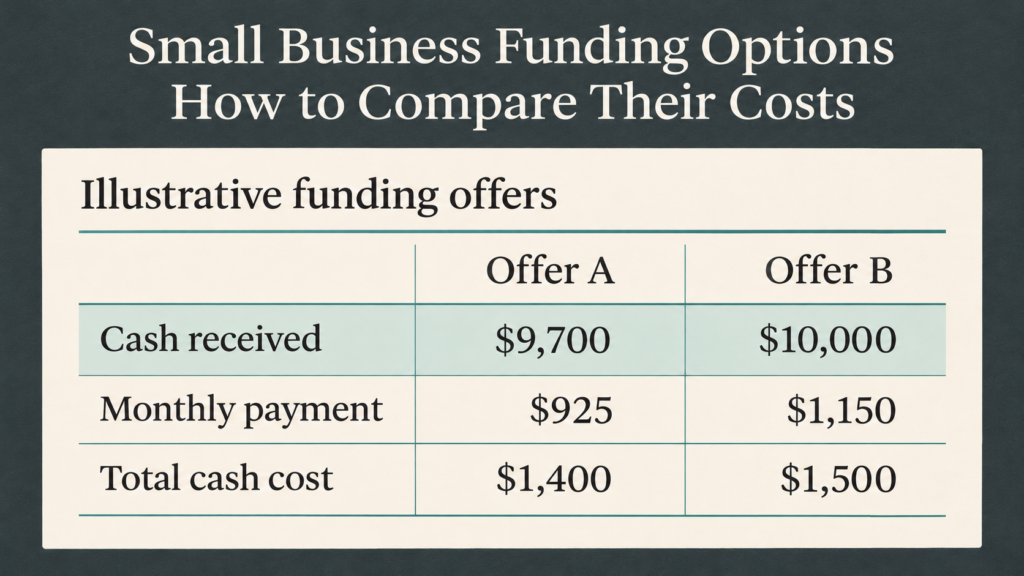
A fictional print shop needs $10,000 in cash for equipment and installation. These figures are illustrative and each offer has a fixed payment schedule.
| Item | Offer A | Offer B |
|---|---|---|
| Stated financing amount | $10,000 | $10,000 |
| Fee deducted before deposit | $300 | $0 |
| Cash received | $9,700 | $10,000 |
| Payment schedule | 12 monthly payments of $925 | 10 monthly payments of $1,150 |
| Total scheduled repayments | $11,100 | $11,500 |
| Separately paid required financing fees | $0 | $0 |
| Total cash cost | $1,400 | $1,500 |
Offer A costs $100 less in cash terms and requires $225 less each month. It also leaves the shop $300 short of what it needs. The owner can ask for a revised quote that deposits the full $10,000, then check the new fees and repayments. Offer B covers the purchase as quoted, but the shop needs to check whether it can afford the larger payment in a slow month. The offers cover different terms and deliver different amounts, so the cash-cost figures alone are insufficient to decide which fits.
Copy-ready funding comparison checklist
- Amount requested and cash deposited after deductions
- Required fees paid separately and fees included in repayments
- Total repayments, payment frequency, term, and first due date
- APR or estimated APR, if available, and the assumptions behind any estimate
- Early payoff amount for a specific date and any penalties
- Collateral, personal guarantees, and what happens after a missed payment
- Expected cash balance in a normal month and a slower month
For equity, replace the repayment schedule with the percentage of ownership, any approval rights, and terms that affect future funding or a sale of the business. Compare those terms against what you need from the investor as well as the cash on offer.
Frequently asked questions
1. Is the lowest interest rate always the cheapest option?
The rate is one part of the cost. Compare fees, cash received, how long you’ll pay, and the total due. Ask for comparable written quotes and review the payment schedule alongside the rate.
2. How can I tell if a business loan is affordable?
Add the scheduled payments to your cash forecast and test a slower month. Check whether you can still cover operating bills and retain enough cash for routine delays. Look at the dates money comes in and goes out.
3. Is a line of credit cheaper than a term loan?
It depends on how much you draw, how long you carry the balance, and the fees. A line of credit can suit an occasional short gap. Compare a realistic draw-and-repayment scenario with the loan schedule.
4. Is equity funding free if there are no monthly payments?
An equity investor receives ownership and may receive decision rights or a share of future proceeds. The cost depends on the agreement and how the business develops. Review what you’re giving up alongside what the investor brings.
5. What should I ask a funding provider to put in writing?
Ask for the net disbursement, all required fees, repayment schedule, and any collateral, guarantee, or early payoff terms. For variable offers, request an explanation of what changes the payment or estimated term.
Conclusion
Start with the cash your business needs to receive and the dates it can afford to pay it back. Compare written offers on net proceeds, total cash cost, and repayment timing. Then test the payment schedule against a slower month and review the terms that apply if you repay early or miss a payment.