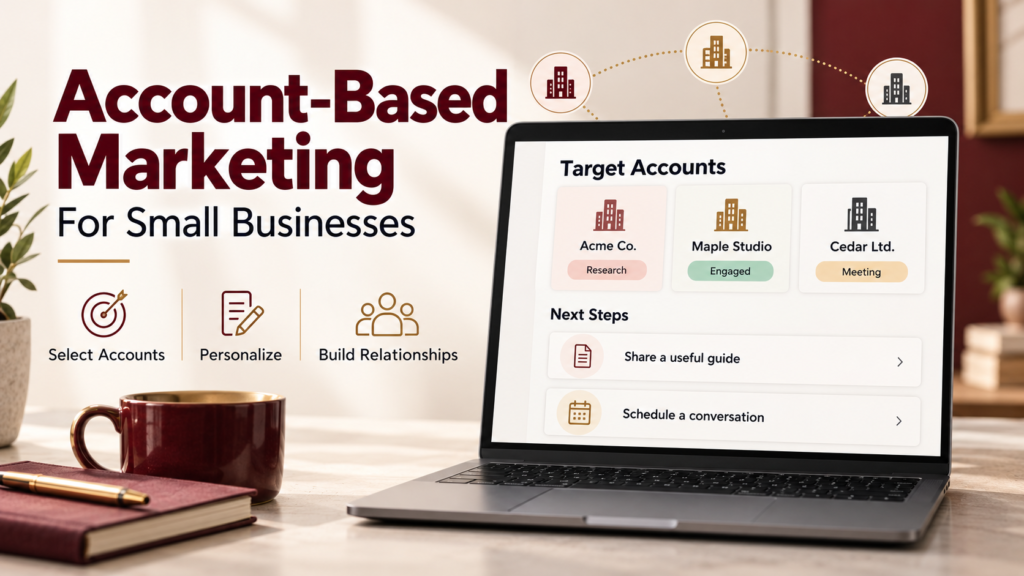

A small business does not always need more leads. Sometimes it needs better relationships with a carefully chosen group of companies.
Imagine a small IT provider that can serve only a few new business customers each quarter. Attracting hundreds of unrelated enquiries may create more work without improving sales. A focused approach could be more useful: identify suitable companies, understand their needs, and coordinate relevant marketing and sales activity around them.
That is the basic idea behind account-based marketing for small businesses.
You do not need to begin with an expensive advertising platform or a large marketing department. You need a clear customer profile, a manageable account list, useful content, and a consistent way to track progress.
This guide explains when account-based marketing makes sense, how to start, and how to evaluate whether the effort is worthwhile.
What Is Account-Based Marketing?
Account-based marketing, usually shortened to ABM, is a business-to-business strategy that focuses coordinated marketing and sales efforts on selected organizations.
An “account” means the company or organization you want to serve. It may contain several people involved in evaluating, approving, and using your product.
Salesforce describes ABM as an approach centered on specific high-value accounts and personalized marketing and sales engagement.
For a small business, “high-value” should mean commercially suitable—not simply large or well known.
A smaller company with a clear need, a realistic budget, and manageable service requirements may be a better target than a major corporation with an unsuitable procurement process.
ABM Is More Than Personalized Outreach
Adding a company name to an email does not create an account-based strategy.
A practical ABM approach connects:
- Account selection.
- Research into relevant business needs.
- Useful marketing content.
- Conversations with appropriate stakeholders.
- Coordinated follow-up.
- Measurement at the company level.
If you operate alone, you can still perform these functions. The important point is that they support the same account plan.
Account-Based Marketing vs Broader Lead Generation
Broader lead generation attracts individuals who may later be assessed for fit. ABM starts by identifying organizations worth pursuing, then works to build relevant relationships within them.
| Area | Broader lead generation | Account-based marketing |
|---|---|---|
| Starting point | An audience or topic | A selected group of companies |
| Content | Useful to a wider market | Adapted to account or segment needs |
| Main tracking unit | Individual lead | Account and its stakeholders |
| Coordination | Can begin within marketing | Requires connected marketing and sales activity |
| Useful measures | Qualified enquiries and conversions | Account engagement, opportunities, and commercial outcomes |
These approaches can work together.
An educational article may attract a suitable company organically. Once you recognize the fit, you can add that organization to your account plan.
Is Account-Based Marketing Right for Your Small Business?
ABM deserves consideration when the value of a potential relationship justifies the research and follow-up required.
When It May Be a Good Fit
Consider ABM if:
- You sell to businesses or organizations.
- You can describe your ideal customer clearly.
- Contracts involve meaningful value or recurring work.
- Several people influence the purchase.
- Buyers need explanation, evaluation, or reassurance.
- Your team can support a considered sales process.
Examples might include specialist consulting, business software, commercial maintenance, managed IT, or professional training.
These are possible applications, not evidence that every company in those industries should use ABM.
When a Broader Approach May Be More Practical
ABM may be difficult to justify when individual purchases generate little contribution, buyers purchase quickly without consultation, or your potential market is extremely broad.
It can also underperform when the product-market fit is unclear. Targeting a short company list does not fix an offer customers do not need.
Before committing, ask:
If we win one suitable account, could its expected contribution reasonably justify the acquisition effort and delivery requirements?
How to Build an Account-Based Marketing Strategy
1. Define Your Ideal Customer Profile
An ideal customer profile, or ICP, describes the type of organization that fits your offer.
HubSpot’s guidance distinguishes this company-level profile through characteristics such as industry, size, and technology environment.
Keep your first version specific enough to guide choices.
| Factor | Example for a small IT provider |
|---|---|
| Organization type | Independent professional services firms |
| Size | Teams large enough to need ongoing IT support |
| Location | Areas the provider can reliably serve |
| Main need | Support for distributed staff and devices |
| Buying fit | Willingness to consider an ongoing service agreement |
| Exclusions | Requirements beyond the provider’s technical capacity |
Use existing customer experience where available. Look at which relationships are profitable, manageable, and likely to benefit from your service.
Separate known information from assumptions.
2. Choose a Manageable Account List
Start with a list your team can research and follow up properly.
For illustration, a small pilot might include 10–20 accounts. That is a planning example, not a recommended minimum or industry benchmark.
Evaluate each account against:
- Fit with your customer profile.
- A plausible need.
- Ability to serve it effectively.
- Commercial potential.
- Access to relevant people.
- Timing or a credible reason to engage.
Do not prioritize companies solely because their logos would look impressive on your website.
3. Research Business Context
Useful research can come from company websites, public announcements, job advertisements, professional profiles, and existing conversations.
Look for context that relates directly to your offer.
For example, a company advertising for staff in several locations may have coordination needs. That is a hypothesis to explore, not proof that it has a problem.
Record:
- What you observed.
- Where you found it.
- Why it may matter.
- What you still need to confirm.
Avoid inventing internal challenges or implying access to information you do not have.
4. Identify Relevant Stakeholders
A business purchase may involve different perspectives.
| Stakeholder | Possible concern |
|---|---|
| Owner or executive | Commercial value and business risk |
| Department manager | Whether the solution addresses the operational need |
| Finance representative | Cost, terms, and affordability |
| Technical reviewer | Compatibility, security, and implementation |
| End user | Ease of use and daily usefulness |
One person may cover several roles in a small company.
Identify who is relevant rather than contacting everyone. Record what each person needs to understand and coordinate outreach so colleagues do not receive overlapping messages.
5. Create a Useful Offer
Give the account a reason to engage that relates to its business.
Possible offers include:
- A relevant planning checklist.
- A focused product demonstration.
- An implementation guide.
- A comparison worksheet.
- A clearly scoped assessment.
- A case study you have permission to share.
Avoid presenting a sales call as an independent assessment or promising results you cannot substantiate.
The offer should make the next step clear: what the person receives, how much time it requires, and whether it involves a sales discussion.
6. Personalize at a Sustainable Level
Small teams rarely have time to build entirely new content for every account.
A practical approach is to create a strong core resource, adapt it for a segment, and add account-specific context where justified.
For example:
- Core resource: a guide to organizing customer enquiries.
- Segment version: enquiry management for multi-location retailers.
- Account adaptation: questions about how its locations coordinate responses.
Personalization should improve relevance. It should not merely repeat company names or unrelated personal details.
7. Coordinate Channels and Follow-Up
Choose channels based on the relationship and how the audience prefers to engage.
Options may include professional networking, relevant events, introductions, educational content, appropriate business email, and paid advertising.
Keep a shared record of:
- The account owner.
- People contacted.
- Content shared.
- Responses.
- Open questions.
- The next agreed action.
Respect communication preferences and applicable outreach requirements. Avoid continuing repetitive contact when someone has declined.
8. Use Advertising Selectively
Paid advertising can support ABM, but it is not required.
LinkedIn offers company targeting through Matched Audiences. Its documentation also specifies a minimum usable advertising audience of 300 matched members. A small company list may therefore be insufficient after matching and additional targeting filters. Check current requirements before budgeting.
The threshold concerns matched people, not a guarantee that your chosen companies can be reached effectively.
Do not expand your account list with unsuitable organizations merely to make an advertising campaign run.
A Practical Small Business ABM Example
Consider a hypothetical company offering inventory software to independent wholesalers.
It selects a small group of wholesalers that fit its implementation capacity and product requirements.
The team then:
- Researches publicly available information about each business.
- Identifies relevant operations and management roles.
- Creates a stock reconciliation checklist for wholesalers.
- Shares useful content through appropriate channels.
- Offers a demonstration focused on the prospect’s confirmed workflow.
- Records objections, stakeholders, and next steps at the account level.
Success is not assumed. The pilot is designed to reveal whether the selected businesses have a need, whether the offer is relevant, and whether conversations progress.
The company should not claim that its software will reduce stock losses by a particular percentage without evidence.
A Simple 30-Day Starting Plan
The first month should establish and test the process. It may be too short to judge revenue outcomes.
| Period | Main work | Output |
|---|---|---|
| Week 1 | Define customer fit and select accounts | A justified target list |
| Week 2 | Research needs and stakeholders | Short account plans |
| Week 3 | Prepare content and begin suitable engagement | Relevant conversations and documented responses |
| Week 4 | Review feedback and follow-up | Revised messaging and next actions |
Continue evaluation over a period appropriate to your sales cycle.
What Tools Do You Need?
A small pilot can begin with:
- A shared spreadsheet or CRM.
- Company and contact records.
- A content creation tool.
- A shared calendar.
- Basic website and campaign measurement.
A spreadsheet can work when ownership, notes, and next steps remain clear. A CRM becomes more useful as multiple people coordinate interactions and opportunities.
Specialist ABM platforms may add capabilities, but buy them to solve an identified problem. They are not a prerequisite for testing the strategy.
How to Measure Account-Based Marketing
Track progress from account fit through commercial outcomes.
Early Indicators
Useful early measures include:
- Target accounts researched.
- Relevant stakeholders identified.
- Meaningful responses received.
- Meetings held.
- Needs confirmed.
- Agreed next steps.
A content view or email open alone is weak evidence of buying intent.
Commercial Measures
As the pilot develops, track:
- Accounts becoming qualified opportunities.
- Opportunities progressing.
- Customers won.
- Acquisition costs.
- Contribution from won business.
- Time from first meaningful engagement to purchase.
Keep definitions consistent. A “qualified opportunity” should require more than downloading a guide.
Assess Economics Carefully
Include staff research and follow-up time alongside content, tools, advertising, and other campaign costs.
When estimating return, compare attributable contribution with acquisition costs rather than treating all revenue as profit.
Distinguish accounts your activity introduced from existing opportunities it helped progress. Engagement does not prove that ABM caused the sale.
Common Mistakes to Avoid
Choosing too many accounts. A list has little value if your team cannot work it consistently.
Confusing large companies with good customers. Suitability includes profitability and delivery capacity.
Contacting one person and ignoring the wider decision. Relevant purchases may require several perspectives.
Using unsupported personalization. Public information should inform questions, not invented claims about internal problems.
Buying software before testing the process. Tools cannot establish customer fit for you.
Expecting fast results from a long sales cycle. Evaluate early progress without presenting it as completed revenue.
Neglecting existing customers and broader marketing. ABM should fit your overall workload and growth plan.
Frequently Asked Questions
1. Can a small business use account-based marketing without a marketing team?
Yes. An owner or small team can coordinate account selection, content, conversations, and follow-up. Keep the scope manageable and responsibilities clear.
2. How many accounts should a small business target?
There is no universal number. Choose a list based on research capacity, sales workload, customer value, and delivery resources.
3. Does ABM require paid LinkedIn advertising?
No. ABM can include introductions, useful content, events, and appropriate direct engagement. Advertising is an optional supporting channel.
4. How long does account-based marketing take to produce results?
It depends on the relationship, offer, and buying process. Initial responses may occur earlier than qualified opportunities or sales. Use your normal sales cycle to set realistic review periods.
5. Can ABM support existing customer relationships?
Yes. It can help coordinate relevant engagement around renewal, adoption, or an additional need. Confirm that the offer benefits the customer rather than treating every interaction as an expansion opportunity.
Conclusion
Account-based marketing for small businesses works best as a focused, manageable process.
Choose companies you can serve well, research relevant needs, provide useful content, and coordinate the next steps. Start with a pilot and assess account progress alongside the cost of the work. Expand when evidence supports it.