
You have selected a product or service to advertise. Now Google Ads asks how closely searches should relate to your keywords.
Broad, phrase, and exact match influence which searches can make your ad eligible to appear. The choice affects the demand you can reach and the search terms you will need to review.
For a first campaign, consider the specificity of your offer, the reliability of your conversion tracking, and how much exploration your budget can support. This guide focuses on keywords in Google Ads Search campaigns.
What Are Broad, Phrase, and Exact Match?
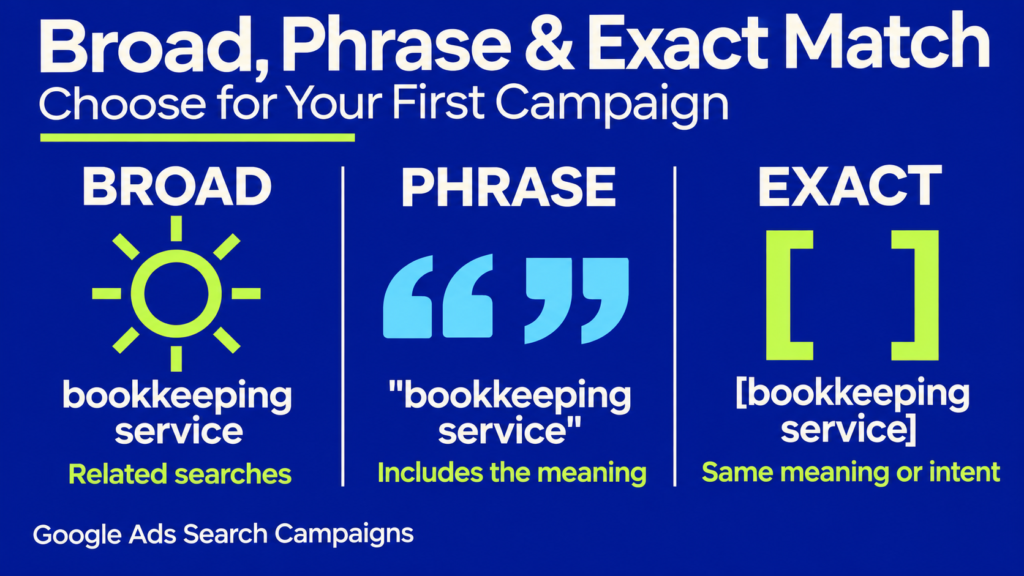
Google’s match types use meaning and intent when relating keywords to searches. They also overlap. Phrase match covers the searches reached by the equivalent exact keyword and more, while broad match extends further. Actual ad delivery still depends on campaign eligibility and the auction. Google Ads Help
| Match type | How to enter it | General matching scope |
|---|---|---|
| Broad | bookkeeping service | Searches related to the keyword |
| Phrase | "bookkeeping service" | Searches including the keyword’s meaning |
| Exact | [bookkeeping service] | Searches sharing the keyword’s meaning or intent |
Use quotation marks for phrase match and square brackets for exact match. A keyword entered without those symbols uses broad match. Google Ads Help
Broad Match Explained
Broad match can reach related searches beyond the wording you enter. Google says it can also consider signals such as recent searches, landing-page content, assets, and other keywords in the ad group. Google Ads Help
For a bookkeeping service, this creates an opportunity to discover customers who describe their needs differently. It also makes reviewing relevance and business outcomes important.
When Broad Match Deserves Consideration
Consider a measured test when you have a clear conversion goal, verified measurement, a relevant landing page, and room in your budget to explore additional demand.
Google strongly recommends pairing broad match with Smart Bidding, including strategies such as Maximize conversions or Maximize conversion value. These strategies optimize bids for conversions or value. Google Ads Help
A new account does not automatically rule out broad match. The practical question is whether the campaign’s goals, measurement, bidding, and review process support it.
What to Watch
A recorded conversion should represent an outcome you value. If a service campaign measures every form submission equally, review whether the resulting leads are suitable customers.
Also keep ad groups focused. A group mixing unrelated services makes the intended offer harder to assess.
Phrase Match Explained
Phrase match can match searches that include the meaning of your keyword. That meaning may be implied, and a search may express a more specific version of it. Google Ads Help
For example, "bookkeeping service" might be relevant to a search such as “monthly bookkeeping service for an online store.” This is an illustrative possibility, not a prediction of a particular auction.
When Phrase Match Deserves Consideration
Phrase match can be a practical starting point when you want to explore variations around a clearly defined service while keeping a tighter scope than broad match.
For a small store or service business, it can help you learn which modifiers customers use, such as product type, business size, or location.
What to Watch
Phrase match does not require every search to repeat your wording in the same sequence. Close variants can include synonyms, implied words, and reordered wording where meaning is preserved. All positive match types are eligible for close variants, and Google provides no opt-out. Google Ads Help
Review actual search terms even when the keyword list looks specific.
Exact Match Explained
Exact match can reach searches with the same meaning or intent as your keyword. It offers the narrowest scope of these three match types. Google Ads Help
The keyword [bookkeeping service] can therefore match more than one literal spelling or word sequence.
When Exact Match Deserves Consideration
Consider exact match when you have identified a specific buying intent and want a focused initial test.
A tightly defined service, a small product selection, or a limited capacity to handle enquiries may make that focus useful.
What to Watch
Exact match can limit discovery. It also cannot make an unclear keyword commercially useful. A vague keyword such as [business help] still leaves substantial uncertainty about what the searcher wants.
Start with a specific customer need before choosing the match type.
How to Choose for Your First Campaign
The following recommendations are an editorial decision framework. Google recommends broad match with Smart Bidding when advertisers have clear, accurately measured performance goals. Google Ads Help
| Your situation | Practical starting approach |
|---|---|
| A narrow offer and known buying terms | Consider exact match around those terms |
| A defined service with useful query variations | Consider phrase match |
| Reliable conversion measurement and a goal of finding additional demand | Consider testing broad match with Smart Bidding |
| Tracking is unverified or measures unsuitable actions | Fix measurement before scaling spending |
| Little time to review search terms or lead quality | Keep the launch focused and budget within review capacity |
| Very little traffic from relevant keywords | Check eligibility and demand before widening targeting |
1. Define One Commercial Goal
Choose the result the campaign should produce, such as a purchase or a qualified service enquiry.
Make sure the conversion setup reflects that goal. Test the action and check that reporting works before relying on it to evaluate performance.
2. Write Down What You Can Fulfil
Specify the product or service, customer type, location, and any important restrictions.
A business offering monthly bookkeeping to small online stores should communicate that offer clearly in its keywords, ads, and landing page.
3. Launch With a Manageable Scope
Choose a focused set of themes that you can review. You do not need to enter every keyword in all three match types.
Google’s guidance explains that broader match types already cover the queries available to narrower equivalents. Duplicating keywords is therefore not required simply to obtain that coverage. Google Ads Help
Different match types can have a deliberate role, but document that role before expanding the account.
4. Check Expansion Settings
Review AI Max settings as well as keyword match types. AI Max search term matching can expand reach using broad match and keywordless technology.
For a test intended to evaluate your chosen keyword match types, confirm whether that expansion is enabled and account for it when interpreting results. Google Ads Help
Practical First-Campaign Example
Suppose a small business sells monthly bookkeeping services to online retailers.
Its landing page explains the service, customer requirements, and enquiry process. Its goal is qualified enquiries.
| Proposed keyword | Match type | Reason to consider it |
|---|---|---|
[ecommerce bookkeeping service] | Exact | Focus on a defined service intent |
"bookkeeping for online stores" | Phrase | Explore variations around the intended customer |
ecommerce bookkeeping | Broad | Test additional related demand with Smart Bidding and verified measurement |
These are illustrative options. Launching all three together would create overlapping coverage, making a simple row-by-row comparison difficult.
One reasonable first test is a focused exact-and-phrase setup, followed by a measured broad-match experiment when the business is ready. Another is a broad-match launch with Smart Bidding and dependable measurement. Choose according to the campaign’s readiness and goals.
Add Negative Keywords With Context
Negative keywords help exclude searches you do not want.
For a client-acquisition bookkeeping campaign, employment searches may be unsuitable. However, a blanket exclusion of “free” could also block a relevant search such as “bookkeeping service with free consultation.”
Negative match types behave differently from positive match types. Review their rules and scope before saving exclusions. support.google.com
Maintain exclusions based on the offer and evidence from actual searches.
Review Search Terms and Business Results
After launch, review the search terms report alongside cost, conversions, and lead or order quality.
The report’s Match type column describes how a search related to the matched keyword. It can differ from the keyword’s configured match type, so include the Keyword column when checking what triggered an ad. Google Ads Help
Use the following review questions.
- Does the search describe a need we can satisfy?
- Did the ad and landing page match that need?
- Were recorded enquiries or purchases valuable?
- Has enough time passed for conversions to be reported?
- Is there enough evidence to justify a change?
Conversion delay can temporarily make recent cost per acquisition look higher and return on ad spend look lower. Allow for your conversion cycle before judging results. support.google.com
Where available, use a campaign experiment for a more structured comparison. Comparing keyword rows alone does not isolate the effect of match type because traffic can overlap and differ.
Frequently Asked Questions
1. Is exact match best for every beginner?
Choose based on the offer and campaign goals. Exact match offers a focused scope, but it can limit discovery. Reliable measurement and a suitable review process may support a broader approach.
2. Does phrase match require the same words in the same order?
Positive phrase match uses meaning and can include close variants. Do not assume searches must repeat your wording. Negative phrase match follows different rules.
3. Can a new account use broad match?
Yes. Consider it with Smart Bidding, verified conversion measurement, relevant ads and landing pages, and an affordable test scope. Account age alone does not establish readiness.
4. Is exact match always cheaper?
Match type alone does not determine click cost or acquisition cost. Compare the cost of suitable customers or valuable conversions, rather than assuming the narrowest option will cost less.
5. Should I change match types after a few days?
Act on clearly irrelevant searches when you identify them. For performance decisions, consider traffic volume, conversion delay, and the significance of the change. A short period with few clicks may provide little evidence.
Conclusion
Choose match types around a specific offer and a measurable business goal. Use exact match for focused intent, phrase match to explore meaning-based variations, and broad match when the campaign is ready to test additional demand with Smart Bidding.
Review actual searches and customer outcomes after launch. Those findings should guide the next change to your campaign.