
A customer finds your service, asks for a quote, and then goes quiet. Where did the experience break down? The price might have been higher than expected, or the customer might have wanted to book but missed the next step. A customer journey map helps you trace what happened and decide which questions to investigate.
If you’re learning how to create a customer journey map, start with one customer and one goal. This example follows a first-time customer who hires a residential cleaning company. It shows how to map the experience, spot a problem worth solving, and measure whether the change helps.
What is a customer journey map?
A customer journey map shows what a customer does, needs, and encounters as they work toward a goal. For a service business, that might run from searching for a provider to booking, receiving the service, and deciding whether to return.
Each interaction is a touchpoint. A website visit, quote email, phone call, and appointment reminder are all touchpoints. The map shows how these interactions connect from the customer’s point of view. You can use it to see where one team’s work affects another. For example, a booking page can promise a time window that the crew’s dispatch process cannot reliably meet.
How to create a customer journey map in six steps
1. Choose one customer scenario
Write a sentence that identifies the customer and what they want to accomplish. For example, “A first-time customer wants to book a standard home cleaning before the weekend.” Start the map when they begin looking for a provider and end after they receive the service and have an opportunity to book again.
Create a separate map if another type of customer goes through a substantially different process. A recurring customer may simply choose a new date, while a first-time customer needs a quote and an explanation of what the service includes.
2. Gather evidence from actual interactions
Review recent inquiries, quote replies, booking records, and customer feedback. Speak to a few customers and the staff who answer questions or deliver the service. Ask customers to recall what happened in order. What did they check first? At which point did they need to follow up? What information did they wish they’d had sooner?
Record what you observed and mark assumptions as questions to verify. If three customers asked whether cleaning supplies were included, you have evidence that the question came up. You can then check whether others had trouble finding the answer on the service page.
3. Lay out the stages and touchpoints
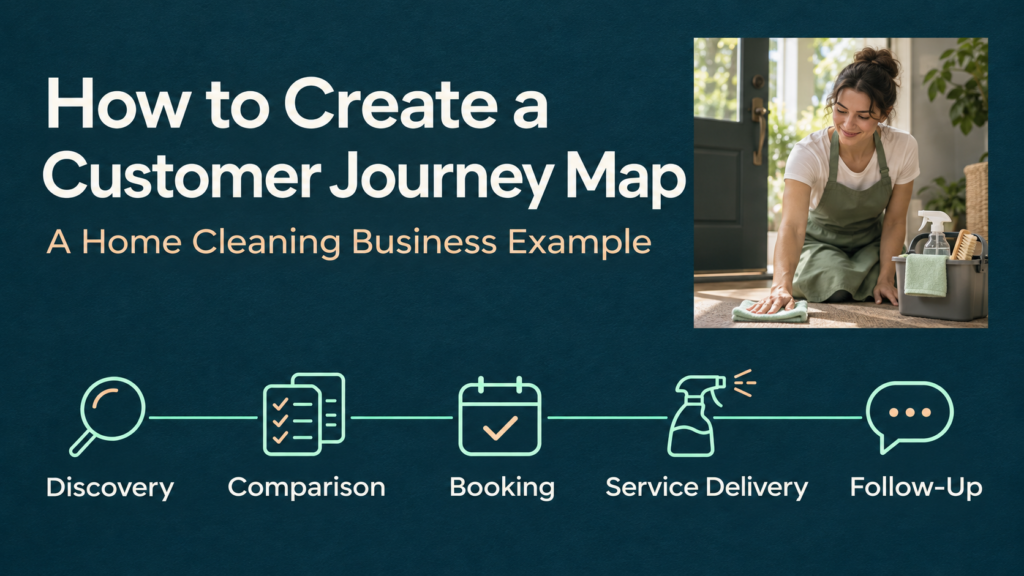
Write the main stages in the order customers typically encounter them. For the cleaning company, those are discovery, comparison, booking, service delivery, and follow-up.
Under each stage, add the customer’s action and the touchpoint where it takes place. Include handoffs, such as when a website inquiry moves to a quote email or when the office passes a booking to the crew. Customers may return to an earlier stage or switch channels. Capture the common path and note any alternate path that causes a recurring problem.
4. Add the customer’s questions and points of friction
For each stage, write one question the customer needs answered. During booking, that could be “Is this date confirmed?” Add any delay, missing information, or extra work the customer faces.
If you include emotions, connect them to what customers say or label them as estimates. A quote reply asking “Should I book another cleaner while I wait?” gives you more to work with than a generic “frustrated” rating.
5. Choose a change and assign an owner
Start with one problem that affects a meaningful customer decision and that your team can address. Consider how often it comes up, how much it affects the customer, and how hard it would be to fix.
Write the action beside the problem and name the person responsible. For example, “The office manager adds a booking link and a clear confirmation message to every eligible quote.” Check that the promise matches the booking system. If customers are requesting a time that staff still need to verify, tell them when to expect confirmation.
6. Measure the result and update the map
Pick a measure related to the problem. If customers struggle after receiving a quote, track the share of quotes that lead to confirmed bookings. If customers ask repeatedly about arrival, track how often customers contact the office about their arrival window.
Keep the definition consistent before and after the change. Compare similar periods where you can and note changes in pricing, seasonality, or appointment availability. Update the map with what you learn and choose the next problem to investigate.
Worked example of a customer journey map for a cleaning business
This example is fictional. A local cleaning company wants to understand why first-time customers ask for a quote and then contact the office again before booking. It maps the steps from initial search through follow-up.
| Stage | Customer action and touchpoint | Customer’s question | Friction to investigate | Proposed improvement |
|---|---|---|---|---|
| Discovery | Searches for a cleaner and visits the company’s website | “Do you serve my area?” | The service area appears only on the contact page. | Add the service area to the main cleaning page. |
| Comparison | Reads the service page and requests a quote | “What’s included in a standard clean?” | The page does not say how add-ons are handled. | Add a clear list of included tasks and common add-ons. |
| Booking | Opens the quote and replies by email | “How do I reserve a time?” | The quote asks the customer to reply, and the office confirms availability later. | Add a booking link and send an email when the reservation is confirmed. |
| Service delivery | Waits for the crew and checks the reminder | “When will the cleaners arrive?” | The reminder has the date but omits the arrival window. | Include the window and the office contact in the reminder. |
| Follow-up | Reads the receipt and considers another cleaning | “How do I book the same service again?” | The receipt has no link to book again. | Add a link for repeat bookings. |
How the business measures its booking change
The company chooses the booking stage because quote replies frequently ask how to reserve a time. The office manager adds a link to available slots and makes sure customers receive confirmation after they reserve. For this example, the team counts each eligible first-time quote once and checks whether it becomes a confirmed booking within seven days. The team waits seven days after the last quote in each group before comparing results.
| Period | Eligible quotes | Confirmed bookings within 7 days | Quote-to-booking rate |
|---|---|---|---|
| Before the booking link | 40 | 12 | 30% |
| After the booking link | 40 | 16 | 40% |
The illustrative rate rose by 10 percentage points, from 30% to 40%. The company also checks whether appointment availability changed and reads customer replies to see whether fewer people asked how to book. Those details help the team decide whether to keep the change and what to watch in the next period.
Copyable customer journey map template
Start with a shared document or spreadsheet. Add one row for each stage, and give each improvement a named owner.
| Stage | Customer action and touchpoint | Customer question or need | Evidence or assumption | Friction | Proposed change | Owner | Measure |
|---|---|---|---|---|---|---|---|
| [Stage name] | [What they do and where] | [What they need at that point] | [Source or question to verify] | [What slows them down] | [Action to test] | [Person responsible] | [How you’ll track it] |
Write the customer scenario at the top. If the team disagrees about how a stage works, pick one recent booking or inquiry and trace it together. Record any gap you still need to investigate.
Frequently asked questions
1. What are the five stages of a customer journey?
A service business can start with discovery, comparison, booking, service delivery, and follow-up. Change the stages to reflect how customers use your service. A consultation or site visit may need its own stage if it affects whether customers book.
2. Do I need special software to create a journey map?
A spreadsheet, shared document, or whiteboard is enough for a first map. Choose something your team can update and use to record evidence, owners, and measures.
3. What’s the difference between a customer journey map and a sales funnel?
A sales funnel groups prospects by their progress toward a sale and helps you measure conversion. A journey map shows what customers try to do at each stage and where problems occur. It can also cover delivery, support, and repeat bookings.
4. Can I create a map if my business is new?
Yes. Use your planned booking process and what you know from early inquiries or customer interviews. Mark unverified points and update the map after your first customers move through the process.
5. How often should I update my customer journey map?
Review it after a change that affects what customers do, such as a new booking system or a different service policy. Revisit it when the same complaint keeps appearing or when the data shows a drop at an important step.
Conclusion
Map one customer’s goal using the evidence you already have. Find a step where customers need to ask again, wait, or switch channels to get something done. Assign one improvement and measure what happens next. Add what you learn to the map so the team can make its next decision with better information.