
Setting a service price can feel straightforward until you account for everything involved. A two-hour appointment may also require preparation, travel, follow-up, software, and time spent finding the customer.
Charge only for the obvious delivery time, and you may stay busy without earning enough to sustain the business.
Learning how to price your services: costs, time, and profit explained starts with understanding what each job must contribute. You can then compare that calculation with customer expectations and the value of your work.
This guide provides a practical method for setting hourly rates, project fees, and recurring packages.
All amounts and scenarios below are hypothetical. They illustrate the calculations and are not recommended market rates. Replace them with your own currency and business figures.
What Should Your Service Price Cover?
A useful starting price should account for:
- The cost of delivering the service.
- A share of general business expenses.
- Compensation for your work.
- A planned profit above those amounts.
New Zealand’s official business guidance similarly frames pricing around paying business expenses, paying yourself, and making a profit. It distinguishes cost-based, competitor-based, and customer-based approaches. Business.govt.nz
Your cost calculation establishes a planning baseline. Whether customers will pay that price requires a separate assessment.
Step 1: Calculate Your Business Costs
Start with recent records rather than estimates where possible.
General Business Expenses
These support the business across multiple clients:
| Expense | Examples |
|---|---|
| Software | Design tools, scheduling, accounting, cloud storage |
| Workspace | Rent, internet, business-use utilities |
| Administration | Bookkeeping, insurance, professional fees |
| Marketing | Website hosting, advertising, networking |
| Equipment | Maintenance and an appropriate replacement allowance |
| Staffing | Administrative support and relevant employment costs |
For a monthly budget, divide annual recurring expenses by 12 and quarterly expenses by three.
Use a consistent treatment for equipment. Avoid counting its full purchase price and a separate allocation for the same cost in one calculation.
Job-Specific Costs
These arise because you accept a particular assignment:
- Materials and supplies.
- Subcontractor charges.
- Travel required for the job.
- Project-specific software or licenses.
- Payment or platform fees.
Count each expense once. If a cost is already included in your general budget, do not add it again without an adjustment.
Step 2: Include Compensation for Your Own Work
Owner compensation deserves its own line in your pricing model.
Suppose you want the business to provide $3,000 a month for your work. Include that requirement when calculating the revenue your services must generate.
The accounting treatment depends on your business structure. An owner’s drawings may not be an accounting expense, but they remain relevant to personal income planning.
Throughout the examples below, owner compensation is treated as a planning cost. Profit means the amount left after that compensation and the other listed costs. Your financial statements may classify these amounts differently.
Do not include the same owner income in both the cost budget and the profit target.
Step 3: Estimate Realistic Billable Time
Available working hours and billable hours are different.
A service business also needs time for proposals, administration, marketing, training, and gaps between bookings. Business Queensland’s pricing guidance highlights the importance of available time and warns against overestimating working capacity, including overlooking leave. Business Queensland
Consider this hypothetical month:
| Activity | Hours |
|---|---|
| Client delivery | 80 |
| Marketing and proposals | 25 |
| Administration | 20 |
| Training and process improvements | 10 |
| Leave, gaps, and contingency | 25 |
| Total planned time | 160 |
The pricing calculation uses 80 billable hours, not 160.
The allocation is illustrative. Track your own time to understand your actual capacity.
Step 4: Calculate Your Cost Per Billable Hour
Use:
Cost per billable hour = Monthly overhead and owner-compensation budget ÷ Expected monthly billable hours
Assume:
- Monthly overhead: $1,000
- Planned owner compensation: $3,000
- Expected billable hours: 80
Then:
($1,000 + $3,000) ÷ 80 = $50 per billable hour
This $50 covers the stated budget at the assumed workload. It does not yet include job-specific costs or additional profit.
If billable hours fall to 60:
$4,000 ÷ 60 = $66.67 per billable hour
That difference shows why optimistic booking assumptions can produce an unsustainable rate.
Step 5: Add Profit Using the Correct Formula
You can add a fixed profit amount or calculate a price using a target margin.
For a target margin:
Price = Total modeled cost ÷ (1 − Target margin)
Enter the margin as a decimal. A 20% target becomes 0.20.
Suppose an hour of service has:
- Allocated overhead and owner compensation: $50
- Job-specific costs: $10
- Total modeled cost: $60
For a 20% margin:
$60 ÷ 0.80 = $75
At a $75 price:
| Item | Amount |
|---|---|
| Revenue | $75 |
| Modeled cost | $60 |
| Profit above modeled cost | $15 |
Margin = $15 ÷ $75 = 20%
This margin applies only to the costs included. It is not automatically your accounting net profit margin or after-tax return.
Margin and Markup Are Different
Markup measures profit against cost. Margin measures profit against selling price.
| Calculation using a $60 cost | Selling price | Profit | Margin |
|---|---|---|---|
| Add a 20% markup | $72 | $12 | 16.67% |
| Set a 20% margin | $75 | $15 | 20% |
Business Queensland expresses markup pricing as cost plus cost multiplied by the markup percentage. Business Queensland
Always label which method you are using.
Example: How to Price a Fixed-Fee Project
Imagine a designer preparing a defined package of marketing materials.
The estimated workload is:
| Task | Hours |
|---|---|
| Briefing and research | 2 |
| Design work | 6 |
| Included revisions | 2 |
| Project administration and handover | 2 |
| Total | 12 |
Using the $50 internal cost per billable hour:
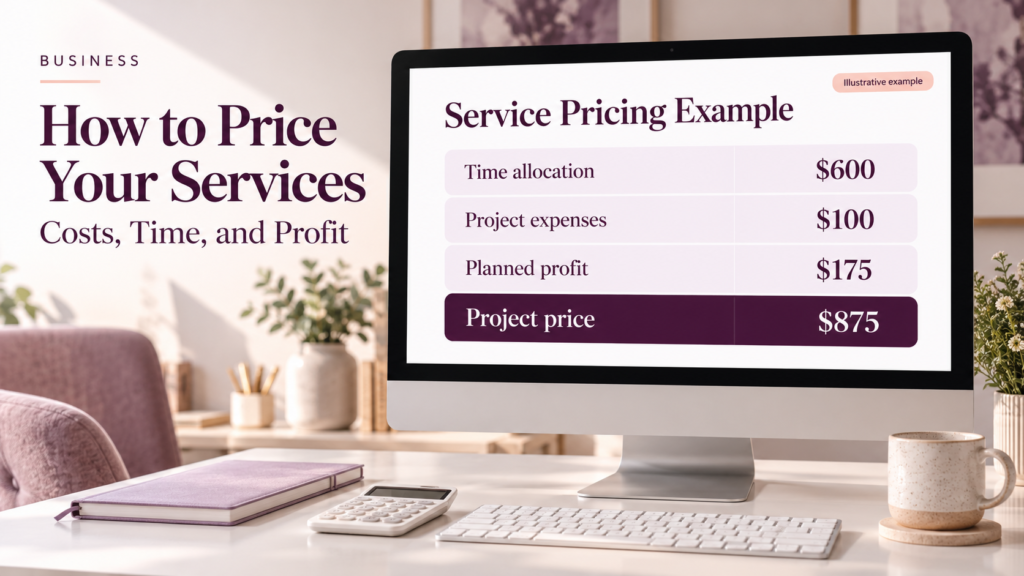
Time allocation = 12 × $50 = $600
Add $100 in project-specific costs:
Total modeled project cost = $700
For a 20% margin:
Project price = $700 ÷ 0.80 = $875
The planned profit above modeled costs is $175.
What If the Project Takes Longer?
If delivery requires 14 hours instead:
Actual modeled cost = (14 × $50) + $100 = $800
At the unchanged $875 fee:
Profit = $875 − $800 = $75
Margin = $75 ÷ $875 ≈ 8.6%
The fee did not change, but the margin fell substantially. Tracking actual delivery time helps you improve future estimates.
Choose a Pricing Model That Fits the Work
| Model | When it may fit | Main limitation |
|---|---|---|
| Hourly | Work with uncertain duration or changing requirements | Customers may find the final cost difficult to predict |
| Fixed project fee | Clearly defined deliverables and scope | Extra work can reduce your margin |
| Monthly package or retainer | Recurring services with agreed capacity | Unclear limits can create excessive demands |
| Value-based pricing | Work whose benefits the customer can meaningfully assess | Value is difficult to estimate and should not become a promise |
| Hybrid | A defined core service with separately priced additions | Requires clear boundaries and communication |
A monthly package should explain what is included, how requests are handled, and what happens when the customer needs additional work.
Avoid offering “unlimited” service unless you have a realistic way to deliver it.
Check Customer Value and Market Alternatives
Once you understand costs, consider the customer’s decision.
Ask:
- What problem does the service solve?
- What alternatives does the customer have?
- What evidence supports your expertise?
- How do turnaround, reliability, and support differ?
- Is the package appropriate for the customer’s budget?
Compare publicly available offers with similar scope. A low advertised price may exclude work that your service includes.
If your calculated price is above what customers will accept, investigate the reason. Options include narrowing the package, improving delivery efficiency, changing the target market, or reconsidering the service.
A higher price alone does not establish higher value.
Account for Percentage-Based Fees
A payment or marketplace fee calculated as a percentage of revenue needs special attention.
Suppose modeled costs are $100, the selling fee is 5%, and you want a 20% margin after that fee:
Price = $100 ÷ (1 − 0.05 − 0.20)
Price = $133.33 approximately
Using the unrounded calculation:
- The fee consumes 5% of revenue.
- Modeled costs consume 75%.
- Planned profit is 20%.
This assumes no additional fixed transaction charge. Check the provider’s actual fee structure and avoid adding fees twice.
Protect Your Price With a Clear Scope
A project fee needs a clear description of the work.
Your quote should explain:
- Deliverables and exclusions.
- Included revision rounds.
- Customer responsibilities.
- Expected schedule.
- Payment stages.
- How additional work will be approved and priced.
- Applicable tax treatment.
Australia’s official quoting guidance emphasizes clear service descriptions, costs, and terms. Local requirements vary, so check the rules relevant to your business. business.gov.au
Example scope wording:
Includes five social graphics, one initial concept, and two revision rounds. Additional designs or changes outside the agreed brief require a separate quote and approval.
Specific boundaries make pricing easier to understand and manage.
Review Discounts Before Offering Them
Using the earlier project example:
- Original fee: $875
- Modeled cost: $700
- Planned profit: $175
A 10% discount reduces the fee to $787.50.
With costs unchanged:
Profit = $787.50 − $700 = $87.50
The discount cuts the planned profit in half.
An alternative is to offer a smaller package with fewer deliverables. That reduces the customer’s price while also changing the work required.
When Should You Review Your Prices?
Review pricing when costs, scope, delivery time, or demand change.
Track:
| Measure | Why it matters |
|---|---|
| Estimated vs actual hours | Identifies underquoted work |
| Revenue less job-specific costs | Shows what remains for overhead and compensation |
| Billable hours | Tests your capacity assumptions |
| Profit under your chosen model | Checks whether pricing meets your goal |
| Quote acceptance and feedback | Helps assess market fit |
| Payment timing | Reveals cash-flow pressure |
Make price changes according to your agreements and communicate the effective date clearly.
Frequently Asked Questions
1. How do I price services when I am just starting?
Estimate costs, owner compensation, and realistic billable capacity. Use those figures to build a baseline, compare similar market offers, and track early projects closely. Revise assumptions as actual results become available.
2. Should I charge hourly or per project?
Hourly pricing can suit uncertain work. Fixed fees can suit a clearly defined outcome. Either approach requires an understanding of costs and delivery time.
3. What is a good profit margin for a service business?
There is no universal target. The appropriate margin depends on your cost structure, risk, demand, and growth plans. The 20% examples here demonstrate the formula; they are not industry benchmarks.
4. Should I charge less because I work faster?
Not automatically. Under a fixed-fee agreement, the price can reflect the agreed deliverable and value. Under hourly billing, record time honestly and follow the agreed terms.
5. Should taxes be included in my service price?
That depends on your jurisdiction, registration, customer type, and price-display rules. Distinguish taxes collected from customers from your own income-tax obligations, and check the relevant tax authority’s guidance.
Conclusion
A useful service price begins with an honest calculation of costs, compensation, and available billable time. Profit, customer value, and market fit then shape the final offer.
Use the formulas as planning tools, define your scope clearly, and compare estimates with actual results. Your pricing becomes more reliable when it reflects how your business delivers work in practice.