
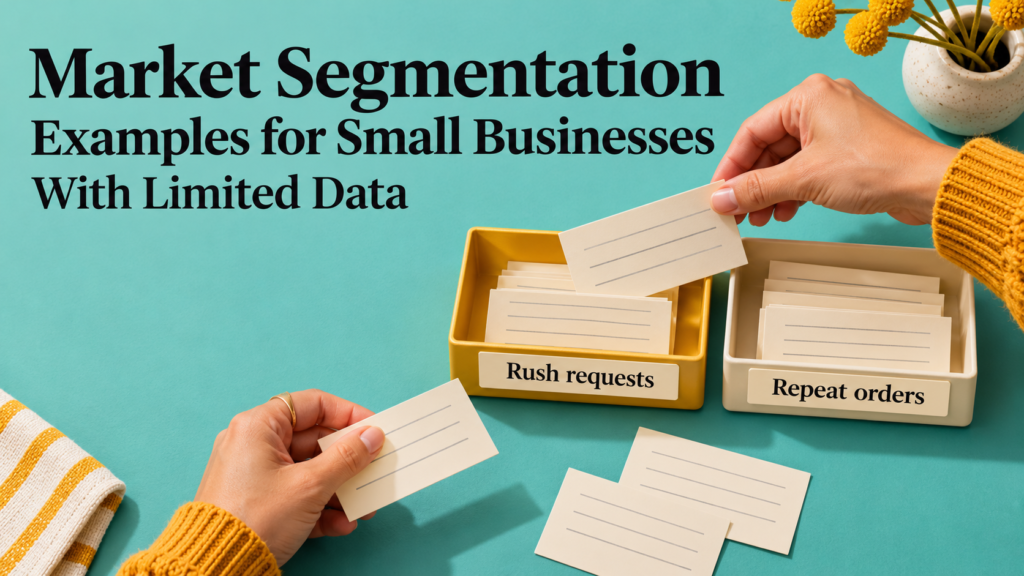

A small print shop notices that some customers ask, “How quickly can I get this?” Others ask, “Can you make the same batch every month?” Both groups buy printing, but the first may respond to a clear turnaround promise while the second may care more about an easy reorder process.
These market segmentation examples for small businesses with limited data show how to find differences like that using order records, customer inquiries, and short conversations. You’ll learn what to record, how to define a segment, and how to decide whether it deserves a different offer or message.
What is market segmentation?
Market segmentation means dividing a broader market into groups with shared needs, circumstances, or behaviors. A useful segment helps you make a decision about what you sell, how you describe it, or where you reach the people likely to buy it.
Your existing customers can give you clues about the broader market. For example, three requests for an urgent print job give you a reason to test an urgent-order option. Those requests tell you what a few people asked for. You’d need more evidence to estimate how common that need is across your market.
Five market segmentation examples for small businesses with limited data
The businesses and scenarios below are illustrative. Each example starts with information a small business can record in the course of its usual work.
| Business | Segments to test | Signal you can record | Marketing decision |
|---|---|---|---|
| Print shop | Deadline-driven buyers and planned repeat buyers | Requested delivery date and mention of a regular order | Show turnaround options for urgent work and offer a reorder process for regular orders. |
| Online stationery shop | First-time buyers and returning buyers | Completed order history | Give first-time buyers help choosing a product. Give returning buyers a quick way to reorder. |
| Local bakery | Pickup customers and customers seeking nearby delivery | Fulfillment choice or delivery area requested | Make pickup times prominent and show delivery costs and availability before checkout. |
| Bookkeeping service | Businesses setting up records and businesses catching up on overdue records | Reason for contacting the service | Describe setup and catch-up work separately, with the information needed to quote each. |
| Gift shop | Occasion buyers and shoppers buying for themselves | Buying occasion shared in an inquiry or an optional checkout answer | Test an occasion-specific product guide or gift-wrapping option where demand and margins support it. |
Choose a signal that changes what you do
An urgent print request calls for a different response from a routine reorder. A customer’s age would add little if the decision you need to make is whether to show pickup deadlines or a reorder link. Start with the information closest to the buying decision, such as the required date, preferred fulfillment method, or reason for the purchase.
A single customer can fit several groups. Someone may be a returning buyer who also needs next-day delivery. For a turnaround message, the deadline matters more. For a reorder campaign, order history may matter more.
How to build useful segments from a small sample
1. Start with one marketing decision
Write down what you want to change. For example, “Should I add a reorder option to our quote emails?” gives you a reason to check how often customers ask for the same product, what slows them down, and whether a different email could help.
One decision keeps your data collection manageable. You can add a new field later if it would answer a different question.
2. Review the information you already have
Start with a recent period you can review consistently. Look through completed orders, quote requests, and messages customers sent to the business. Record only details relevant to the decision, such as the product, the requested date, and the outcome. If the reason for buying is unclear, mark it as unknown.
Use short conversations to fill gaps. Ask a question that lets the customer describe the situation in their own words, such as “What made you look for this service now?” or “What mattered most when choosing where to order?” The U.S. Small Business Administration discusses interviews and surveys as ways to learn about a specific audience. SBA guide to market research and competitive analysis
3. Define each segment so another person could apply it
A label such as “urgent customers” becomes usable once it has a rule. A print shop could define a rush inquiry as one requesting delivery within two business days. It could define a repeat-order inquiry as a request to reprint a previous order or establish a recurring batch.
Decide how to handle overlap before counting. If a request qualifies for both and you’re testing turnaround messaging, assign it to the rush group for that test. Keep an unknown category for inquiries without enough information.
4. Test one change and track a useful result
Choose a change you can deliver consistently, such as a clearer quote reply or a service page that answers a recurring question. Track the next action that matters. For a quote reply, that could be how many eligible inquiries become paid jobs. For a delivery page, it could be how often shoppers complete eligible orders after seeing the fee.
Record both the number of outcomes and the number of people who had the chance to act. “Three orders from eight inquiries” provides more context than a conversion percentage by itself. Keep an eye on costs and staff time if the new offer requires extra work.
Worked example using 24 print shop inquiries
A fictional shop reviews 24 distinct inquiries from the past month. It puts each inquiry in one category using the rules above and gives rush requests priority when the rules overlap.
| Group | Inquiries | Paid jobs | What the shop checks next |
|---|---|---|---|
| Rush requests | 8 | 3 | Were turnaround and pickup times clear enough to make a decision? |
| Repeat-order requests | 7 | 5 | Would a reorder link save time for customers and staff? |
| Other or unclear | 9 | 2 | What details should staff ask for at the start of a quote? |
| Total | 24 | 10 |
The shop starts with one change. For the next batch of rush inquiries, staff include the earliest realistic pickup time and any rush fee in the first reply. They record how many eligible inquiries become paid jobs and whether the promised deadlines are met.
The initial three paid jobs from eight rush inquiries give the shop a baseline. A few more jobs in the next batch could reflect the new reply, a quieter production schedule, or a different mix of orders. The owner can repeat the test over another comparable period before investing in a dedicated rush service.
Simple spreadsheet fields to track
Use one row per inquiry or order, depending on the decision. If you measure inquiries that become paid jobs, keep the inquiry as the unit throughout and update its outcome on the same row.
| Field | Example entry |
|---|---|
| Inquiry ID and date | Q-024, 6 October |
| Buying signal | Requested pickup in two business days |
| Segment | Rush request |
| Message or offer | Pickup window and rush fee in first reply |
| Outcome | Paid job |
| Fulfillment note | Ready by the promised time |
Use an internal ID for analysis and limit access to the original customer records. Collect personal details only when they serve a clear purpose. For example, a bakery can assess demand for delivery using an area or postal code without copying full addresses into its marketing worksheet.
Frequently asked questions
1. How much data do I need to start segmenting customers?
There’s no fixed minimum for forming an initial hypothesis. A handful of similar requests can justify a small, reversible test. You’ll need more observations across comparable periods before drawing broader conclusions or committing significant money.
2. What are the common types of market segmentation?
Common approaches group customers by location, demographics, behavior, or attitudes and interests. You can also group customers by their needs or by the situation that prompts a purchase. Pick the approach that helps you make a specific decision with information you can collect reliably.
3. Is market segmentation the same as customer segmentation?
Market segmentation can cover potential buyers as well as current customers. Customer segmentation usually groups people or businesses you already serve. Your customer records can suggest where to look in the broader market, especially if you check those signals with prospective buyers.
4. Can I segment customers without a CRM?
Yes. A spreadsheet can track a defined signal, group, and outcome. A CRM becomes more useful when several people need to manage the same records or you need consistent tagging across a larger volume of inquiries.
5. What should I do if a segment is very small?
Keep the label if the group has a distinct need worth observing. Use a low-cost test and record actual counts. If several groups would receive the same message or service, combine them for that decision and keep any useful notes for later.
Conclusion
Choose a marketing decision you can test this month. Use recent orders or inquiries to define a group with a clear rule, then try one change that makes buying easier for that group. Track paid orders and the effort needed to serve them. Repeat the test if the numbers are too small to tell whether the change is worth keeping.