
Searching for small business grants in the U.S. gets easier when you start with a project. A retailer replacing a storefront sign, a manufacturer attending its first overseas trade show, and a software company testing a prototype may qualify for very different opportunities. Write down what you want to do, where the work will happen, and what it will cost before you start searching.
The U.S. Small Business Administration (SBA) says it does not provide grants to start or expand a business. It points businesses toward specific opportunities, including research and development programs and export assistance. State and local programs may support other activities, depending on their rules and available funding. SBA grant guidance
Where to find small business grants in the U.S.
| If your project involves… | Start here | Check first |
|---|---|---|
| Research or prototype development | Look for Small Business Innovation Research (SBIR) and Small Business Technology Transfer (STTR) opportunities. | Does the project match an agency’s current topic and applicant requirements? |
| Entering or expanding in an overseas market | Use the SBA’s State Trade Expansion Program (STEP) directory. | Does your state or territory have an opportunity for businesses, and is your activity eligible? |
| Improving a commercial storefront | Search your city or county’s economic development website. | Is the address in an eligible area, and do you need approval before work starts? |
| Applying to another federal program | Search Grants.gov by project and applicant type. | Does the notice explicitly allow your type of small or for-profit business to apply? |
SBIR and STTR funding opportunities · SBA STEP directory · Grants.gov eligibility guidance
Federal research opportunities
SBIR and STTR support research or development that fits a participating agency’s published opportunity. STTR involves collaboration with a qualifying research institution. Start with the topic description, then follow the issuing agency’s current solicitation for eligibility, proposal instructions, and the submission portal. A program’s existence alone tells you little about whether a suitable round is open today. Official SBIR and STTR funding opportunities · NIST’s SBIR program guidance
State and local programs
For export assistance through STEP, start with the SBA’s directory and contact the organization listed for your state or territory. It can tell you which expenses are eligible, how applications are handled, and whether the application window is open. SBA STEP awardee directory
For a local project, search your city, county, or state website with the expense you want funded, such as “storefront improvement,” and your location. Philadelphia’s Storefront Improvement Program is one example of a local reimbursement program. Its requirements apply to that program. Your own city may use different boundaries, eligible expenses, or approval steps. Philadelphia’s Storefront Improvement Program FAQ
How to apply for a small business grant
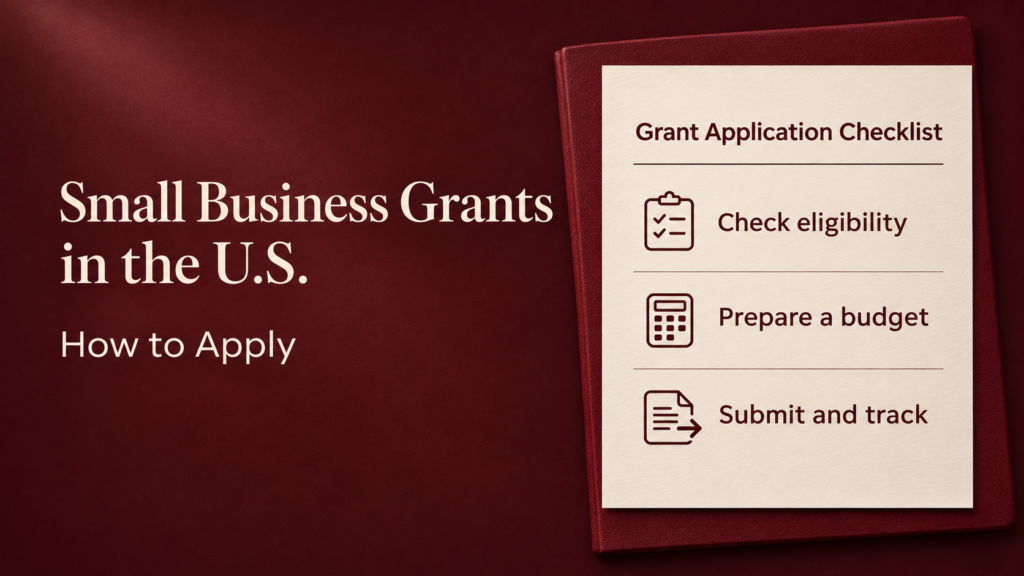
1. Write a short project brief
Describe the work, the request, the timeline, and the result. For example, “We want to replace the storefront sign and repair the front-facing entry trim. We have contractor quotes and can complete the work within eight weeks of written approval.” That brief gives you a way to filter out grants that fund a different activity.
2. Read the eligibility and spending rules before drafting
Open the official announcement and check who can apply, where the project must take place, and which costs the program covers. Look for a match requirement, an award cap, reimbursement rules, and restrictions on spending before approval. Record the deadline and time zone from the announcement. If your business type or expense is unclear, ask the program contact before investing time in the application. Grants.gov eligibility guidance
3. Confirm where to apply and register early
Follow the portal listed in the announcement. For an organization applying through Grants.gov, register the entity at SAM.gov first and obtain its Unique Entity ID (UEI) through that process. Then set up Grants.gov access and confirm who is authorized to submit on the organization’s behalf. Entity registration is free. Give yourself time to resolve registration or access issues before the deadline. State, local, and agency-run opportunities can use their own portals. Grants.gov applicant registration · SAM.gov entity registration checklist
4. Gather documents and build an eligible budget
Make a checklist from the application instructions. Depending on the grant, that may include business registration, proof of address, vendor quotes, a project narrative, financial information, or a landlord’s permission. Gather only what the program requests and upload sensitive documents through the official application channel.
Put each cost on its own budget line. Show what the grant would cover, what your business would pay, and what you may need to pay before a reimbursement arrives. If the program requires matching funds, verify what counts toward the match.
5. Answer the scoring criteria with specific evidence
Use the program’s criteria as a checklist while drafting. Explain the current problem, the work you’ll complete, and how you’ll document completion. A storefront applicant could use current photos, itemized quotes, and a dated work plan to support its request. If the program asks for an expected outcome, explain how you’ll measure it and label projections as estimates.
6. Submit, save confirmation, and track the application
Check the signature, attachments, budget totals, and required file formats. Submit early enough to address a validation error. For Grants.gov Workspace applications, save the tracking number and confirmation PDF. For other portals, keep the confirmation email or reference number. If selected, read the award terms before ordering materials or signing a contractor agreement. Grants.gov Workspace tracking instructions
Worked example of a matching grant budget
Imagine a fictional city program that reimburses 50% of eligible costs, up to $2,500. A bakery wants to replace its storefront sign and repair its entrance trim. Assume both quotes are eligible and that the business must wait for written approval before spending.
| Budget item | Amount |
|---|---|
| Sign fabrication and installation | $4,000 |
| Entrance trim repair | $2,000 |
| Total eligible project cost | $6,000 |
| 50% of eligible costs | $3,000 |
| Grant request after applying the $2,500 cap | $2,500 |
| Business share after reimbursement | $3,500 |
The bakery requests $2,500 because the award cap is lower than half the project cost. If the program pays only after the bakery pays its vendors and submits proof, the bakery needs a plan to cover the full $6,000 upfront. This example shows why checking the reimbursement schedule matters as much as checking the award amount.
Frequently asked questions
1. Can a brand-new business get a grant?
Some opportunities may allow new businesses to apply. Others require a minimum operating history, an eligible location, or a project that fits a specific program. The SBA does not provide general grants for starting a business, so verify eligibility in the individual announcement before applying. SBA grants guidance · Grants.gov eligibility guidance
2. Do I need an LLC to apply?
Check the applicant section for accepted business structures and required documentation. A program may accept sole proprietors, while another may require a different legal structure, proof of registration, or a specific operating history. Use the rules for that opportunity to decide whether to apply. Grants.gov eligibility guidance
3. Do I need to repay a small business grant?
Grants generally do not have a scheduled repayment like a loan. The award agreement governs how you can use the money and what documentation or reporting is required. Read any provisions about disallowed expenses or returning funds before you accept an award. Grants.gov grant lifecycle
4. Are federal grant applications or SAM.gov registration free?
Applying through Grants.gov and registering at SAM.gov are free. Grants.gov warns against unsolicited offers of government grant money and requests for fees to receive federal grant funds. Go directly to the official program page to verify the opportunity and its application instructions. SAM.gov entity registration checklist · Grants.gov grant scam guidance
5. Where can I get help preparing my application?
Use the SBA’s local assistance finder to locate a Small Business Development Center (SBDC) or another resource partner. Ask what application or budgeting support they offer and bring the announcement, your draft budget, and any eligibility questions. The program’s listed contact is the best starting point for questions about its specific rules. SBA local assistance finder
Conclusion
Choose one project and compare it with the rules of one credible opportunity. Confirm that your business and expenses qualify, work out what you’ll need to pay before any reimbursement, and give yourself time to register and submit. A grant is worth pursuing when the award terms fit a project you can complete and document.