

A business plan helps you decide what to sell, who is likely to buy it, and how many sales you need to cover your costs. The hardest part is often filling in the first draft. What belongs in each section? Where do the sales estimates come from? And can you cover expenses while you wait for customers to pay?
Use this business plan template for small businesses with a completed example to answer those questions. Copy the blank sections into a document, then follow the worked example for a fictional office-cleaning service. Its startup budget, monthly forecast, and break-even calculation use the same assumptions, so you can see how each decision affects the numbers.
Choose the right business plan format
A one-page plan is a useful starting point if you’re testing one offer or sharing priorities with a small team. Summarize the customer, offer, sales channel, costs, and next milestone. Keep the supporting calculations in a separate worksheet.
A traditional business plan gives you room for market evidence, operating details, financial forecasts, and supporting documents. If you’re applying for financing, check the lender’s instructions before you draft. They may specify the forecast period, format, and documents they need. The U.S. Small Business Administration’s business plan guide explains traditional and lean formats.
Copy this small business plan template
Copy the nine sections below. Add a date to the draft and label each important figure as confirmed, estimated, or to verify. When you estimate a cost or sales figure, write down what you based it on.
1. Executive summary
Fill in — [Business name] sells [offer] to [specific customers] in [market or location]. We’ll reach them through [sales channels]. Our goal by [date] is [measurable milestone]. We need [startup amount], funded by [source].
Write this section last so it reflects the decisions and numbers in the rest of the plan.
2. Business description and objectives
Fill in — We’re at [idea, pilot, launch, or operating stage]. Our ownership and legal structure are [details or pending decision]. The owner and team are responsible for [roles]. By [date], we plan to achieve [one or two measurable goals].
If your business requires registration, permits, or insurance, note who will confirm the requirements and when. Use the relevant local authority for current requirements.
3. Customers and competition
Fill in — Our primary customers are [specific group]. They need [problem solved] and currently use [competitor, substitute, or in-house option]. They may choose us because [reason you can test]. We’ll check this through [interviews, pilot sales, or other evidence].
Compare alternatives on what buyers actually weigh, such as price, scheduling, reliability, or scope. Record any objections that could change the offer.
4. Products, services, and pricing
Fill in — Our main offer includes [deliverables] and excludes [out-of-scope items]. Customers pay [price] per [visit, order, or subscription]. Each sale costs about [variable cost] to fulfill. Our payment terms are [when payment is due].
If you sell services, check how much time the quoted price covers. If you sell products, estimate costs such as packaging, payment fees, and shipping that you pay.
5. Marketing and sales
Fill in — We’ll reach buyers through [one or two channels]. A typical sale moves from [first contact] to [quote or checkout] to [payment]. We’ll track [leads, quotes, paid sales, repeat bookings, or other measures]. We’ll review the results on [date].
Build the sales forecast from observable steps. If you expect four first orders from 20 qualified inquiries, state that you’re assuming one in five will buy. Update the forecast once you have actual results.
6. Operations and capacity
Fill in — [Person] handles orders or bookings. We deliver through [process] using [equipment, tools, and suppliers]. We can handle [number] orders or jobs per week or month at current capacity. If [likely disruption] occurs, we’ll [response].
Account for time spent on travel, admin, returns, or rework before committing to a sales target.
7. Startup budget and funding
Fill in — One-time startup spending totals [amount] and covers [equipment, deposits, setup, or launch expenses]. We’ll set aside [amount] in starting cash for operating bills. The total funding needed is [amount], covered by [owner funds or external funding]. If there’s a gap, we’ll [address it before committing to the spending].
Show the starting cash reserve separately from setup spending so you can see how much cash remains after launch.
8. Financial forecast and cash flow
Fill in — Each month we expect [sales volume] at [price]. Variable costs are [cost per sale], and fixed costs total [monthly amount]. Customers typically pay [timing], and major bills are due [timing]. Our low-sales scenario assumes [fewer sales or slower payments].
| What to calculate | Simple starting formula |
|---|---|
| Sales revenue | Units sold × average selling price |
| Total variable costs | Units sold × variable cost per unit |
| Contribution per unit | Selling price − variable cost per unit |
| Operating result in a simple forecast | Revenue − variable costs − fixed operating costs |
| Ending cash | Beginning cash + cash received − cash paid |
For a single offer with a positive contribution per unit, divide monthly fixed costs by contribution per unit and round up to find the whole units you need to cover those costs. If you have several offers with different margins, the result depends on the mix you sell. SBA break-even guide
9. Milestones, risks, and supporting documents
Fill in — By [date], [person] will complete [milestone]. If [warning sign] occurs, we’ll [response]. Supporting records include [quotes, interview notes, agreements, or forecasts].
Tie each risk to a specific decision. For example, if sales stay below break-even for two consecutive months, review pricing and lead sources before committing to another fixed expense.
Completed business plan example for a small service business
Harbor Desk Cleaning is fictional. All amounts are illustrative and in U.S. dollars. Customer demand, pricing, and sales volumes are assumptions used to demonstrate the planning process.
1. Executive summary
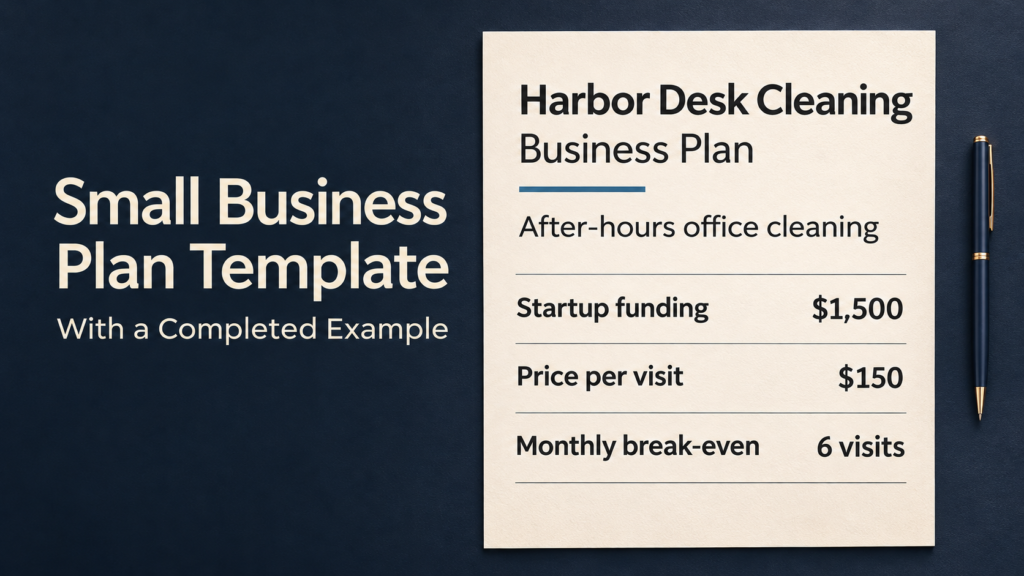
Harbor Desk Cleaning will offer after-hours cleaning to small offices in one neighborhood. It will start with a $150 fixed-scope visit and use direct outreach to office managers to generate paid trial bookings. The goal is eight visits in Month 3. The owner will contribute $1,500 to cover setup and an opening cash reserve.
2. Business description and objectives
The business is in the pre-launch stage. The owner will handle cleaning, scheduling, billing, and quality checks. Before accepting bookings, the owner will confirm the business structure, registration and insurance requirements, and equipment costs. The first operating targets are four paid visits in Month 1 and eight in Month 3.
3. Customers and competition
The initial customers are managers of small offices who need a predictable after-hours cleaning slot. Their alternatives include larger cleaning companies, independent cleaners, and assigning the work in-house. The owner will test whether a written scope and a consistent appointment time appeal to buyers by interviewing five office managers and tracking why quotes are accepted or declined.
4. Products, services, and pricing
A standard $150 visit covers floors, bins, restrooms, and shared surfaces in a small office that fits the agreed scope. Carpet extraction and deep cleaning require separate quotes. The forecast assumes $50 in supplies, travel, and payment costs per visit. Payment is due when the visit is completed.
5. Marketing and sales
The owner will build a prospect list from nearby office buildings and contact office managers directly. The first-month target is 20 outreach contacts, eight quote requests, and four paid visits. That assumes half of the eight quotes turn into bookings. The owner will log each stage and offer a recurring slot after a successful first visit.
6. Operations and capacity
The owner will use a checklist for every visit and allow four hours for the job, travel, and closeout. The initial capacity is 12 visits per month, or up to 48 hours for those visits, with sales and admin time scheduled separately. When an office requests extra tasks, the owner will confirm the revised scope and price before starting.
7. Startup budget and funding
| Item | Amount |
|---|---|
| Cleaning equipment and protective gear | $550 |
| Initial booking materials and website setup | $150 |
| Registration and setup allowance | $200 |
| One-time startup spending | $900 |
| Opening cash reserve after setup | $600 |
| Total owner funding needed | $1,500 |
The plan assumes no external financing. The owner will replace the registration allowance and other estimates with confirmed amounts before launch. The $600 reserve is the business’s starting cash after the $900 setup spending.
8. Financial forecast and cash flow
The example assumes $600 per month in fixed operating costs for insurance, storage, phone and scheduling tools, and ongoing marketing. Customers pay in the month they’re served, and operating costs are paid in the month shown. The forecast excludes owner pay, taxes, and future equipment replacement.
| Forecast item | Month 1 | Month 2 | Month 3 |
|---|---|---|---|
| Paid visits | 4 | 6 | 8 |
| Revenue at $150 per visit | $600 | $900 | $1,200 |
| Variable costs at $50 per visit | $200 | $300 | $400 |
| Fixed costs | $600 | $600 | $600 |
| Operating result | −$200 | $0 | $200 |
| Beginning cash | $600 | $400 | $400 |
| Ending cash | $400 | $400 | $600 |
Break-even — Each visit contributes $100 toward fixed costs ($150 − $50). Dividing $600 by $100 gives a break-even point of six visits per month before owner pay and other excluded costs. To generate another $500 per month for the owner before taxes, the business would need 11 visits at the same price and cost, close to its 12-visit capacity.
First-year projection — If visits stay at eight per month from Month 4 through Month 12, the business would complete 90 visits and generate $13,500 in revenue. After $4,500 in variable costs and $7,200 in fixed operating costs, the operating result would be $1,800 before setup spending and the exclusions above.
Cash-flow check — If two Month 3 customers pay the following month, Month 3 cash receipts fall by $300 and ending cash drops from $600 to $300. The work performed and its costs are unchanged. That’s why the owner tracks invoice due dates alongside sales.
9. Milestones, risks, and supporting documents
Before launch, the owner will obtain equipment and insurance quotes, confirm local requirements, and complete the office-manager interviews. At the end of Month 1, the owner will compare actual bookings and cost per visit with the plan. If fewer than four visits are booked, the owner will review outreach and quote feedback before increasing marketing spending. If visits take longer than planned, the owner will update the scope, price, or capacity estimate.
The supporting documents will include the supplier quotes, interview notes, a sample service agreement, the cleaning checklist, and a monthly cash forecast.
Frequently asked questions
1. How long should a small business plan be?
For your own use, a one-page summary and a financial worksheet may be enough to guide early decisions. For a loan or investment application, use the recipient’s required format and add the requested forecasts, evidence, and supporting documents.
2. Can I write a business plan before I have any customers?
Yes. Start with assumptions you can test. Use supplier quotes to estimate costs, speak with potential customers about what they currently buy, and track interest in a paid pilot. Replace estimates with actual costs and sales as you collect them.
3. What financial information should a simple business plan include?
Include setup costs, available funding, prices, expected sales volume, fixed and variable expenses, and a month-by-month cash forecast. Show when customers pay and when bills come due. If you’ll draw money from the business or repay a loan, reflect those cash outflows in your forecast.
4. Can I use this template to apply for a business loan?
Yes, as a starting outline. Ask the lender which sections and documents it requires. It may ask for historical statements, detailed projections, a breakdown of how you’ll use the funds, and assumptions that show how you expect to repay the loan.
5. How often should I update my business plan?
Review actual sales, costs, and cash against the forecast each month during launch. Revise the plan when a major assumption changes, such as your price, staffing, supplier costs, or customer payment terms.
Conclusion
Start with one offer and a monthly forecast you can explain line by line. Then identify the assumption that would change your decision most if it turned out to be wrong. Check it with a supplier quote, a paid pilot, or actual customer payment dates. Use the result to decide what you can afford to commit to and what needs another round of testing.