

“We make your life easier” could describe a bookkeeping service, a meal delivery company, or a piece of software. It sounds appealing, but a buyer still has to work out what you sell and whether it solves their problem. A value proposition gives them enough detail to make that judgment.
Here’s how to write a value proposition, with five small-business examples, a fill-in template, and a quick test you can run before changing your homepage or paying to promote the offer.
What is a value proposition?
A value proposition explains who your offer is for, what useful outcome they can expect, and what makes the offer a good fit for their situation. That reason can be practical. A repair service that visits customers at work saves them a trip to the workshop. A bookkeeper who lists the records clients need to provide each month gives owners a clearer way to prepare.
A tagline is a short phrase people can remember. A value proposition gives them the details they need to decide. On a website, you can express it in a headline and one supporting sentence. A nearby example, photo, checklist, or price can make the claim easier to evaluate.
How to write a value proposition in five steps
1. Choose one buyer and the moment they need you
Start with the offer you want to sell and the people most likely to need it. “Small businesses” is a starting point. “Solo consultants who spend the last day of each month sorting receipts” gives you a specific situation to write about.
Use recent inquiries, sales conversations, or support questions to find that moment. Ask customers what happened just before they started looking for help. A deadline, a recurring inconvenience, or a change in their workload can tell you what benefit to emphasize.
2. Name the outcome in plain language
Describe what becomes easier or possible after the customer buys. If the offer is a spreadsheet for tracking quotes, “See which quotes need a follow-up this week” is easier to picture than “streamline your pipeline.”
Keep the outcome within your control. A service can promise to deliver a report by an agreed date if it can reliably do so. A claim that the report will double a customer’s sales would require evidence and depends on factors outside the service.
3. Compare your offer with what buyers already do
Ask what buyers would do if they didn’t choose you. They might use a spreadsheet, hire a provider, do the work themselves, or postpone it. Then pick one difference that matters to them.
For a customer who wants to hand off a task, a fixed scope and clear handover may matter more than a long list of features. For a customer with a deadline, a dependable delivery process may matter more than customization.
4. Back up the claim with something buyers can inspect
Choose evidence that fits the claim. A sample report can show the level of detail you provide. A service-area map can show whether you’ll come to a buyer’s location. A photo or list of dimensions can help someone check whether a product will fit.
If you’re new, use a clearly labeled sample or explain your actual process. Replace broad claims such as “best service” with details you can verify.
5. Draft it and check what people understood
Write two versions using different customer priorities, such as predictable scheduling or less work for the buyer. Show one version at a time to a few people who fit the audience. Ask them what the business sells, who it’s for, and what they would expect after buying.
If they give different answers, look for the words that led them there. Revise the unclear part and check again. Once people understand the offer, look for signs of interest such as a request for a quote, a product question, or a booking. Understanding and willingness to buy are two separate things to measure.
Copy-ready value proposition template
We help [specific customer] [achieve a useful outcome or solve a problem] with [specific offer or approach]. You get [detail that shows why the offer fits].
You can use the sentence to draft your copy and then turn it into a headline and supporting line.
| Part | Fill in |
|---|---|
| Customer | Who makes the purchase, and when do they need help? |
| Outcome | What should become easier, faster, or clearer? |
| Offer | What do they receive or what work do you do? |
| Reason to choose it | Which detail matters compared with their usual alternative? |
| Proof | What sample, process, or verified result supports the claim? |
5 small-business value proposition examples
These examples use fictional offers. Adapt the structure to your business and verify any delivery times, service details, or terms before publishing them.
1. Bookkeeping for independent consultants
Before — “We offer personalized financial solutions.”
Value proposition — “Monthly bookkeeping for independent consultants who want to see what they earned and spent. Send your records through one checklist and receive a reconciled monthly summary.”
Why it works — It names the buyer, describes the result, and explains what both parties do. A labeled sample summary gives prospective clients a way to see what they’d receive.
2. Mobile bike repair for commuters
Before — “Quality bike servicing for everyone.”
Value proposition — “Get your commuter bike tuned up while you’re at work. We visit participating workplaces in our service area and confirm which repairs we can complete on-site before you book.”
Why it works — The benefit is avoiding a trip to the shop. The service-area and repair limits help buyers decide whether the offer applies to them. A coverage map and list of on-site repairs can support the claim.
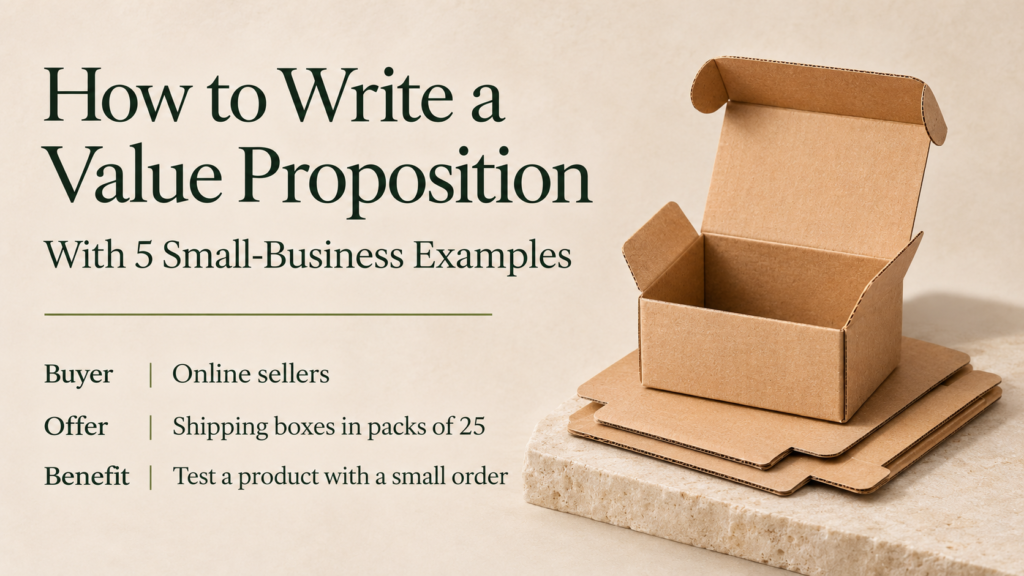
3. Packaging supplies for online sellers
Before — “We have affordable packaging for businesses of all sizes.”
Value proposition — “Buy shipping boxes in packs of 25 when you’re testing a new product. Compare internal dimensions before ordering so you can choose a box that fits your item and padding.”
Why it works — The pack size and dimensions answer practical questions for sellers who want to test a product without committing to a large order. Product pages should show the dimensions and pack count clearly.
4. Proposal formatting for freelance consultants
Before — “Take your documents to the next level.”
Value proposition — “Turn your existing proposal draft into a client-ready PDF and editable file. The fixed-scope package covers up to five pages and one revision.”
Why it works — Buyers know what to supply, what they’ll receive, and where the scope ends. A before-and-after sample helps them judge the formatting style before requesting a quote.
5. An appointment tracker for independent tutors
Before — “The ultimate productivity template for tutors.”
Value proposition — “See upcoming lessons, cancellations, and unpaid sessions in one Excel sheet. The template includes a filled-in week so you can see how to log a session before adding your own.”
Why it works — It describes everyday tasks the buyer can picture. A preview of the sample week and a note about software compatibility can help people decide whether it suits their setup.
Put the value proposition where customers make decisions
Use a broad version on the homepage if several offers serve the same audience. Give each service or product page a version that reflects the specific offer and its limits. Then choose a next step that fits what the customer can do, such as checking service availability, viewing a sample, or requesting a quote.
When you test a rewrite, compare similar traffic sources and time periods where you can. Record changes in qualified inquiries or orders alongside any shifts in price, traffic, or availability. If you only have a few responses, use them to decide what to test next.
Frequently asked questions
1. How long should a value proposition be?
A headline and one or two supporting sentences often give you enough room to explain the buyer, outcome, and offer. Add detail below if buyers need to check the scope, pricing, or prerequisites.
2. Is a value proposition the same as a slogan?
A slogan helps people remember a brand. A value proposition helps a prospective buyer understand why an offer fits their situation. You can use both on the same page if each has a clear job.
3. Can a business have more than one value proposition?
Yes. A business can use one broad proposition on its homepage and more specific ones for offers that serve different buyers or buying situations. Keep each page focused on the people and outcome it serves.
4. What if competitors offer the same service?
Look for a meaningful difference in how you deliver it, what’s included, or whom it suits. A smaller minimum order, a predictable schedule, or a clear handover can matter when it solves a real buyer problem.
5. How can I test a value proposition before launching?
Show it to people who match your intended buyers. Ask them to explain the offer in their own words, then give them a realistic next step such as requesting a sample or asking for a quote. Record what they do and what questions they still have.
Conclusion
Pick one offer and write down who needs it, what they want to accomplish, and which detail makes your offer fit. Show the draft to a likely buyer and ask them to explain it back to you. Use their answer to tighten the copy before you put it on your website or pay to promote it.