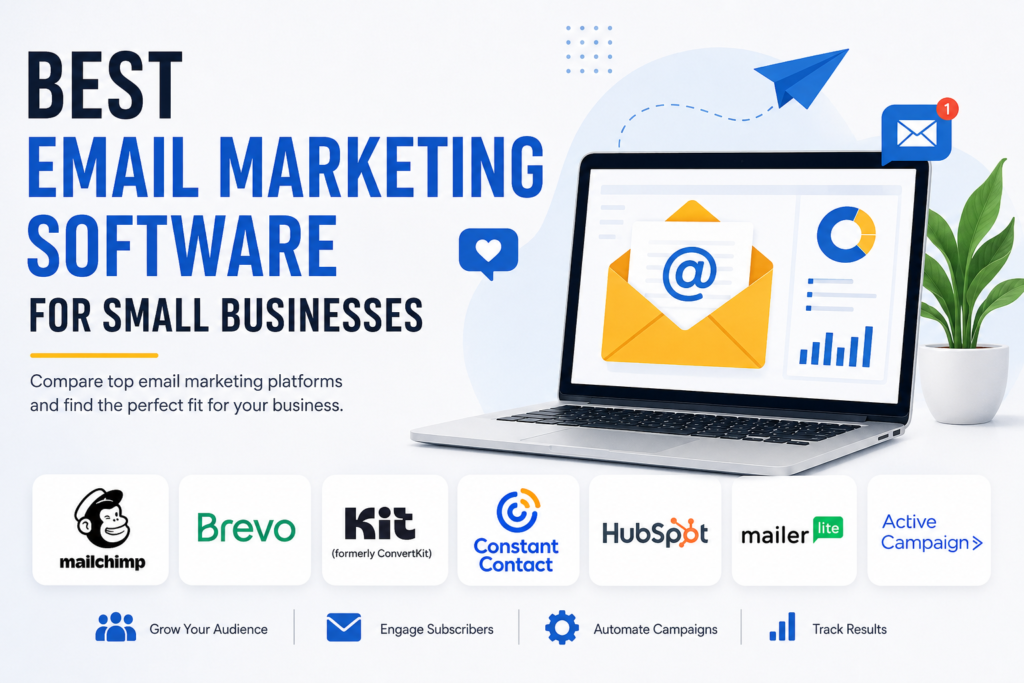

Email marketing can be one of the most practical ways for a small business to communicate with customers, promote products, share useful content, and encourage repeat visits. But choosing the right platform can be difficult because email marketing software varies significantly in pricing, automation, contact limits, integrations, and ease of use.
The best email marketing software for small businesses isn’t necessarily the platform with the most features. It is the one that fits your audience, budget, technical skills, and marketing goals without adding unnecessary complexity.
In this guide, we’ll compare seven popular options, explain what each is best suited for, discuss important limitations, and show you how to choose the right platform for your business.
Note: Pricing and features can change. The prices mentioned below are based on publicly available information checked in September 2026. Always verify current pricing and plan limits on the provider’s official website before subscribing.
What Is Email Marketing Software?
Email marketing software is a platform that helps businesses create, send, manage, and analyze email campaigns.
Depending on the service and plan, you may be able to:
- Create newsletters
- Build signup forms
- Organize subscribers into segments
- Schedule campaigns
- Automate welcome emails
- Send promotional campaigns
- Track opens and clicks
- Test different subject lines
- Connect email campaigns with websites and other business tools
- Manage automated customer journeys
For a small business, these capabilities can reduce repetitive work and make customer communication more organized.
What Should Small Businesses Look for in Email Marketing Software?
Before choosing a platform, consider the following factors.
1. Ease of Use
If you don’t have a dedicated marketing team, complicated software can become a burden.
Look for an intuitive email editor, simple campaign creation, useful templates, and straightforward contact management.
2. Pricing
Don’t look only at the advertised starting price.
Check:
- Number of contacts included
- Monthly email limits
- Automation availability
- Number of users
- Extra charges
- Annual versus monthly pricing
- Features available at each tier
A platform that appears inexpensive at first can become considerably more expensive as your audience grows.
3. Automation
Automation lets you create emails that are triggered by specific actions.
For example:
Visitor subscribes → Welcome email → Educational email → Product information → Follow-up
Automation can save time, but beginners don’t necessarily need dozens of complex workflows.
4. Segmentation
Segmentation allows you to send different messages to different groups.
For example, an online store could separate:
- New subscribers
- Existing customers
- Frequent buyers
- Customers who haven’t purchased recently
Relevant segmentation can make campaigns more useful than sending exactly the same message to everyone.
5. Integrations
Your email platform may need to connect with your website, ecommerce store, CRM, analytics tools, or other services.
For example, Constant Contact currently advertises more than 300 integrations, including Shopify, Canva, LinkedIn, Zapier, and Eventbrite.
6. Reporting
Good reporting helps you understand what happened after a campaign was sent.
Useful metrics can include:
- Opens
- Clicks
- Unsubscribes
- Bounces
- Conversions, where supported
Don’t choose a platform simply because it displays a large number of metrics. Choose one that gives you information you can actually use.
7 Best Email Marketing Software for Small Businesses
There is no universal winner. Each platform has different strengths.
1. Mailchimp — Best for Familiarity and Broad Marketing Features
Mailchimp is one of the most recognizable names in email marketing.
It provides tools for creating campaigns, managing contacts, building forms, and setting up marketing automation. Its current pricing structure includes a free/basic option as well as paid plans, with limits based on contacts and email sends.
Why consider Mailchimp?
- Familiar interface
- Email templates
- Marketing automation
- Audience management
- Reporting and analytics
- Integrations
- Tools beyond basic newsletters
Potential limitation
The cost and available features depend on your plan and audience size. Mailchimp also applies limits and potential overage charges when certain contact or sending thresholds are exceeded.
Best for: Small businesses that want a widely used platform with a broad set of marketing tools.
2. Brevo — Best for Email Plus Multichannel Communication
Brevo takes a broader approach than traditional newsletter software. Its platform supports email alongside channels such as SMS, WhatsApp, chat, and other customer communication tools.
Brevo’s email features include automation workflows such as welcome emails, birthday messages, and abandoned-cart campaigns.
Why consider Brevo?
- Free plan available
- Email campaigns
- Automation
- SMS capabilities
- Transactional email
- Contact management
- Multichannel communication
Its current free plan includes up to 300 email sends per day, while paid plans start from $9 per month according to Brevo’s pricing information.
Potential limitation
Businesses that only need simple newsletters may not need all of Brevo’s additional communication features.
Best for: Small businesses that want email marketing alongside other customer communication channels.
3. Kit — Best for Creators and Newsletter-Focused Businesses
Kit is particularly focused on creators, newsletters, and businesses that build an audience around content.
Its current free plan supports up to 10,000 subscribers and includes unlimited landing pages and forms, unlimited email broadcasts, audience tagging, and segmentation. Its paid Creator plan adds features such as visual automations, email sequences, and subject-line A/B testing.
Why consider Kit?
- Strong newsletter focus
- Landing pages and signup forms
- Subscriber tagging
- Segmentation
- Automated sequences
- Digital product and subscription tools
Potential limitation
A traditional local business looking primarily for advanced CRM, ecommerce, or multichannel marketing capabilities may find another platform more appropriate.
Best for: Creators, bloggers, newsletter publishers, and content-driven businesses.
4. Constant Contact — Best for Beginners and Small Organizations
Constant Contact is designed to make email and broader digital marketing accessible to small organizations.
Its current plans include email creation, templates, signup forms, reporting, automation features, social media tools, and integrations. Its Standard plan adds features such as email scheduling, subject-line testing, segmentation, and automated campaigns.
Why consider Constant Contact?
- Beginner-friendly tools
- Drag-and-drop editor
- Templates
- Email scheduling
- Segmentation
- Automation
- Social media features
- 300+ integrations
- Live support
Current U.S. starting prices are listed at $12/month for Lite, $35/month for Standard, and $80/month for Premium when billed monthly, although pricing varies by plan and contact level. Annual billing can reduce the starting prices.
Potential limitation
It may cost more than some alternatives for businesses that only require basic email newsletters.
Best for: Small businesses that value simplicity, support, and an integrated marketing toolkit.
Constant Contact official website
5. HubSpot Marketing Hub — Best for Businesses That Need a CRM
HubSpot is more than an email marketing platform. Its Marketing Hub connects marketing activities with customer relationship management and other business tools.
HubSpot currently offers a free option, while its paid Marketing Hub plans provide progressively more marketing automation and reporting capabilities. The Starter plan includes 1,000 marketing contacts, while higher tiers provide additional functionality and contacts.
Why consider HubSpot?
- CRM integration
- Email marketing
- Lead management
- Forms
- Marketing automation
- Reporting
- Customer data management
- Large integration ecosystem
Potential limitation
HubSpot can become significantly more expensive as your marketing requirements grow. Professional and Enterprise plans also have substantially higher starting prices and required onboarding costs.
Best for: Growing businesses that want email marketing connected to a broader CRM and marketing system.
6. MailerLite — Best for Simple Email Marketing
MailerLite is another platform worth considering if your primary goal is to create newsletters, manage subscribers, and build simple automated campaigns without unnecessary complexity.
It can be particularly suitable for small teams that want a relatively focused email marketing workflow.
Why consider MailerLite?
- Simple campaign creation
- Email templates
- Signup forms
- Landing pages
- Automation
- Subscriber management
- Segmentation
Potential limitation
Businesses with complicated CRM requirements or highly advanced marketing operations may eventually need a more comprehensive platform.
Best for: Small teams that prioritize straightforward email marketing and audience management.
7. ActiveCampaign — Best for Advanced Automation
ActiveCampaign is known for going beyond basic newsletters and focusing heavily on automation and customer journeys.
For example, a business could create different follow-up sequences depending on whether someone opened an email, clicked a link, completed a form, or interacted with a campaign.
Why consider ActiveCampaign?
- Advanced automation
- Customer journeys
- Segmentation
- Email campaigns
- Personalization
- Sales and marketing workflows
- CRM functionality
Potential limitation
The platform can be more complicated than necessary for a small business that only sends occasional newsletters.
Best for: Businesses that have enough marketing activity to benefit from sophisticated automation.
ActiveCampaign official website
Email Marketing Software Comparison
| Platform | Best For | Main Strength | Potential Limitation |
|---|---|---|---|
| Mailchimp | General small-business marketing | Broad marketing features | Pricing and limits vary by plan |
| Brevo | Multichannel communication | Email, SMS and other channels | May offer more features than some users need |
| Kit | Creators and newsletters | Audience and newsletter tools | Less focused on traditional business CRM |
| Constant Contact | Beginners and organizations | Ease of use and support | Can be relatively expensive at higher contact levels |
| HubSpot | Growing businesses | CRM + marketing | Advanced plans can be expensive |
| MailerLite | Simple email marketing | Straightforward workflows | May be limiting for complex operations |
| ActiveCampaign | Advanced automation | Customer journeys and automation | Higher learning curve |
The comparison is intentionally based on general product positioning rather than declaring one platform universally “best.”
Which Email Marketing Software Is Best for Your Business?
Your ideal choice depends on what you actually need.
Choose Mailchimp if:
You want a well-known platform with a broad range of email and marketing tools.
Choose Brevo if:
You want email marketing combined with SMS, transactional communication, and other channels.
Choose Kit if:
You are a creator, blogger, newsletter publisher, or content-focused business.
Choose Constant Contact if:
You prioritize ease of use, customer support, templates, and an integrated marketing toolkit.
Choose HubSpot if:
You want email marketing connected to a CRM and broader marketing operations.
Choose MailerLite if:
You want a relatively simple solution for newsletters, forms, landing pages, and automation.
Choose ActiveCampaign if:
Automation and customer journeys are central to your marketing strategy.
How to Choose the Right Email Marketing Platform
Instead of choosing based only on popularity, follow a simple process.
Step 1: Define Your Main Goal
Ask yourself what you want email marketing to accomplish.
Is your goal to:
- Send newsletters?
- Promote products?
- Generate leads?
- Follow up with customers?
- Build a community?
- Recover abandoned carts?
- Automate onboarding?
Your answer will narrow the options.
Step 2: Estimate Your Contact List
Think about how many subscribers you have today and how many you reasonably expect to manage in the future.
Don’t choose a platform solely because it has a free plan. Check what happens when your audience grows.
Step 3: List the Features You Actually Need
Create two lists:
Essential
- Email campaigns
- Signup forms
- Basic reporting
- Contact management
Optional
- Advanced automation
- CRM
- SMS
- Ecommerce workflows
- Advanced segmentation
- Complex customer journeys
This prevents you from paying for features you won’t use.
Step 4: Calculate the Real Cost
Consider the cost at your expected subscriber level rather than today’s audience.
For example:
Current audience: 500 subscribers
Expected audience: 5,000 subscribers
Required features: newsletters + automation + segmentation
Compare the cost of those requirements across several providers.
Step 5: Test Before Committing
When a provider offers a free plan or trial, use it to test your actual workflow.
Try creating:
- A signup form
- A welcome email
- A newsletter
- A basic automated sequence
- A subscriber segment
If these tasks feel unnecessarily difficult, the platform may not be the right fit.
Email Marketing Best Practices for Small Businesses
Choosing good software is only part of the process. How you use it matters too.
Build Your List With Permission
Don’t add people to your marketing list simply because you have their contact information.
Use legitimate signup methods and clearly communicate what subscribers are signing up to receive.
Send Useful Content
Every email should have a reason for being sent.
Useful content might include:
- Product updates
- Helpful educational information
- Special offers
- Company news
- New resources
- Event announcements
- Relevant recommendations
Avoid sending messages simply because you haven’t emailed your list recently.
Keep Your Emails Easy to Read
Use:
- Short paragraphs
- Clear headings
- One primary message
- Descriptive buttons
- Mobile-friendly layouts
- Appropriate images
A reader should understand the purpose of your email quickly.
Segment When It Makes Sense
Not every subscriber has the same interests.
A simple segmentation strategy could separate customers based on what they purchased, what content they requested, or how they interact with your emails.
Monitor Performance
Review your campaign reports regularly.
If subscribers consistently ignore a particular type of message, consider changing the topic, format, timing, or audience.
Keep Your List Clean
Remove or appropriately manage invalid, bounced, or disengaged contacts according to your platform’s tools and your applicable legal requirements.
A smaller, engaged audience can be more useful than a large list filled with inactive contacts.
Common Email Marketing Mistakes to Avoid
Small businesses often make avoidable mistakes when starting email marketing.
Buying email lists
Purchased lists can create quality, permission, and compliance problems. Build your audience through legitimate signup methods instead.
Sending too frequently
More emails do not automatically mean better marketing. Excessive messages can frustrate subscribers.
Making every email a sales pitch
Educational and useful content can help maintain a healthier relationship with your audience.
Ignoring mobile readers
Many people read email on phones. Test your campaigns on smaller screens before sending them.
Failing to check links
A broken link can undermine an otherwise useful campaign. Test important links before publication.
Choosing software based only on price
A cheap plan isn’t necessarily economical if it lacks the features you actually need.
Frequently Asked Questions
1. What is the best email marketing software for small businesses?
There isn’t one universal answer. Mailchimp, Brevo, Kit, Constant Contact, HubSpot, MailerLite, and ActiveCampaign can all be suitable depending on your goals. The best choice depends on your budget, audience size, automation requirements, integrations, and technical needs.
2. Can small businesses use email marketing software for free?
Yes. Some platforms provide free plans or trials, although free versions normally have limitations involving contacts, sending volume, features, branding, or automation. For example, Brevo currently offers a free plan with 300 daily email sends, while Kit’s free plan supports up to 10,000 subscribers with specified feature limits.
3. How much does email marketing software cost?
Costs vary considerably. Some services have free options, while paid plans may begin at relatively low monthly prices and increase as your contact list or feature requirements grow. For example, Constant Contact currently lists monthly U.S. starting prices of $12, $35, and $80 for its three main plans, depending on the tier.
Always check the provider’s current pricing page because prices and plan structures can change.
4. How often should a small business send marketing emails?
There is no single frequency that works for every business. Your ideal schedule depends on your audience, industry, content, and expectations established when people subscribed.
A useful starting point is to create a consistent schedule that allows you to provide genuinely useful information without overwhelming subscribers.
5. Is email marketing still useful for small businesses?
Yes, email remains a practical channel for communicating directly with people who have chosen to hear from your business. However, software alone doesn’t make a campaign successful. Results depend on factors such as audience quality, relevance, content, timing, offer, and overall marketing strategy.
Final Thoughts
The best email marketing software for small businesses is the platform that solves your actual marketing needs without creating unnecessary cost or complexity.
For general-purpose marketing, Mailchimp may be worth considering. Brevo is attractive for businesses interested in multichannel communication, while Kit is particularly relevant to creators and newsletter businesses. Constant Contact emphasizes ease of use and support, HubSpot combines marketing with CRM capabilities, MailerLite focuses on straightforward email marketing, and ActiveCampaign is better suited to businesses that need sophisticated automation.
Before paying for a subscription, identify your audience size, marketing goals, essential features, and expected growth. Then compare the platforms based on the features and pricing that apply to your situation.
Most importantly, remember that email marketing software is only the infrastructure. The real value comes from building a permission-based audience and consistently delivering information that subscribers find useful.