
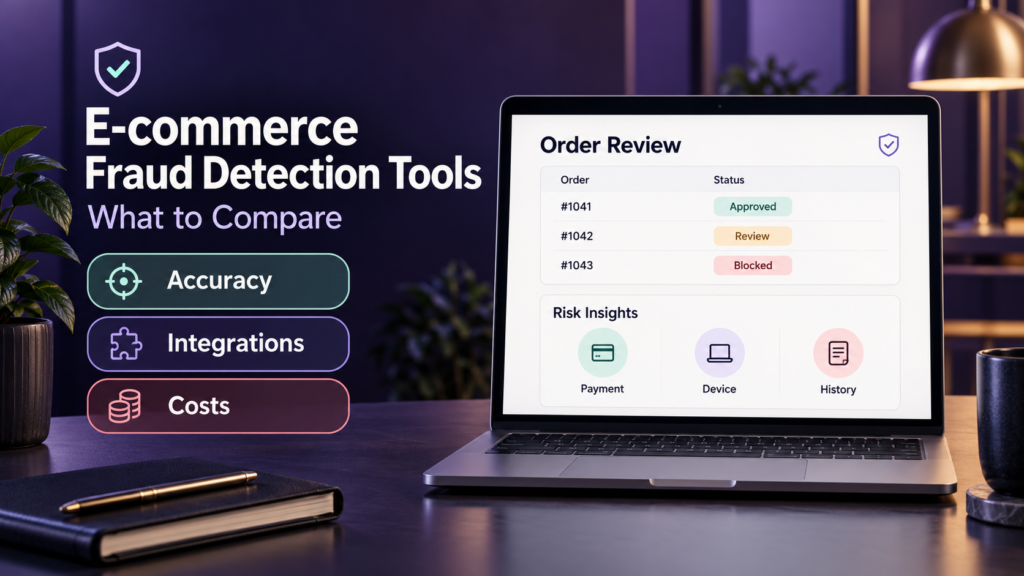

An online order can look suspicious and still come from a genuine customer. A returning shopper might use a new device, send a gift to another address, or place an unusually large order.
Meanwhile, an apparently ordinary transaction can later turn out to be fraudulent.
That creates a difficult balance for online retailers: reduce fraud without unnecessarily rejecting customers or slowing down checkout.
When reviewing e-commerce fraud detection tools, what to compare goes beyond the number of security features. You need to understand which risks a product addresses, how it makes decisions, what happens when it gets something wrong, and how much work it creates for your team.
This guide explains the main comparison points and provides a practical checklist for evaluating a tool before committing.
What Are E-commerce Fraud Detection Tools?
E-commerce fraud detection tools assess transactions or customer activity for signs of potential fraud. Depending on the product, they may recommend an action, block a payment, request additional authentication, or send an order for review.
Some work inside a payment processor or commerce platform. Others connect through an application, API, or broader integration.
For example, Shopify’s fraud analysis provides order risk information, while Stripe Radar evaluates transaction risk and supports actions such as allowing, blocking, reviewing, or requesting authentication where supported. Their capabilities and availability differ.
A risk assessment is not proof that an order is fraudulent. It is information used to support a decision.
Start with the Risk You Need to Address
“Fraud protection” can describe several different services. Before comparing vendors, identify the problem your store actually faces.
| Risk or problem | Capability to investigate |
|---|---|
| Unauthorized card purchases | Payment risk assessment and authentication support |
| Card testing attempts | Payment abuse detection and controls for repeated attempts |
| Account takeover | Login, account, and session protection |
| Refund or promotion abuse | Policy abuse detection and customer history analysis |
| Fraud-related chargebacks | Prevention, eligible reimbursement, and dispute workflows |
| Non-fraud disputes | Dispute management and operational improvements |
These categories can overlap, but they are not interchangeable.
A payment screening product may not protect customer accounts. A chargeback response service may help after a dispute without screening orders before shipment.
Likewise, not every refund request or chargeback indicates fraud. Delivery problems, unclear billing descriptions, and customer service issues need their own solutions.
E-commerce Fraud Detection Tools: What to Compare
1. Detection Methods and Relevant Data
Providers may use rules, statistical models, machine learning, network information, or combinations of these approaches.
Potential inputs include transaction details, customer history, device information, purchase patterns, and supported verification results.
Instead of asking whether a product “uses AI,” ask:
- Which data does it need from our store?
- Which signals are available through our integration?
- Does it evaluate payments, orders, accounts, or all three?
- How does it handle customers with little purchase history?
- What happens when important information is missing?
A sophisticated model cannot use data your integration never supplies.
Also, avoid treating one signal as decisive. A difference between billing and delivery addresses, for example, may have a legitimate explanation.
2. False Positives and Lost Sales
A false positive occurs when legitimate activity is incorrectly flagged as fraudulent.
This matters because a tool that blocks more transactions can appear effective while also rejecting customers who would have completed genuine purchases.
Ask providers how they assess false positives and distinguish confirmed findings from estimates. Blocked orders are difficult to classify with certainty because many never produce an observable outcome.
Useful questions include:
- Can staff investigate and correct an incorrect decision?
- Can a customer complete additional verification?
- Are new and returning customers evaluated differently?
- Can results be reviewed by market, payment method, and customer segment?
- How are merchant overrides handled?
A high block rate is not evidence of high accuracy. Evaluate fraud losses alongside legitimate order completion.
3. Decision Timing and Checkout Friction
Find out exactly when the tool acts:
- Before payment authorization.
- During checkout.
- After payment authorization.
- Before fulfillment.
- After a dispute occurs.
The timing changes what the tool can prevent and how your operations must respond.
An order flagged after payment may require a fulfillment hold. If your warehouse ships automatically before the decision arrives, the screening process may have little practical value.
Also ask whether suspicious activity can trigger additional verification rather than immediate rejection.
For card payments, 3D Secure can add authentication through the card issuer. Stripe documents that the issuer may request a security prompt, such as a code or biometric verification. This is distinct from a merchant’s risk score.
Do not assume authentication eliminates every dispute or that liability shifts in every situation. Confirm the applicable conditions with your payment provider.
4. Integration with Your Store and Payment Stack
A platform logo on a vendor’s website is only the beginning of the compatibility check.
Confirm support for your actual setup, including:
- Commerce platform and version.
- Payment gateways.
- Headless or custom checkout.
- Mobile applications.
- Subscriptions and recurring payments.
- Digital or physical products.
- Order management and fulfillment systems.
- Refund, cancellation, and dispute updates.
Ask which features work through a standard plugin and which require development.
Shopify notes that some third-party payment gateways do not send fraud review updates back to its administration interface. That illustrates why compatibility must include information flow, not just installation.
5. Manual Review and Team Workload
Automation does not necessarily remove the need for human review.
Compare how the tool organizes flagged orders:
- Are reasons and supporting information understandable?
- Can reviewers prioritize urgent orders?
- Are notes and decision histories retained?
- Can permissions separate reviewers from administrators?
- Can the team escalate uncertain cases?
- What happens outside working hours?
A review queue that exceeds your team’s capacity can delay genuine customers and disrupt shipping.
Estimate workload using your order volume and expected review share. Treat a vendor’s estimate as something to validate during a pilot.
6. Chargeback Protection and Contract Terms
Fraud detection and financial protection are different services.
Some vendors assess risk while the merchant retains the financial consequences. Others offer reimbursement or guarantees for eligible transactions and dispute categories.
Riskified and Signifyd, for example, advertise products with chargeback protection. This establishes that such models exist; it does not establish that every order or type of loss is covered.
Before purchasing, request written answers to these questions:
- Which transactions qualify?
- Which dispute reasons are covered?
- Are shipping costs and chargeback fees included?
- What documentation must the merchant provide?
- Are there fulfillment deadlines or tracking requirements?
- Do manual overrides affect eligibility?
- Are there exclusions, reimbursement limits, or submission deadlines?
- How are rejected claims reviewed?
Do not treat a marketing guarantee as a replacement for the contract.
7. Pricing and Total Operating Cost
Fraud tools may charge by screened transaction, approved order, protected sales value, subscription, or a combination.
Ask what triggers a billable event. Failed payments, retries, canceled orders, refunds, and test transactions may be treated differently.
Compare:
| Cost category | What to check |
|---|---|
| Software fees | Subscription, transaction charges, or percentage fees |
| Implementation | Setup, integration, testing, and migration |
| Operations | Manual review and rule maintenance |
| Additional services | Dispute handling, account protection, or premium support |
| Commercial terms | Minimum commitments, overages, renewal, and cancellation |
Consider business impact separately: residual fraud losses, customer delays, and estimated lost legitimate sales.
Avoid double-counting a loss that is later reimbursed or a fee already included elsewhere.
8. Reporting and Explainability
Useful reporting should help you understand both decisions and outcomes.
Look for visibility into:
- Orders screened, flagged, approved, and blocked.
- Manual review volume and turnaround time.
- Authentication requests and completion.
- Confirmed fraud and dispute outcomes.
- Reimbursements received.
- Results by market, payment method, and customer group.
Clarify what “approval” means. A fraud tool approving an order is different from a bank authorizing the payment.
Also check when outcomes become reliable. A transaction with no dispute today may still be disputed later. Compare groups of orders with similar time to develop outcomes.
9. Data Handling and Access Controls
Understand what the provider collects, where it goes, how long it is retained, and who can access it.
Review:
- Data processing documentation.
- Hosting and transfer arrangements.
- Subprocessors.
- Retention and deletion options.
- Staff access controls.
- Audit logs.
- Incident response procedures.
If the provider presents security certifications or assurance reports, check their scope and date.
Ask which data is essential. Additional collection can create implementation and governance work without necessarily improving your particular use case.
10. Reliability and Support
A screening service can become part of a critical order workflow.
Ask what happens if its service is unavailable or a decision is delayed. Does the order proceed, stop, or enter review?
There is no universally correct fallback. Your choice depends on fulfillment speed, order value, and operational capacity.
Compare support hours, escalation channels, service commitments, and responsibility for integration maintenance.
Should You Use Built-In Tools or a Specialist Provider?
Start by reviewing capabilities already included in your platform or processor.
A built-in option may be sufficient when your risks are manageable, the reporting is useful, and your team can handle exceptions.
A specialist deserves evaluation when you have a specific unmet need, such as multiple payment gateways, account protection, complex review workflows, or contractual reimbursement.
| Your situation | Practical next step |
|---|---|
| Limited fraud history and manageable reviews | Establish a baseline using existing tools |
| Frequent legitimate orders being flagged | Investigate decision quality before adding stricter controls |
| Multiple gateways and fragmented reporting | Evaluate broader integration and reporting |
| Refund or promotion abuse | Compare policy abuse capabilities specifically |
| Need for financial protection | Review eligible coverage and contractual obligations |
These are starting points, not endorsements of a particular product.
How to Run a Useful Evaluation
Step 1: Establish Your Baseline
Document order volume, confirmed fraud losses, disputes, review workload, and customer complaints about blocked or delayed orders.
Separate fraud disputes from other causes.
Step 2: Define Success
Choose measures such as reduced confirmed fraud losses, lower review workload, or improved legitimate order completion.
Do not use blocked order count as the sole measure.
Step 3: Test the Full Workflow
Use supported testing environments to check decision delivery, fulfillment holds, cancellations, refunds, and failure handling.
A working connection is not enough; the operational response must also work.
Step 4: Pilot Carefully
Where available, use historical analysis or observation mode before enforcing decisions.
Historical testing has limits. It may lack the data available at checkout and cannot prove what would have happened to every blocked order.
Avoid directly comparing raw risk scores across vendors. Their scales and meanings may differ.
Step 5: Review Outcomes and Responsibilities
Allow sufficient time for disputes to emerge. Confirm who owns reviews, rule changes, customer communication, and vendor escalation.
Document findings before expanding the deployment.
Frequently Asked Questions
1. Can an e-commerce fraud detection tool prevent all fraud?
No. Fraud assessment involves uncertainty, and some fraudulent activity can appear legitimate. The goal is to manage risk while preserving legitimate transactions.
2. Is a risk score the same as a decline decision?
No. A score is an assessment. Whether it causes a decline, review, or authentication request depends on the product and configuration.
3. Do fraud detection tools automatically reimburse chargebacks?
No. Reimbursement requires a product or agreement that provides it, and eligibility conditions apply. Detection alone does not establish coverage.
4. Are built-in fraud tools enough for a small store?
They may be. Evaluate your actual losses, workflow, and review burden before purchasing an additional service. Store size alone does not determine the need.
5. Which metric matters most when comparing tools?
No single metric is sufficient. Assess confirmed fraud losses, legitimate order completion, review workload, customer friction, and total cost together.
Conclusion
Choose a fraud detection tool around the risks and workflows your store needs to manage.
The strongest comparison examines decision quality, integration, customer friction, operating costs, and contractual coverage together. A controlled pilot and clear responsibilities will tell you more than a long feature list or a promise to stop every fraudulent order.