
Choosing an advertising platform is easy when you focus only on clicks. Choosing one that brings suitable business customers requires a closer look.
A campaign can generate inexpensive enquiries that never become sales conversations. Another can produce fewer leads but reach people with the right responsibilities, business needs, and purchasing influence.
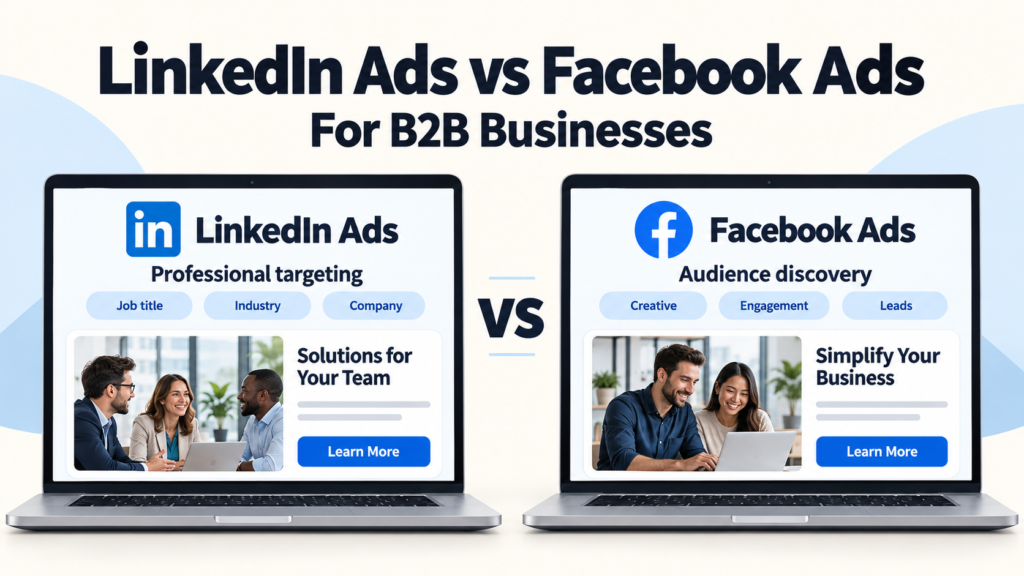
When comparing LinkedIn Ads vs Facebook Ads for B2B businesses, the most useful question is therefore: which platform can help you reach suitable buyers at an acquisition cost your business can support?
LinkedIn deserves consideration when professional characteristics are central to your targeting. Facebook deserves consideration when your offer can attract business buyers through relevant messaging, demonstrations, and an effective qualification process.
Neither platform guarantees better results. Your audience, offer, creative, measurement, and follow-up process all affect the outcome.
LinkedIn Ads vs Facebook Ads: The Main Differences
LinkedIn provides advertising tools built around professional information. Its documented targeting options include job title, company, industry, and seniority. It also offers Matched Audiences for activities such as retargeting and account-based campaigns.
Facebook advertising reaches people in a broader social environment. Your potential buyers may be there, but the campaign still needs to distinguish genuine business interest from general engagement.
Facebook campaigns are managed through Meta’s advertising tools. Depending on placement settings, a campaign may also deliver outside Facebook, including Instagram. If you want a Facebook-only comparison, check placement settings and reporting.
| Decision area | LinkedIn Ads | Facebook Ads |
|---|---|---|
| Audience approach | Professional characteristics and business audiences | Audience selection, delivery optimization, and messaging that attracts relevant buyers |
| Useful starting scenario | Reaching specific roles or types of companies | Promoting an accessible offer to a broader business audience |
| Lead capture | Website forms or LinkedIn Lead Gen Forms | Website forms or Meta instant forms |
| Creative approach to test | Professional insights, demonstrations, case studies, and educational offers | Clear demonstrations, problem-focused visuals, and concise videos |
| Qualification challenge | A relevant job title does not establish purchasing intent | An interested user may not fit your business customer profile |
| Main measurement priority | Qualified opportunities and acquisition economics | Qualified opportunities and acquisition economics |
| Cost comparison | Depends on the campaign and market | Depends on the campaign and market |
These are practical distinctions, not rules that determine campaign performance.
Audience Targeting: How Precisely Must You Reach Buyers?
When LinkedIn’s Professional Targeting Matters
Consider a software company selling procurement tools to purchasing managers at manufacturing businesses.
For that company, the buyer’s job function and employer characteristics are central to the campaign. LinkedIn’s professional targeting provides a direct way to build an audience around those requirements.
However, avoid treating targeting as verification. A profile can be outdated, a job title can mean different things across companies, and a relevant professional may have no current need for your product.
Narrow targeting also involves trade-offs. An audience that looks perfect on paper may be too small to deliver useful campaign volume.
When Facebook Deserves a Test
Now consider a service that helps independent retailers organize stock and customer orders.
A short demonstration showing a familiar operational problem may attract suitable owners even when the advertiser cannot identify every buyer through a precise professional filter.
The creative should make the intended audience clear:
“Managing stock across two or more retail locations? See how a shared inventory dashboard works.”
This is more useful for qualification than a broad promise such as “Transform your business today.”
Check the audience controls available in your account before launching. Do not assume that every audience input is a strict delivery restriction; some automated settings may use inputs as suggestions.
Lead Generation: Form Submissions Are Only the Beginning
Both platforms can support lead collection without requiring every prospect to complete a form on your website.
LinkedIn Lead Gen Forms can prefill fields using members’ profile information. LinkedIn also documents options to download leads or connect them with supported CRM and marketing tools.
Meta offers instant forms and documents CRM feedback workflows intended to help advertisers optimize toward downstream lead outcomes. The available setup and terminology should be checked in current account guidance.
Convenience helps people submit their information. It does not prove that they understand the offer, meet your requirements, or intend to buy.
Define a Qualified Lead Before Launching
Agree on what makes an enquiry useful. Depending on your business, that might include:
- Operating in a market you serve.
- Working for a suitable type of organization.
- Having a relevant problem.
- Participating in the buying process.
- Showing an appropriate level of interest.
- Providing usable contact information.
Ask only the questions necessary for the next step. Excessive qualification can discourage suitable buyers, while an overly simple form can leave your sales team with little context.
Match the Offer to Buying Readiness
A checklist download and a demonstration request represent different levels of commitment.
Someone downloading a planning guide may be researching a problem. Someone requesting a product demonstration may be evaluating solutions, although further qualification is still necessary.
Compare similar offers when assessing platforms. Otherwise, you may be measuring differences in buying readiness rather than differences between LinkedIn and Facebook.
Advertising Costs: Compare Qualified Results
There is no universal cost per click or cost per lead that applies to every B2B advertiser.
Costs depend on factors such as audience, location, competition, creative, objective, and conversion performance. A platform’s reputation for being expensive or affordable cannot replace your own results.
An Illustrative Cost Comparison
Imagine two campaigns with the following outcomes:
| Metric | LinkedIn campaign | Facebook campaign |
|---|---|---|
| Advertising spend | $1,000 | $1,000 |
| Form submissions | 20 | 50 |
| Qualified leads | 10 | 5 |
| Cost per submission | $50 | $20 |
| Cost per qualified lead | $100 | $200 |
These figures are hypothetical. They are not benchmarks or predictions.
In this example, Facebook produces cheaper submissions, while LinkedIn produces cheaper qualified leads. Different campaigns could produce the opposite result.
The calculation is straightforward:
Cost per qualified lead = advertising spend ÷ qualified leads
Then examine what happens after qualification. A campaign generating affordable qualified leads may still be unsuitable if few become customers.
Include Costs Beyond Advertising Spend
A realistic comparison may also include:
- Creative production.
- Landing-page development.
- Campaign management.
- Tracking and CRM tools.
- Time spent contacting and qualifying leads.
- Sales effort required to close customers.
For an initial comparison, cost per qualified lead can be useful. For a broader business decision, consider total acquisition costs and customer economics.
Which Platform Should Different B2B Businesses Test First?
The following are starting hypotheses to test, rather than performance guarantees.
Specialized Enterprise Software
Consider LinkedIn first when the product serves defined departments, seniority levels, or company types.
The campaign still needs a credible offer and enough budget to evaluate relevant outcomes over the sales cycle.
Services for Small Business Owners
Consider Facebook first when the offer addresses a recognizable problem across a broad group of owners and can be explained clearly through visuals or a short demonstration.
Examples might include appointment management, bookkeeping support, or inventory services. Qualification remains essential.
Professional Training and Industry Events
Consider LinkedIn when attendance depends strongly on a participant’s role or industry.
Consider Facebook when the audience is broader and the topic can attract suitable business owners through clear messaging.
In either case, distinguish registrations from actual attendance and commercially relevant interest.
Businesses with Existing Audience Data
Existing website traffic, customer relationships, and previous engagement may create additional campaign options on either platform.
Check audience eligibility, usable audience size, and applicable platform requirements before designing a retargeting strategy.
How to Test LinkedIn Ads vs Facebook Ads for B2B Businesses
A useful test needs consistent definitions and enough time for results to develop.
1. Choose One Business Goal
Select a primary outcome, such as qualified demonstration requests or sales-accepted opportunities.
Clicks and engagement can help diagnose performance, but they should not substitute for the outcome you need.
2. Define One Audience and Offer
Document the customer profile, relevant problem, and next action.
Keep the offer comparable across platforms. Comparing an educational download on one with a consultation request on the other will not provide a clean assessment.
3. Adapt the Creative
Consistency does not require identical ads.
You can communicate the same value through a professional insight on LinkedIn and a concise demonstration on Facebook. Keep the claims, eligibility, and offer consistent.
4. Establish Tracking Before Spending
Use clear campaign naming, consistent tracking parameters, and CRM source fields.
Test the full journey: ad click, form submission, confirmation, CRM entry, and sales notification.
If you collect leads through native forms, confirm that they reach the responsible team reliably.
5. Set Budget and Review Rules
There is no single test budget suitable for every business.
Choose an amount you can afford to spend for learning, informed by audience estimates and the cost of the outcome you need. Avoid splitting a small budget across too many audiences and variations.
Set an early review for technical problems and a later review for lead quality. Allow for your normal sales cycle before judging customer acquisition.
6. Apply the Same Follow-Up Standard
Compare leads using similar response times, qualification criteria, and sales effort.
If one platform’s enquiries receive prompt attention and the other’s sit untouched, the comparison will be unreliable.
7. Review Results by Lead Cohort
Track what happens to leads acquired during the same period:
- Were they reachable?
- Did they fit the customer profile?
- Did they attend meetings?
- Did they become opportunities?
- Did any become customers?
Recent campaigns may not have had time to generate revenue. Label incomplete results accordingly.
Can LinkedIn and Facebook Work Together?
Yes, provided each has a clear purpose.
For example, a business might use LinkedIn to introduce a specialist solution to relevant professionals and Facebook to test a demonstration-led campaign for a broader owner audience.
However, do not assume you can identify and follow the same individuals seamlessly across both platforms. Audience matching, eligibility, and measurement limitations affect what is possible.
Also, platform-reported conversions may overlap. Use CRM outcomes to help prevent counting the same customer twice. Where practical, holdout tests can provide stronger evidence of incremental impact than attribution reports alone.
Common Mistakes to Avoid
Assuming LinkedIn automatically produces qualified buyers. Professional relevance and purchasing intent are different.
Assuming Facebook cannot work for B2B. Treat audience fit as a testable question.
Choosing the winner by cost per submission. Check qualification and sales progression.
Using vague offers. Explain who the product helps, what problem it addresses, and what happens next.
Expecting immediate sales from research-stage leads. Follow-up should reflect the offer and the buyer’s readiness.
Changing everything at once. Keep a record of changes so results remain interpretable.
Frequently Asked Questions
1. Is LinkedIn better than Facebook for B2B advertising?
LinkedIn is a logical option when reaching specific professional roles or company types is important. Facebook may also work when the offer, messaging, and qualification process suit the audience. Test against qualified business outcomes.
2. Are Facebook Ads cheaper than LinkedIn Ads?
Not in every campaign. Even when clicks or submissions cost less, qualified opportunities or customers may cost more. Compare the outcome that matters to your business.
3. Can Facebook Ads generate B2B leads?
Yes, business buyers can respond to Facebook advertising. The challenge is attracting suitable prospects and distinguishing their enquiries from general interest.
4. Should a small B2B company advertise on both platforms?
Only if it has enough budget and operational capacity to learn from both. Starting with one well-defined campaign can be more useful than spreading limited resources across several incomplete tests.
5. How long should a B2B advertising test run?
Long enough to assess delivery, lead quality, and relevant sales progression. The appropriate duration depends on spend, audience size, conversion volume, and sales-cycle length. A short test with few leads cannot establish a dependable winner.
Conclusion
The right platform is the one that helps your business acquire suitable customers at a sustainable cost.
Start with LinkedIn when professional targeting is central to reaching your buyers. Consider Facebook when a clear offer and strong creative can attract a broader business audience. Then use consistent qualification, follow-up, and CRM measurement to decide where further investment is justified.