
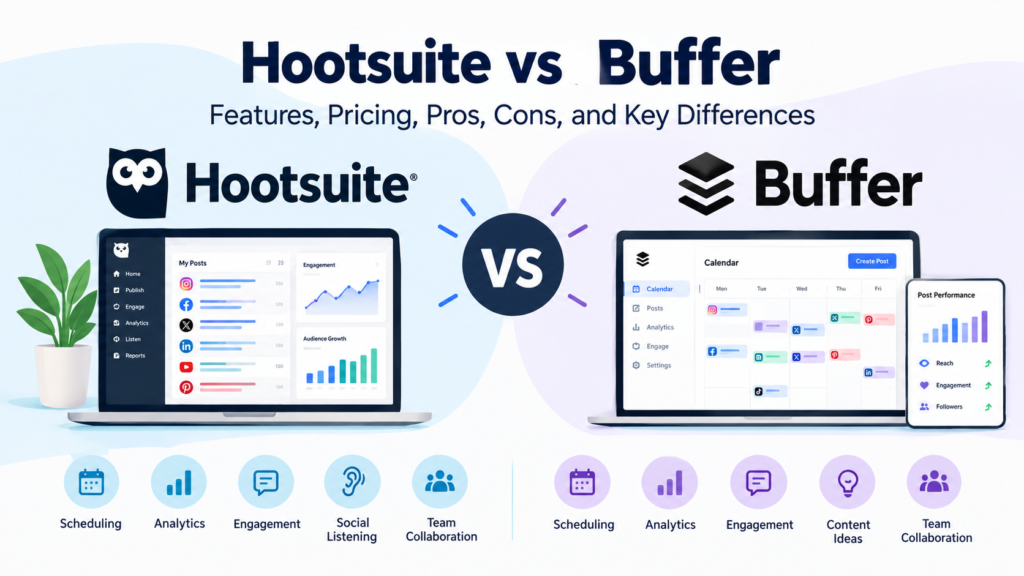

Choosing a social media management platform can become difficult when several tools offer similar core features. Hootsuite vs Buffer is a common comparison because both platforms help businesses, creators, and marketing teams plan, publish, manage, and analyze social media content.
However, they approach social media management differently. Hootsuite positions itself as a broader social media management and social intelligence platform, with publishing, engagement, analytics, monitoring, listening, and AI-powered features. Buffer focuses heavily on accessible publishing and content management while also offering analytics, community engagement, collaboration, and integrations.
The right choice depends less on which platform has the longest feature list and more on what your workflow actually requires.
This guide compares Hootsuite vs Buffer across features, scheduling, analytics, engagement, collaboration, pricing structure, advantages, limitations, and use cases.
Hootsuite vs Buffer: Quick Comparison
| Feature | Hootsuite | Buffer |
|---|---|---|
| Social media scheduling | Yes | Yes |
| Content calendar | Yes | Yes |
| Analytics | Yes | Yes |
| Community engagement | Yes | Yes |
| AI-assisted content tools | Yes | Yes |
| Social listening | Yes | More focused on publishing and engagement |
| Competitor monitoring | Yes | More limited |
| Team collaboration | Yes | Yes |
| Free plan | No | Yes |
| Paid-plan structure | Primarily user/plan based | Primarily channel based |
| Best suited to | Businesses and teams needing broader social management | Creators, small businesses, and teams focused on content workflows |
The exact features available depend on the plan and social network being used, so this table should be treated as a high-level comparison rather than a guarantee that every feature is included in every plan.
What Is Hootsuite?
Hootsuite is a social media management platform designed to bring multiple social media activities into one environment.
Its current platform combines publishing, engagement, analytics, monitoring, social listening, and AI-powered insights. Hootsuite’s Standard plan, for example, supports management of up to 10 social media accounts and includes unlimited scheduled posts, a content calendar, engagement tools, analytics, and monitoring features.
Hootsuite also offers more advanced capabilities for organizations that need workflows around social monitoring, reporting, approvals, and larger-scale social media management.
Hootsuite’s Main Features
Some of its major capabilities include:
- Social media scheduling
- Content calendar
- Multi-platform publishing
- Social inbox
- Analytics and reporting
- Social listening
- Brand and competitor monitoring
- AI-assisted content creation
- Team collaboration
- Approval workflows
- Social advertising tools
Hootsuite says its listening tools can monitor conversations across social networks, review sites, and websites, while its analytics capabilities include organic and paid social reporting.
What Is Buffer?
Buffer is a social media management platform centered around planning, publishing, analyzing, and engaging with social media content.
Buffer currently offers a Free plan alongside paid Essentials and Team plans. Its Free plan supports up to three channels, while paid plans provide additional publishing, analytics, collaboration, and engagement features.
Buffer supports a range of platforms, including Facebook, Instagram, TikTok, LinkedIn, Threads, Bluesky, YouTube Shorts, Pinterest, Google Business Profile, Mastodon, and X.
Buffer’s Main Features
Key capabilities include:
- Social media scheduling
- Content calendar
- Content ideas and drafts
- AI Assistant
- Analytics
- Community inbox
- Comment management
- Team collaboration
- Approval workflows
- Hashtag management
- API access
- Third-party integrations
Buffer has also expanded beyond basic scheduling. Its Community functionality lets users manage comments across multiple platforms, while its analytics tools provide information about content performance.
Hootsuite vs Buffer: Social Media Scheduling
Scheduling is one of the most important reasons marketers use social media management software.
Both platforms allow users to plan content ahead of time rather than publishing every post manually.
Hootsuite Scheduling
Hootsuite’s Standard plan includes unlimited scheduled posts and a multi-platform content calendar. Users can manage publishing across supported networks from a central dashboard.
This can be useful for marketing teams that manage several social channels and want publishing, engagement, and analytics connected in the same platform.
Buffer Scheduling
Buffer also places significant emphasis on scheduling. Its Free plan currently allows up to 10 scheduled posts per channel, while paid plans provide unlimited scheduled posts per channel subject to Buffer’s fair-use policy.
Buffer also provides visual planning, queues, custom publishing schedules, and other tools designed around maintaining a consistent content workflow.
Which Scheduling Approach Fits You?
If your main requirement is straightforward content planning and publishing, Buffer may provide the features you need without requiring a broader social intelligence platform.
If scheduling is only one part of a larger workflow involving monitoring, analytics, engagement, and listening, Hootsuite provides more of those functions within the same platform.
Hootsuite vs Buffer: Analytics
Analytics help marketers understand whether their social media activity is actually producing useful results.
Hootsuite Analytics
Hootsuite provides reporting capabilities that can cover organic and paid social performance. Its Standard plan includes reports with a wide range of metrics, report templates, and benchmarking capabilities.
Higher-level plans provide additional reporting and workflow capabilities.
Buffer Analytics
Buffer also provides analytics for content performance.
Its current plans include insights covering areas such as follower growth, engagement, impressions, and post performance. Paid plans add more advanced analytics capabilities and broader reporting options.
What Should You Look For?
Before choosing either platform, decide which metrics actually matter to your business.
For example:
- A content creator may care about reach, comments, saves, and follower growth.
- An ecommerce company may focus on traffic and conversions.
- A B2B company may care about engagement, website traffic, and lead-generation activity.
- An agency may need client-ready reports and comparison data.
The most sophisticated analytics system is not necessarily useful if your team does not use the information to improve its content strategy.
Hootsuite vs Buffer: Social Media Engagement
Publishing content is only one part of social media marketing. Responding to comments and messages can also require significant time.
Hootsuite provides a unified inbox designed to bring conversations from supported social networks into one workspace. Its current Standard plan includes messaging and engagement capabilities across multiple networks.
Buffer also offers a Community inbox that allows users to reply to comments across several social platforms.
For small teams, centralized engagement can reduce the need to constantly switch between individual social platforms.
However, you should check the exact supported features for each social network because publishing and engagement capabilities can differ by platform.
Hootsuite vs Buffer: Team Collaboration
Collaboration becomes increasingly important when several people are involved in social media production.
A typical workflow might involve:
- A writer creates a draft.
- A designer prepares the visual.
- A marketing manager reviews the caption.
- Another team member approves the post.
- The social media manager schedules it.
- The team reviews the results.
Hootsuite provides collaboration and approval functionality, particularly within its higher-level plans.
Buffer’s Team plan provides unlimited team members, access levels, and content approval workflows.
This means both platforms can support collaborative workflows, but the specific plan requirements should be checked before making a purchasing decision.
Hootsuite vs Buffer: Pricing Structure
Pricing is an important part of the comparison, but it can also be one of the easiest areas to misunderstand because both companies offer different plan structures.
Hootsuite Pricing
Hootsuite currently offers Standard, Professional, and Advanced plans. Its Standard plan is designed to manage up to 10 social media accounts, while Professional supports unlimited social accounts and additional automation capabilities. Hootsuite also offers a 14-day free trial on its plans.
The cost structure is oriented around the plan and user rather than simply charging for each individual social channel.
Buffer Pricing
Buffer currently offers:
- Free
- Essentials
- Team
Its Free plan supports up to three channels. The paid plans use per-channel pricing, with different rates depending on the number of channels and plan selected.
Buffer also offers a 14-day trial of its paid plans.
Why Pricing Structure Matters
Imagine a freelancer managing three social accounts.
A channel-based pricing system may be easier to understand because the cost is closely connected to the number of accounts being managed.
Now imagine an organization with multiple users, clients, approval processes, reporting requirements, and many social profiles. In that situation, you should compare the complete cost of the workflow rather than simply comparing the advertised starting prices.
Because prices and plans change, always check the official pricing pages before subscribing.
Advantages of Hootsuite
Hootsuite may be useful for organizations that need a broader social media management environment.
1. Broad Management Capabilities
Publishing, engagement, analytics, monitoring, and listening can be managed within the broader Hootsuite ecosystem.
2. Social Listening
Its listening functionality can help organizations monitor conversations, trends, mentions, and topics relevant to their brand or market.
3. Reporting
Businesses with more complex reporting requirements may benefit from its analytics and reporting capabilities.
4. Team Workflows
Larger teams can use collaboration, review, and approval features to organize publishing processes.
Limitations of Hootsuite
Hootsuite may not be necessary for every social media user.
If you only need basic scheduling for a small number of accounts, its broader collection of monitoring, analytics, and listening capabilities may provide more functionality than you actually use.
The platform can also become more expensive as your requirements grow, depending on the plan and number of users or accounts involved.
For that reason, businesses should identify their required features before selecting a plan.
Advantages of Buffer
1. Free Plan
Buffer provides a Free plan that supports up to three connected channels, making it possible to test the platform without immediately purchasing a subscription.
2. Straightforward Publishing Workflow
Buffer has traditionally emphasized content planning and scheduling, and its current platform continues to provide scheduling, calendars, queues, drafts, and content ideas.
3. Channel-Based Pricing
Buffer’s paid plans charge according to connected channels, with pricing that scales as more channels are added.
4. Growing Engagement and Analytics Features
Buffer is no longer limited to scheduling. It provides community management and analytics alongside publishing tools.
Limitations of Buffer
Buffer may not be the ideal fit for organizations looking for an extensive social listening and social intelligence environment.
Its capabilities and pricing also vary by plan, so users should carefully check which features are included before subscribing.
For agencies or larger organizations, the number of channels and required collaboration features can have a significant effect on total cost.
Hootsuite vs Buffer: Which One Should You Consider?
Instead of asking which platform is universally better, consider your actual workflow.
Consider Hootsuite If You Need:
- Broader social media management
- Social listening
- Brand and competitor monitoring
- Advanced reporting
- Larger-scale social workflows
- Publishing and engagement in one platform
- More extensive social intelligence capabilities
Hootsuite’s current platform places considerable emphasis on social intelligence, monitoring, analytics, and broader management capabilities.
Consider Buffer If You Need:
- Straightforward content scheduling
- A free starting option
- Content planning tools
- Social analytics
- Community engagement
- Channel-based pricing
- A workflow suitable for creators or smaller teams
Buffer’s current plans combine scheduling with content creation, analytics, community management, and collaboration features.
How to Choose Between Hootsuite and Buffer
Before signing up, follow these steps.
Step 1: List Your Social Networks
Write down every social account you currently manage.
For example:
- TikTok
- YouTube
- X
Then confirm that the tool supports the specific account types and publishing functions you need.
Step 2: Identify Your Main Task
Ask yourself what consumes most of your time.
Is it:
- Creating posts?
- Scheduling?
- Responding to comments?
- Monitoring mentions?
- Preparing reports?
- Managing a team?
- Tracking competitors?
Your answer should influence your choice.
Step 3: Calculate the Real Cost
Don’t compare only the advertised starting price.
Calculate:
Total software cost = plan cost + required channels/users + additional tools
Also consider whether you need separate software for analytics, social listening, content creation, or reporting.
Step 4: Test the Workflow
Use the available free plan or trial where appropriate.
Create a few posts, schedule them, review analytics, and test collaboration features.
A tool that looks excellent on paper may not fit your team’s day-to-day workflow.
Step 5: Review Your Requirements Regularly
Your social media needs can change as your business grows.
A platform that works for a solo creator may not be suitable once you have multiple clients, employees, social networks, and approval processes.
Common Mistakes When Choosing Social Media Software
Choosing Based Only on Price
The cheapest option is not necessarily the most cost-effective.
A lower subscription price can become less attractive if you need additional software to perform important tasks.
Paying for Features You Never Use
Advanced features can be useful, but unused functionality still adds complexity and potentially increases costs.
Ignoring Social Network Compatibility
Not every social platform provides identical publishing and analytics capabilities to third-party tools.
Always check compatibility for the specific accounts you manage.
Forgetting About Team Workflows
If multiple people create and approve content, collaboration should be considered before choosing a platform.
Not Testing the Interface
A platform can have impressive features but still be difficult for your team to use efficiently.
Testing the workflow before committing can help identify problems early.
Frequently Asked Questions
1. Is Hootsuite better than Buffer?
There is no single answer that applies to every user. Hootsuite offers a broader set of social management, listening, monitoring, and reporting capabilities, while Buffer provides a strong combination of publishing, content planning, analytics, and community features. Your choice should depend on your requirements.
2. Does Buffer have a free plan?
Yes. Buffer currently offers a Free plan that supports up to three connected channels and allows up to 10 scheduled posts per channel at a time.
3. Does Hootsuite have a free plan?
Hootsuite currently promotes paid plans with free trials rather than a permanent free plan. Its website currently lists a 14-day free trial for its plans.
4. Can Hootsuite and Buffer schedule posts automatically?
Yes. Both platforms provide social media scheduling functionality. The exact publishing capabilities depend on the social network, account type, and subscription plan.
5. Can Buffer be used by businesses and agencies?
Yes. Buffer offers Team features and an agency-focused offering with client management, collaboration, approvals, reporting, and channel-based pricing.
Hootsuite vs Buffer: Final Thoughts
The Hootsuite vs Buffer comparison is ultimately about matching the platform to your social media workflow.
Hootsuite offers a broader environment for organizations that need publishing alongside monitoring, listening, analytics, engagement, and more advanced social management capabilities. Buffer provides a practical combination of publishing, content planning, analytics, engagement, and collaboration, with a free entry-level option and channel-based paid pricing.
Before subscribing, list the social networks you manage, identify the features you actually need, calculate the complete cost, and test the workflow when possible. Also check the providers’ current pricing and feature documentation because social networks, plans, and software capabilities can change over time.